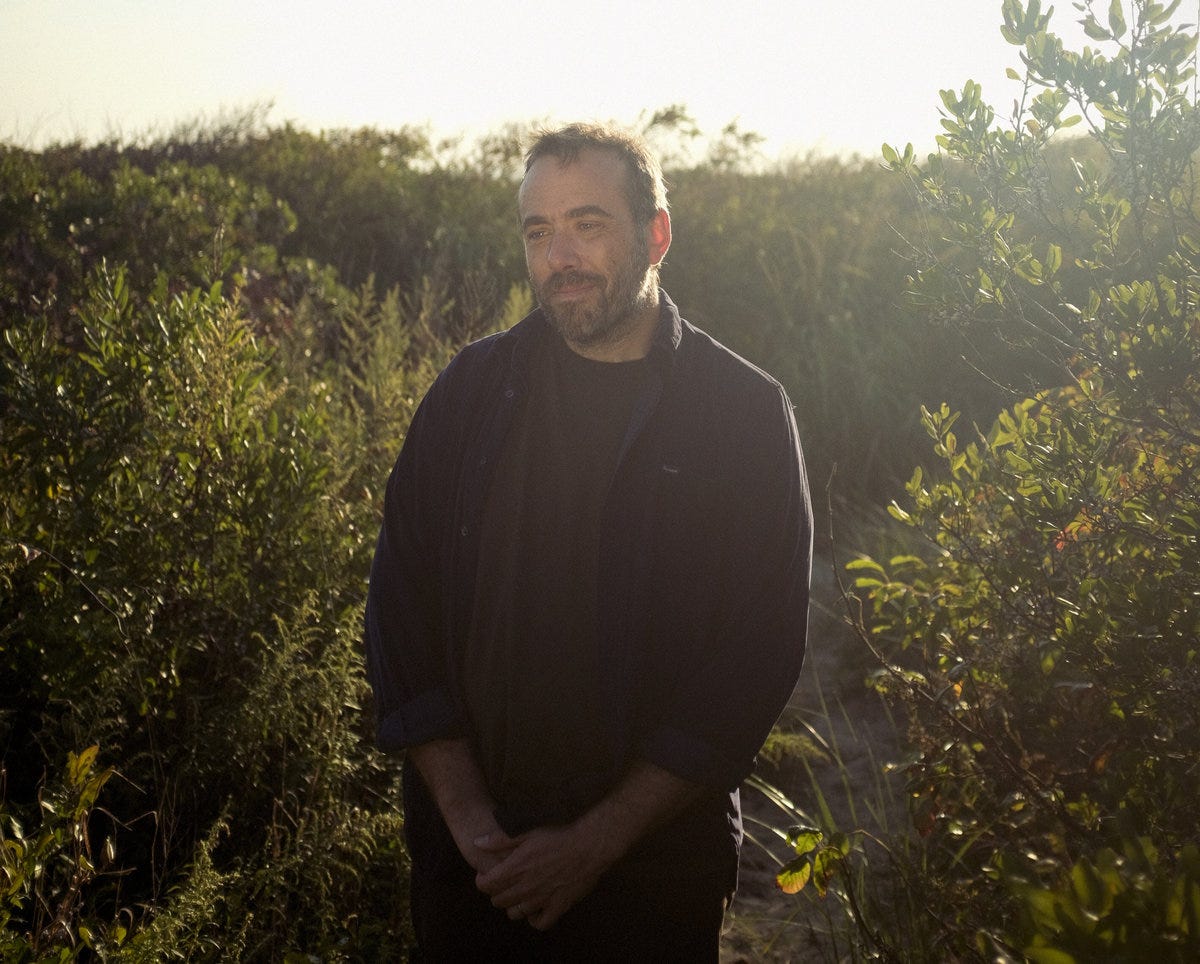
On today’s episode of Across the Horizon, host Bob Holmes of SUSS is joined once again by David Moore in the second part of his two-part conversation. David’s known for his work with Bing & Ruth and Cowboy Sadness, as well as his collaborations with Steve Gunn and Stephanie Coleman. In part two, he brings along a beautiful set of solo piano pieces from artists including Debussy, Philip Glass, Dr. John, Brother Theotis, and more. He also discusses Graze the Bell, a collection of solo piano pieces he released last week on RVNG Intl.
Flow State also posed a few questions to Moore over email about his musical journey generally and his work on Graze the Bell in particular – that conversation follows the streaming links. While playing Graze the Bell, listen for the influences he discussed with Bob on the two Across the Horizon episodes. We’re pairing the new record with one of those influences, Glenn Gould’s Goldberg Variations, specifically the 1981 version, recorded a year before he passed away.
Graze the Bell - David Moore (48m, no vocals)
Spotify / Apple Music / YouTube Music / Amazon Music / Bandcamp / Tidal
Goldberg Variations (1981) - Glenn Gould (51m, no vocals)
Spotify / Apple Music / YouTube Music / Amazon Music / Tidal
What’s your earliest memory of music?
It’s really just flashes of many memories more than any complete one, and it’s not even that I remember it physically, but I do remember this feeling of being a tiny little thing and always bashing away on pots and pans. Apparently I had this compulsion to empty the kitchen cabinets and arrange everything in a big drum set on the floor. Just BANG BANG BANG. Bless my parents for putting up with it honestly. Maybe something that’s underappreciated is that behind a lot of drummers are very patient parents.
How did you start playing piano? What was the first piano you played?
I started playing the piano when I was six years old. I told my folks I wanted to learn, so one day I came home and we had a piano in the basement. That’s how they were. It was this little Kimball spinet that we traded up for a Yamaha a few years later. As for when I feel like I really started PLAYING the instrument, that was later. I was one of two drummers in my high school jazz band when the pianist, who was quite good, died tragically in a car accident in the middle of sophomore year. They needed someone to replace her, and the teacher knew I studied classical piano so he sort of volun-told me to switch instruments mid-year. I didn’t know anything about improvising or about jazz, but as I started learning I just became obsessed. That’s when everything changed. I had clarity. By the end of that year I had effectively quit playing the drumset and oriented my whole life and future around the piano. I still think about that girl almost every day. To be quite frank it’s been a heavy debt to carry.
What were the early records or songs that pointed you in the musical directions you ultimately pursued in your solo work and as Bing & Ruth?
The first time I heard Beethoven’s “Moonlight Sonata” it was less like I was hearing music and more like I was learning about a whole new sense. Sight, sound, touch, taste, smell, and… whatever this feeling was. It seems obvious, but the more you open yourself to being moved by music, the more you’ll get moved by music, and so it just kept happening. I found Bach, then Chopin and Debussy. Then as I got older and some of my mental health struggles started to present themselves, I had this whole special world I could go to for relief. By that point I also had McCoy Tyner and Bill Evans in the mix too. All this music became a ground to stand on when no other ground felt solid. Then, one day when I was 19 I stumbled into a Barnes & Noble in Kansas City and heard Steve Reich’s New York Counterpoint, and everything just immediately clicked into place. That’s when the whole thing became about developing this language, a voice to channel the emotive qualities of this more romantic and impressionistic piano music I had been drawn to with the motion and philosophies of minimalist composition. I’m still eating off that sandwich to be honest.
The new record is solo piano. Tell us about the experiences and motivations around focusing on the instrument in this form.
Every direction I have grown as a performer, composer, and human has come out of the piano specifically. It has always been this window through which I looked at and tried to make sense of the world, and it’s where almost everything I do musically starts and returns to. So for Graze the Bell, there’s something in me that feels like it’s important to honor that source, because in the end what I’m honoring when I do that is the human singular. So much of music and the performing arts more broadly is about interplay – a reaction sprouting from the space between us, but there is something so different about performing alone. It lets you explore more thoroughly the context of being truly “solo” – of swimming in those deeper pools, so to speak. There is no consensus. There is no compromise. You live and die by your honesty, and that’s kind of the only thing I’m interested in these days. It’s why there’s no overdubs on the record. Even those felt dishonest in this context.
What was the process of composing and recording these pieces? How much planning was done in advance versus impromptu playing?
A lot of how I approach recording an album is just experimenting with different processes to see what yields the best results for that particular body of music. For Graze the Bell, the songs were all in a sort of incomplete completeness, but almost in this way where, like, the racecar is not finished until the race completes it. In that spirit, the full piece was mostly put together, because for these songs and the nature of how exposed you are in a solo context, it felt important that I approached the sessions more as a pianist than a composer. It’s different brains. I don’t know if it’s like that for everyone but it is for me. Practically speaking this meant that while I was in the studio, instead of going song by song until I had a take, I would just play for long stretches, cycling through different songs, sometimes the same one a few times in a row but mostly jumping around and changing things here and there – altering forms and pacing and dynamics in the moment. I knew I had the record after a couple days of that, but it took a while to sift through everything.
How do you discover new music these days? Any recent notable finds?
I don’t know why I’m a little embarrassed to say this, but I use Shazam a lot. I try to keep my ears open and when I hear something I like I just point the robot at it. Living in a dense place like Brooklyn, especially on nice days you get all kinds of cool stuff from all over the world coming in through car windows, bluetooth speakers, etc. It’s just music everywhere. The most recent find was from a construction site on my block that was blasting this wild Malian stuff that had me in a FIT with an armful of groceries. Here’s the last few from my search history, starting with that:
Ganda Fadiga - “Ouli Abidy Camara / El Geuje”
Baba Rancho - “Viejo de Julio Aramburo la Bandononona”
Jards Macalé - “Farinha do Desprezo”
Snatam Kaur - “Ra Ma Da Sa”
Name an underrated artist from the past 50 years.
It’s got to be my favorite ambient artist Willamette. I don’t know much about them in a biographical sense, but they came on my radar via a friend a long time ago, and all three of their records are perfect. One in particular that deserves a highlight is called Always in Postscript. I was listening to that periodically over the years I was writing Bing & Ruth’s Tomorrow Was the Golden Age, and their sense of timing, texture, and movement are so profound. They are a bit more straight ahead ambient than the direction I ultimately wanted to go, but I like shouting them out whenever I can because they deserve more ears than I sense they’ve gotten. For me they’re shoulder to shoulder with SOTL, Basinski… all the genre greats.
What are you working on next?
Well… a lot! I need to keep busy. I noticed that I have these natural cycles with albums/projects where it’s about five years from seed to harvest, so my plate is usually full with things in different stages of that cycle. Next up will likely be quite a lot of new music from my jambient power trio Cowboy Sadness, and I have some plans to record more pump organ/fiddle duets with Stephanie Coleman this year. Beyond that it’s all still coming into focus. Always writing piano music. I’d like to do another Bing & Ruth record at some point too, but that feels like a ways off. I’m grateful though, because never in my whole life have I felt this creatively clear, and channeled it through a balanced work ethic (not just blasting through and burning out constantly). I’ve also been putting more attention on my own writing/newsletter. As the mechanisms for music discovery continue to be dominated by non-artistic paradigms, it feels more important than ever to cultivate your own garden, so to speak. On that note I’ll end by saying I deeply admire what Flow State has built. Thank you for elevating this shade of music, and thanks for having me involved. Super love peace.