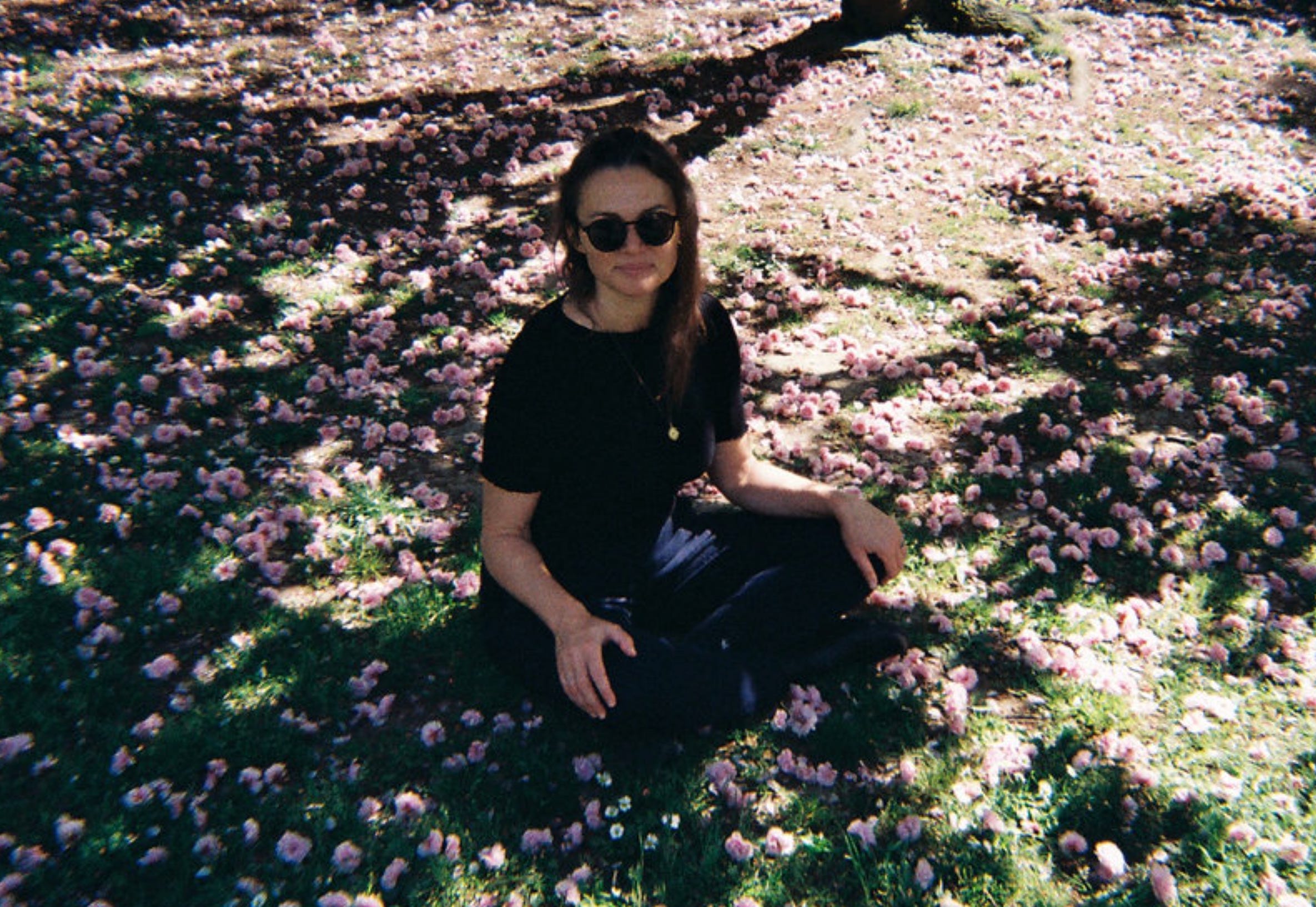
Today we’re listening to Christina Vantzou, a Greek-American multi-instrumentalist and composer from Kansas City. We previously recommended her music in 2019. In the early 2000s she formed The Dead Texan with Adam Wiltzie (one half of Stars of the Lid). Vantzou started putting out solo music in 2011. From her series of numbered albums, we’re playing No. 2 from 2014, which is eleven original compositions for orchestral instruments. Her latest record is The Reintegration of the Ear. She recorded it at Groupe de Recherches Musicales’ studio in Paris, where she got to play on Éliane Radigue’s own ARP 2500 synthesizer. “I spent long hours tuning the machine according to the body’s preferences,” she wrote of the ARP, “wanting to understand how these durations operate on the skin.” The “durational electroacoustic suite” features several collaborators including Oliver Coates on cello and John Also Bennett on flute. A conversation with Christina follows the streaming links.
The Reintegration of the Ear - Christina Vantzou (40m, light vocals)Spotify / Apple Music / YouTube Music / Amazon Music / Bandcamp / Tidal
No. 2 - Christina Vantzou (35m, light vocals on track 6)Spotify / Apple Music / YouTube Music / Amazon Music / Bandcamp / Tidal
What’s your earliest memory of music?
Tina Turner :)
What were the early influences or experiences that pointed you in the sonic direction of your solo work, including the albums on Kranky and subsequent releases?
Both of my parents are artists, albeit in very different ways. I grew up around locally organized art events, huge block parties, barbecues, and exhibition openings with live music. My parents also had a restaurant, and that has always felt like a parallel reality to making music and performing in many ways.
Caring about how things sound and feel goes back as far as I can remember. A big appetite for films and documentaries taught my ears a lot. I love eavesdropping on natural atmospheres and feel passionate about that kind of listening. I cherished my first Walkman and handheld recorder.
There’s a sense of always craving a hint of freedom, always curious about what a sound system can be, and always pondering metaphysical things. I spent childhood summers in Greece near the sea and was introduced early on to people like Angela Farmer, who speak about energy, the underground, and the feminine unfolding as a potential in everything. These things feel formative as much as the radio, MTV, the internet, the first symphony I went to on an elementary school class trip, and of course that time my dad snuck me into the Uptown for Tina Turner.
The notes for The Reintegration of the Ear describe the album as approaching listening as “a radical, embodied act of attention.” Can you speak about the thoughts and experiences that led you to this approach? We sense similarities to Pauline Oliveros’ notion of deep listening.
Sound’s ability to hold, shift, focus, soften, spark imagination, and inspire is a big thing for me. Around three years ago or so an awareness of the Earth, the elements, and a kind of underground reality deepened for me. The Greek roots started calling for attention too.
During the GRM residency, where the work began, there was a day when I left the studio and sat for a long time in a nearby garden. I felt a little intimidated at the beginning of the process, but that afternoon it became clear that as long as the work remained grounded and directed toward the body, and as long as there was a care for the listener’s perspective every step of the way, everything would be okay.
Overly mental formulations felt off. It felt urgent to study certain frequencies and tones, fragments of melody, and to be playful with field recordings. Being in observance of the spaces and sources of sounds felt right. Field and hydrophone recordings were made in several locations, mostly in Greece. Time spent on the coast and in the mountains, reflecting on psychoacoustics and sound’s potential at quieter levels, fed the work.
Meeting with collaborators one on one, in person or long distance, preparing sketches, images, selecting audio fragments and samples, or any combination of those, and with lots of stretches of time in between, allowed the piece to remain constantly moving and slow-forming, yet flexible. The performances became sites where everything could mingle and gel. At the premiere in Paris, the simple beauty of listening together in an extraordinary space, with an exceptional sound system, created that magical focus. Within the acousmonium, audience and performers enter into an interconnected relationship. The act of focusing together like this in 2026 is really something. So many incredible things happen in a shared act of listening. From clearing the head to grounding to bringing a sense of joy and repair, returning home to the body, losing track of time, noticing details in architecture and sensations of clothing and even shoes… it’s so soothing and necessary.
All of this moves toward what Melis Özek described in her album notes as “a radical, embodied act of attention.”
There are clear parallels with Pauline Oliveros, and I’d also include Éliane Radigue.
You performed this work with several collaborators. How did you compose or structure it? How, if at all, did you mix or edit the recording afterwards?
The composing unfolded over about three years, with an attempt to work in an oral / aural tradition. Slowly, the piece found its surreal and effervescent shape.
Recordings were made in Irene Kurka’s home in Düsseldorf, at home in Brussels with John Also Bennett, in Roman Hiele’s kitchen, and Oliver Coates generously sent files from his studio in Glasgow. We practiced a kind of dispersed togetherness, like a study group spread around different cities. There were many conversations along the way with the collaborators on the record, and also with collaborators outside of this core group. Many voices and perspectives and friendships that extend beyond the credits played key roles in the process. It’s always like that for me. In three years a lot happens.
An ensemble practice rooted in oral tradition requires patience and a bit of stamina. There are many check-ins, and what might be called the feminine principle is at play. We dive into the nonlinear, where forms do not fully settle. There’s a desire for precision alongside an openness to change.
Trusting in spontaneity, working by feel, reading and writing poetry alongside composing, and continual reflection on space, texture, directionality, and studying ancient vocal practices to some extent kept things cohesive. The organization and sequencing of the material changed many times. Mixing and editing were slow processes, and editing became a form of mixing. Gradually, a vast and intricate session took shape.
Before any performance, I tried to make everything as clear as possible so the collaborators could follow a simple map. It’s beautiful when a group’s energy unfolds around essential elements that provide gentle grounding and a sense of security. The composing is not forceful; it unfolds with time and care, yielding and renewing. When there is a clear sense of purpose, the structure feels like an ancient path that greets us. The collaborators’ articulations are key elements along that path.
When focus is shared and the core remains grounded, sound becomes potent.
The editing and mixing as a unified process continued for quite some time. Sometimes there was a feeling of being lost, but once the composition felt ready to be released and the transitions were carefully tended to, John Also Bennett completed the final mix.
What is your studio setup? What gear, instruments, or software do you rely on?
Thanks to the commission, the setup at GRM’s studios in Paris was extremely nice, with generous support from their team. It was a great honor to work with Éliane Radigue’s ARP 2500. That remains especially memorable. Her presence and oeuvre felt palpable while spending time with her instrument. Since then, I hear her work with new depth. I often reflected on the preciousness of her ARP and on any encounter with any instrument or natural phenomena that deeply touch us. I spent long hours tuning the machine according to the body’s preferences, wanting to understand how these durations operate on the skin.
Brussels, Tenerife, Athens, the island of Lesvos, and even in bed under the covers have all served as temporary workspaces. I used the Morphagene by Make Noise, and recorded synthesizers at Willem Twee Studios in ’s-Hertogenbosch near the end of the process.
Field recordings were made with a range of gear. I was very focused on sea foam, cans opening, wind, stones, and olive trees on the island of Lesvos, and waves sloshing against a monastery on Sifnos.
How do you discover new music these days? Any notable recent finds?
My partner, John Also Bennett, is a magnet for great records. Thanks to him, we have an incredible music collection at home. Playing festivals, attending shows, and YouTube all play a role. I especially enjoy Coby Sey’s NTS show.
I sometimes become a bit obsessive and listen to one record repeatedly. Recently it’s D’Angelo’s Voodoo, Sade, Delroy Edwards, and Hildegard von Bingen.
Name an underrated artist from the past 50 years.
Radio Hito comes to mind. She performed at Roman Hiele’s second release show in Brussels, and it was a pleasure to hear this piano / voice iteration of her work.
Kassel Jaeger, composing in abstraction.
Clara Levy, with her precision and depth on violin.
Lino Capra Vaccina as well. He is certainly beloved, but I still feel he could be listened to more. We performed together in Italy thanks to an old friend, Marco. Spending two days together, the archive of his experience was extremely generous.
What are you working on next?
Resting, stretching, reading, eating well, walking in nature. Preparing for upcoming performances with Félicia Atkinson :) I’m also beginning a new collaboration and attempting to be selective and open to new energies, and breathing deeply.