

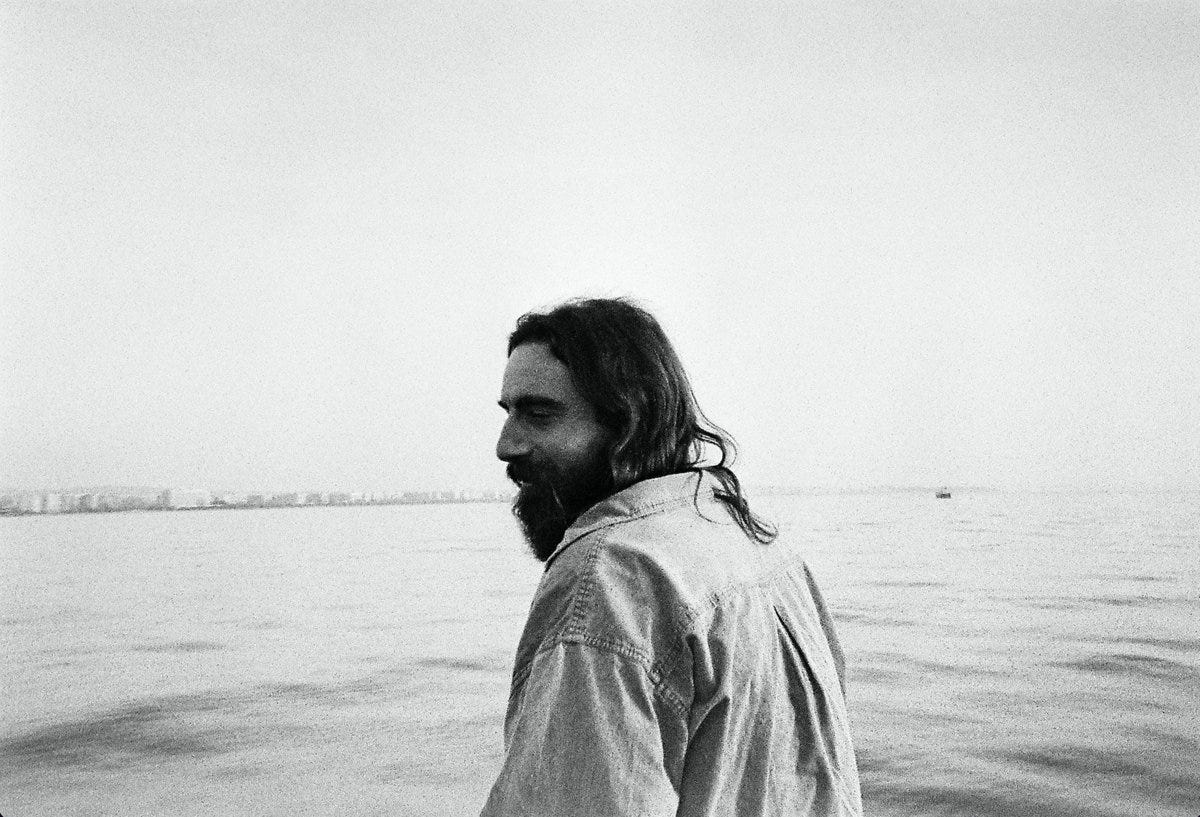
Today we’re listening to John Also Bennett, an American ambient composer and multi-instrumentalist from Ohio. He grew up in a musical household, studying piano and flute. He got into the local Columbus noise scene, and then began making ambient music and releasing it in the 2010s. His latest album, Στον Ελαιώνα / Ston Elaióna, came out just over a week ago, and pairs bass flute with synth chords from his Yamaha DX7ii. We’re also playing his 2019 record, Erg Herbe, a collection of synth pieces using notes tuned at intervals of 30hz. “With the solo music I’m making lately,” he told us, “I’m looking to point out something I noticed in the air, in the light, in the breeze – something that transcends our human consciousness and connects to a different realm.” A conversation with John follows the streaming links.
Στον Ελαιώνα / Ston Elaióna - John Also Bennett (41m, no vocals)
Spotify / Apple Music / YouTube Music / Amazon Music / Bandcamp / Tidal
Erg Herbe - John Also Bennett (44m, no vocals)
Spotify / Apple Music / YouTube Music / Amazon Music / Bandcamp / Tidal
What's your earliest memory of music?
Music was omni-present in our family house, and at a very young age I was already taking piano lessons. My dad had / has thousands of CDs and was / is listening to music all the time. So it’s a bit of a blur – music was such a big part of life that it really wasn’t this separate thing that stands out for me.
My first memory, which seems to be an impression of standing up in a crib in the living room and my mother walking towards me, is backgrounded by the stacks of CDs in that room (though I admit it’s possible I filled that part in later). I have early memories of my mom playing Beethoven’s “Fur elise” on the upright piano, and I can remember my dad playing choral music and sacred chant every Sunday, though our family wasn’t at all religious in the conventional sense.
Where did you grow up and how did you start playing the bass flute?
On a quiet residential street in a very middle class neighborhood in Columbus, Ohio, in between a strip mall style shopping center and the Olentangy River. Our local park was built on top of an old landfill. I started playing flute when I was a child, but didn’t really play the bass flute until around 2021. The bass flute is somewhat uncommon. It’s a few steps below the slightly lower pitched Alto flute, which I first used on the album Erg Herbe. I always wanted to go lower. Bass flute really is a great sound. When played in the right way it’s like the voice of an old man, soft and scratchy and full of experience, but still capable of going up high with a bit of struggle.
Who were the artists / what were the albums that early on pointed you in the sonic direction you ultimately found?
I hesitate to say that I’ve “ultimately found” a sonic direction. It’s really more of a constant state of wandering… though I do find myself returning to sonic places that I remember fondly, with a different perspective gained through experience. Sometimes I find that the vibe in a place has shifted with the passing of time, or I might react to it differently after going through my own changes. With the solo music I’m making lately, I’m looking to point out something I noticed in the air, in the light, in the breeze – something that transcends our human consciousness and connects to a different realm.
Very early influences – I can say that seeing the Phillip Glass ensemble perform Koyannasqatti when I was in high school, thanks to the school music program getting students free tickets, was a big moment. I wasn’t aware then, but Jon Gibson was playing in that ensemble, and much later I came across his solo album Two Solo Pieces which seems to have had a pretty profound influence. I was lucky to eventually be able to collaborate and even tour with Jon. After he passed away I ended up with a bunch of his bamboo flutes, and some other reed instruments, which remain a source of inspiration.
There is a particular CD of Imrat Khan playing ragas on the surbahar (basically a bass sitar) that was really important. I borrowed it from my dad’s collection when I was 13 or so, probably drawn to Indian music due to hearing sitar and tambura in Beatles tunes – I was very curious about that sound! It ended up on fairly heavy rotation until I moved out, and many years later I came back and borrowed it again. It’s all about the low, slow movement of the surbahar, and the strange (to western ears) tonalities of this particular raga. There is a particular dry, yet extremely deep and potent calmness to this recording that still puts me in a type of trance to this day.
Beyond that, coming of age during the peak years of the midwest / American underground noise scene changed my life completely, for better or for worse. Between the age of 18 and 22 I was completely immersed in that scene, booking shows, playing shows, running a DIY space. Living in Columbus, Ohio meant people were constantly passing through on tour, and it just took priority over everything else in my life at the time. I’m lucky to have touched that world. It was just before social media and before the broader corporate tech world changed everything, and it definitely informs my approach to making music today in indirect ways, if not always sonically.
Tell us about the studio setup for Στoν Eλaιώνa / Ston Elaióna. What instruments and gear did you use to make the record?
I used a very simple setup for this album. The primary keyboard instrument is my Yamaha DX7ii. It had been in storage in Brooklyn for years after I had to move out of my loft there, and finally I brought it with me along with all of my possessions to Athens last year. So having that back into the mix was very important. It is a real, physical instrument that reacts to being played in unique ways, that is, when using my patches. It also has limitations, in that it’s not so easy to edit the patches on the fly, so in that way it acts more like a traditional instrument. You need to learn to work with the sound as it is while playing, you can’t just infinitely tweak it. It has built in just-intonation scales which I used all over the album.
The other primary instrument is the bass flute, which was a low cost Chinese-made model I found online. I once brought it in for repair to a flute studio in New York, only to be literally scoffed at for how cheaply it was made. I recently upgraded to a somewhat nicer flute, though I still have the OG – despite it being cheap, it does retain a particular character I like. So that’s the DX7ii, bass flute, and then on certain tracks I’m triggering long tones on a virtual synth using pitch information from the bass flute. This is how I create the sustained resonance clouds that sometimes follow the melodies.
Of course I also took field recordings for the album, some from my studio window, and some out “in the field.” When traveling I typically take along my recorder, in case there is an inspiring soundscape. I don’t always use the recordings, sometimes the act of recording the soundscape itself just serves as an act of meditation. The solo keyboard pieces on the album are mostly recorded during the early morning. When I’m in the mode of composing my own music it’s my favorite time to improvise, when my mind is still clear and the city is quiet and still. That is, if I can manage to get up that early…
How do you discover new music these days? Any recent notable finds?
I like hearing the music that my friends and colleagues are making. Yesterday I was listening to this new midi piano album just released by Bookworms. It really fit the mood of feeling somewhat lonely and wandering around a half empty Athens (it clears out here in July / August). I also spent a good deal of time over the winter scouring European discogs seller pages looking for obscure new age and ambient music. Being based in Europe means I’m more limited to shopping from European sellers to avoid paying big VAT fees, so that means sometimes taking a risk on an oddball euro library music or new age CD from the ‘90s that I’ve never heard of. Sometimes it pays off, sometimes not so much, but it’s really all about the journey, isn’t it?
How are you liking Athens?
It’s an ancient but very modernized – in the 20th century sense of putting concrete everywhere – city with a deep and multi-layered history. It’s polluted, beautiful, ugly, noisy, relaxed, chaotic, sometimes stinky and sometimes smelling like orange blossoms, but always with easy access to affordable farmers markets with great produce that comes straight from the countryside. The people are honest (except when they’re not), passionate, and hard working, the riot cops are awful, the summers are hot, the winters are mild, and for half of the year you can buy giant beautiful basil plants of many types on the street for 2.50 euros.
There is a small experimental music scene I’m marginally involved with, there are dedicated artists and musicians doing meaningful things, there are galleries and institutions, sometimes doing good stuff, many times not. But I can’t claim to know everything that’s going on here culturally, it is still unfolding.
I love the ancient hills where one can escape and feel like they're in the countryside or a village, like Athens used to be long ago, and I love the sound of the cicadas in the summer. I hope the center doesn’t turn into a giant Airbnb playground. It’s not “the next” anything, it’s the capital of Greece, an ancient and mystical city that unfortunately paved over the rivers that used to run through it.
Lots of new immigrants from around the world have moved here in the last ten years. I love to go to the dumpy and legit Chinese restaurants in my neighborhood and converse with them in simple Greek. It inspires me to see the Parthenon outside my window, and to see the modernist houses from the ‘20s and ‘30s and ‘60s that haven’t been replaced by apartment blocks, and to see people growing small forests of plants on their terraces overlooking busy and loud avenues full of motorcycles and taxis, like some eco-brutalist’s warped dream.
Name an underrated artist from the past 50 years.
Ildelfonso Aguilar:
What are you working on next?
These days I’m playing a lot of solo flute at home, various bansuris bamboo and wooden, accompanied by pitched down echo shadows. Today I’m starting work on a new collaboration with the media artist Peter Burr, who I’ve collaborated with off and on for over a decade at this point. This fall I’ll be working on some new music with Christina Vantzou and Michael Harrison. Beyond that, and maybe most importantly, I’m trying to find an olive grove and begin the next chapter of life.
Rich, resonant and earthy, brimming with warmth. I hesitated before diving in; my mind's ear imagined this very differently. The warmest of warm drones.
Great read. Hadn’t heard John’s music before, loving the album!