

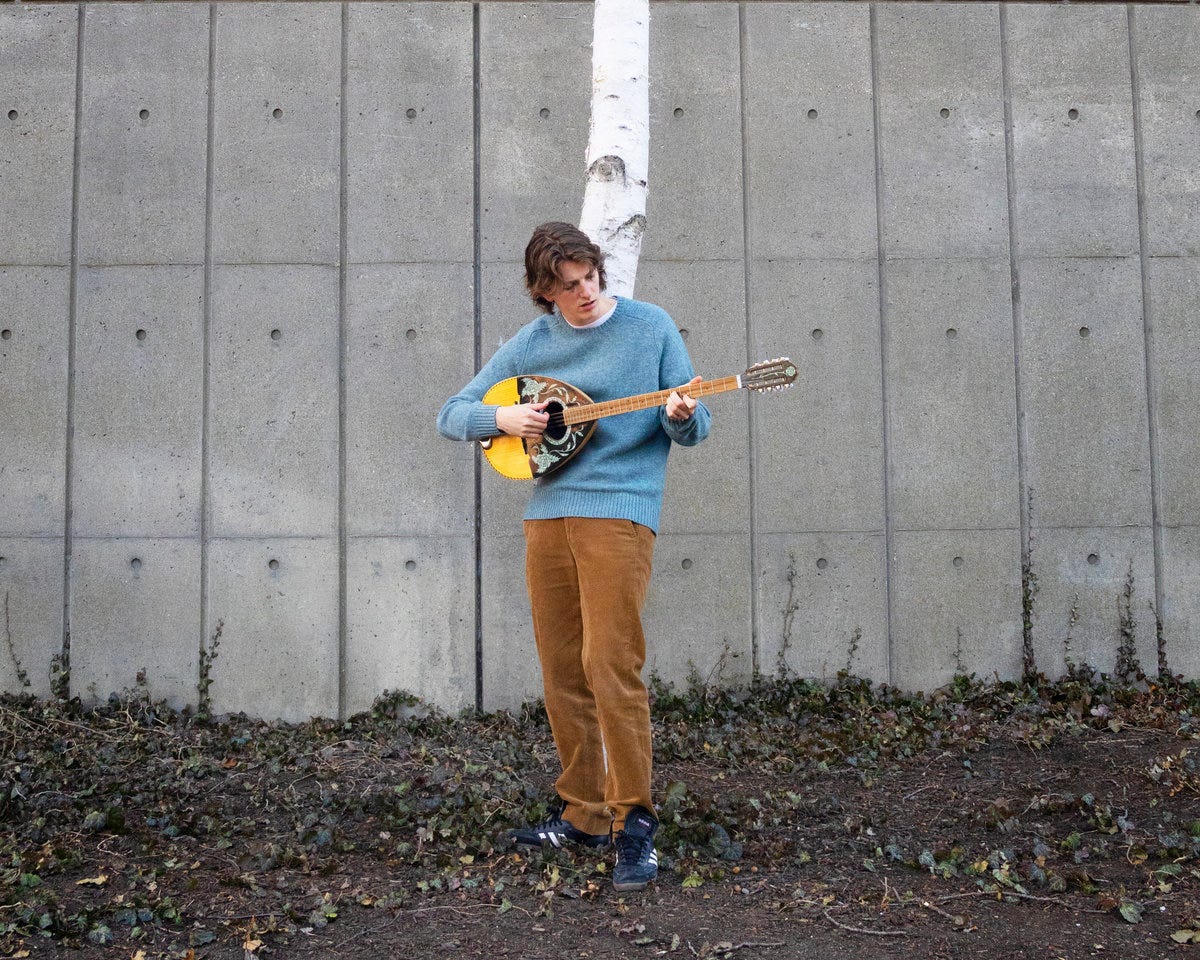
Today we’re listening to Gabriel Brady, an American multi-instrumentalist and composer from Virginia. He grew up playing classical and jazz piano, and was drawn to original composition in high school. Channeling artists ranging from Debussy, Ravel, Bill Evans, to Radiohead, he began recording music in his Harvard dorm room. From those recording sessions, on a small modular rack that processed his piano and bouzouki loops, he assembled Day-blind, his debut album which came out on Tonal Union in June. It’s an original, intimate record, at once an atmospheric listen and a cinematic one. Since Day-blind is his one and only record to date, he recommended we pair it with blueblue by Sam Gendel, whom we previously featured in May 2023. A conversation with Gabriel follows the streaming links.
Day-blind - Gabriel Brady (23m, no vocals)
Spotify / Apple Music / YouTube Music / Amazon Music / Bandcamp / Tidal
blueblue - Sam Gendel (50m, no vocals)
Spotify / Apple Music / YouTube Music / Amazon Music / Bandcamp / Tidal
Where did you grow up?
I grew up in Alexandria, Virginia. I lived there my whole life, basically. And then I moved to Cambridge, Massachusetts for college. But yeah, Alexandria, Virginia is home for me.
How did you start playing music?
I started taking piano lessons when I was like seven. It was classical at first, and then I started taking jazz piano lessons around eighth grade. Throughout, I was more interested in composition than performance. In high school, I really fell in love with with the idea of film scoring and started composing a lot more on my own.
Once I got to college, I did some film scoring, but I also started recording my own solo album. I was also listening to a lot more ambient and jazz and electronic music.
What were your first compositions like?
I would say the three main harmonic influences for me have always been Bill Evans, Debussy, and Ravel. My influences have changed a lot over the years, but those are three people that have stayed constant. I've just kept getting more into them. I got into them in high school and I'm still into them now. That's always been kind of a bit of a touchstone for my music.
For Evans, Debussy, and Ravel, what music would you point people to?
There's this album by Bill Evans, You Must Believe in Spring, which is based on Michel Legrand, a film composer and songwriter. He did the music for a Jacques Demy film called The Young Girls of Rochefort. It's an awesome film, with Gene Kelly. It's really fun. The title track, “You Must Believe in Spring,” is from that film. I love Michel Legrand also; he's a big influence. Having Bill Evans do Michel Legrand tunes is really fun. The record sonically is incredible. I highly recommend that one.
I don't have much of a classical background, so I don't want to act like an expert or anything on classical recommendations. The second movement of Ravel’s Piano Concerto in G is really beautiful. I actually just found a Herbie Hancock version of it today, which is fun.
For Debussy, in high school, I was really into the two Arabesques. Nowadays, it’s Reflets dans l’eau. It's from the Images suite, which is also great.
Did you play Debussy or Ravel?
Yeah, but I don't have great classical piano chops, so I never performed them. I would more just figure out what they were doing harmonically and then try to do that in my own music as well.
On “Untitled,” we hear some adept piano playing.
Well, most of the piano playing on that is looped.
So you just need like two seconds of excellence.
I mean, I can play piano all right, but not at an insane level. “Untitled” was a fun track to make.
Regarding the ambient / jazz / electronic stuff, what were you listening to?
Floating Points I've always loved. Three years ago I heard Promises for the first time, and it just blew me away. I found it super inspiring.
I love Ernest Hood. I love William Eaton, especially the first William Eaton record. I love Nala Sinephro. I’ve always liked Pharaoh Sanders, Alice Coltrane.
One Harold Budd album I love is The Serpent (In Quicksilver). I've listened to that a ton this year. It's really lovely. It's got pedal steel and this cool effected piano sound. It's a pretty fun record.
And Floating Points’ Promises with Pharaoh Sanders – RIP.
I was actually at the Floating Points concert in New York where he was playing with Four Tet. Floating Points left his set 30 minutes early, and it turns out it was because he got a phone call that Pharaoh Sanders was about to die. I didn’t know what was happening in real time, but he ran off the stage.
You recorded Day-blind in your dorm room.
It was a ramshackle recording setup. The one piece of gear I had was a little modular synth that I pieced together. It was like four modules. I also had this one guitar pedal. I would play this Greek bouzouki I bought and then send it into Logic and then send that sound from Logic into the modular effects rack, and then back into Logic.
In terms of recording quality, one of the bouzouki loops was recorded on my phone as a voice memo. A lot of it was lower fidelity, but then as it looped over itself… And also Joe Talia, who mixed it, did a really good job bringing out more high fidelity stuff. It sneakily sounded less ramshackle.
What modules and what guitar pedal?
I have the Make Noise Morphagene and the Tiptop Audio Buchla Randomizer. I have the øchd LFO module. Then I have the Panharmonium, which is an awesome module for effects, and the Magneto tape delay. And then the pedal is the Fairfield Shallow Water.
For all the modules and the pedals, I was going for something that I couldn't replicate in the DAW. I would only really pay for something if it would add something new to the sound, just because it was on a low budget.
I purposely put together this effect rack that would give me access to this new sonic territory that I wouldn't get just through a laptop setup. But yeah, not a very extensive studio setup or anything.
So how long had you been working on this music?
From my freshman year of college to the summer after my junior year of college.
I wrote a lot of the songs on the piano during freshman year. And then right after my freshman summer, I started putting together the modular setup, which defined a lot of the textural stuff in the album. I initially wrote things on the piano, and then I added these moments of textual interest, and then I kept writing throughout college.
That process led me to junior summer, and then I got in touch with Tonal Union during my junior year. They were kind enough to put out the album.
Did you just graduate?
Yeah, I guess a little over a month ago.
Congratulations.
Yeah, yeah, yeah.
So the record was done when?
I sent out demos to Adam and Tonal Union in December of 2023. And then I wrote two more songs after that – “Womb” and “Ambrosial” – just to flesh out the album.
“Womb” actually was originally from my – so I'm scoring a film in Japan right now with my friend, and “Womb” was initially a 30-second cue that got cut from the film, because it just didn't match what the film was doing. I sent it to Adam, the label head, and he loved it, and he asked if I could flesh it out into a full song. That's where the repetition of the song comes from. It's this 30-second clip that I'm trying to elongate into a longer song.
What scores from the past decade do you rank the highest?
In high school, my favorite scores were the If Beale Street Could Talk score and the Minari score by Nicholas Britell and Emile Mosseri. And then after the fact, when I was in college, they got really big on TikTok, so now it's kind of funny that they became – not that they were ever underground, but they went from being kind of things that felt personal to being the most basic film scores. But they're both such incredible works of art.
Also, anything Jonny Greenwood. I'm a big Radiohead fan, but all his scores are incredible.
That's funny because on our recent Tuesday mix, we started with a couple of your tracks, and we ended the mix with one of Jonny Greenwood's tracks from Power of the Dog – an underrated cut from that, “Psalm 22,” which has a very Radiohead kind of chord progression. And we wrote, those chord progressions call back to what Gabriel is doing on the two tracks from Day-blind. So we’re not surprised to hear that Jonny and Radiohead are an influence.
I've never seen Power of the Dog. I'll listen to that track once we hang up. But yeah, Jonny, I mean, in terms of harmonic influences, Radiohead would definitely be up there. In Rainbows and Kid A are two of my favorite albums. It's such a singular harmonic sensibility. I purposely tried to integrate that into my writing over my time in college.
Kid A and In Rainbows – what tracks in particular?
In Rainbows: “Jigsaw,” “Weird Fishes,” “All I Need.”
Steve Reich has this piece called Radio Rewrite where he did a reinterpretation of “Jigsaw Falling into Place” and “Everything in its Right Place.” It kind of blew my mind when I first heard it because it was Steve Reich taking on Radiohead. I found that piece super interesting as an extension of a lot of the things Radiohead’s doing harmonically.
Great interview.