

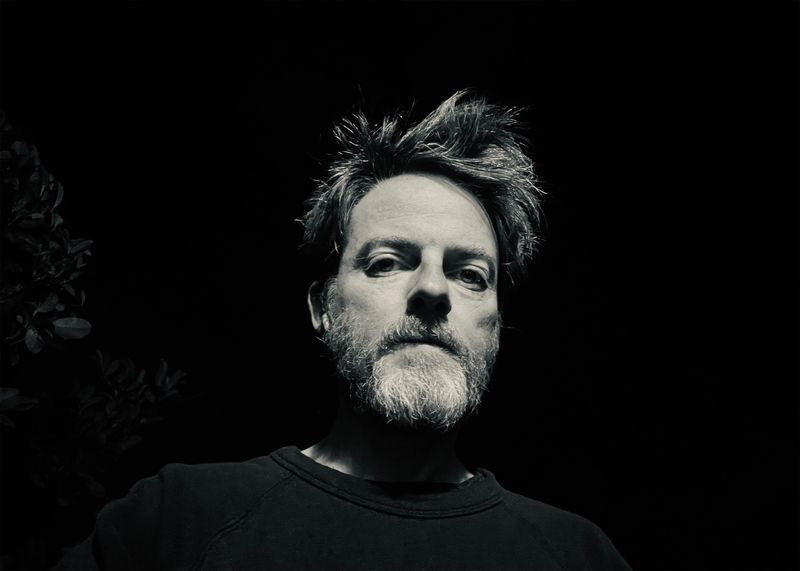
Today we’re listening to Eluvium, an American ambient musician based in Portland, Oregon. He’s a quintessential Flow State artist; we’ve recommended him three times before. He was born in Tennessee and raised in Kentucky – Louisville specifically.1 The DIY sensibility of the Louisville punk and hardcore scene made a strong impression on him, he told us. Since 2003 he’s been putting out records of subtle, contemplative ambient music, beginning with the classic Lambent Material. He summarized his approach: “Using LFOs creatively and attenuated chaotic noise sources as a controller, layering them atop each other with various attenuation parameters, then employing samples of myself playing my own instruments or field recordings I’ve taken or radio samples etc.” In early 2020, he began his Virga series, which consists of more minimal pieces he himself uses to facilitate a meditative headspace. The third volume of the series, which we’re playing first, came out in May. We’re also revisiting that first volume. A conversation with Matthew Robert Cooper, the artist behind Eluvium, follows the streaming links.
Virga III - Eluvium (38m, momentary vocals on track 1)
Spotify / Apple Music / YouTube Music / Amazon Music / Bandcamp / Tidal
Virga I - Eluvium (42m, no vocals)
Spotify / Apple Music / YouTube Music / Amazon Music / Bandcamp /Tidal
What’s your earliest memory of music?
Maybe listening to Peter and the Wolf on my parents’ record player – or possibly my sister playing piano in the house. Sneaking into my brothers room to look at his tapes – Sugarcubes, Billy Bragg, Rush, the Smiths – my family had moved from England to the United States in the late ‘70s and my experiences all came from a blend of what my older siblings were listening to and ‘80s radio hits, Saturday morning cartoons, television ad jingles and MTV. Simon and Garfunkel, Neil Young, the Beatles, and a lot of classical music coming from my parents car tape player.
What were your first recordings like? What did you use to make them?
My first recordings were probably some angsty early teenager songwriter stuff, and covers of popular radio songs, recorded to cassette tape on a boombox microphone in my bedroom. My first recordings of Eluvium were done with a Fostex multitrack, maybe some Casio SK-1, a borrowed guitar, vinyl samples, field recordings, broken foot pedals.
What were the tracks / artists that early on pointed you in the sonic direction you ultimately pursued?
Aerial M, Rachel’s, Hum, Dino Jr., Sonic Youth, Olivia Tremor Control, Windy and Carl, Steve Reich, Eno.
What about your experience growing up in Louisville manifests in your work to this day?
I cling to a DIY ethos that is likely an influence of the punk and hardcore underground music scene and ‘90s zine culture. I don’t know if that is ultimately a product of ‘90s culture in general, or if mine has Louisville-specificness. I had just moved from Memphis and my older siblings were all moved out or soon to be. I was a child of the ‘90s culture, actively playing music with friends but not really finding my own direction, just riffing as I tried to express my general displeasures and yearnings. I had lots of issues and run-ins with various forms of authority and still have a displeasure for that vibe. I had zero taste at the time but had heard and enjoyed lots of great music through my siblings. I just also liked generic radio hook-y emo stuff too – I just liked everything. One of the local radio stations started playing Dinosaur Jr. stuff and Sonic Youth and other 120 Minutes type bands. Sonic Youth were certainly mind expanding especially with their SYR series records. I liked crate digging in a city with an active underground local music scene that had ties to other surrounding cities with even more activity and culture like Chicago and D.C. I made some friends at school who were also plugged into that stuff, which introduced me to Touch and Go Records, Thrill Jockey, Fugazi, etc…
Tell us about your introduction to generative music, and how you approach generative music yourself. What tools/techniques do you use? What’s worked and what did you try before that maybe didn’t work?
Likely it would be Brian Eno’s Discreet Music. I’d imagine that is a pretty common answer. I’m not sure it made me think about technique at that time though. It would be years before that. Getting a job at a record shop blew my mind open to many genres and experimental composers and techniques later on. But I think I’ve always enjoyed listening to music, even while making it – and creating these little universes within the synthesizer system allows for that pleasure.
The tools in my approach are often from a modular system, or related, though I’d say granular synthesis has its fair share if there are enough controls on whichever hardware or software allows for it. My techniques I don’t think are all that remarkable. Using LFOs creatively and attenuated chaotic noise sources as a controller, layering them atop each other with various attenuation parameters, then employing samples of myself playing my own instruments or field recordings I’ve taken or radio samples etc…. whatever I am so determined to sort through – and have at it.
If I am using an oscillator more directly for a synth line, then perhaps the melody presents itself to me through chance notes strumming together, and I can loop this and slowly slightly change minor attributes, or I can recreate it on another synth, loop it there, or sample a smaller section of it and slowly tear it apart.
I think the nice curiosity comes from when these choices all come together to form a unique free expression of a moment or a vision of a thought, or at the very least something that feels true to you in any given moment. One can essentially play captain of the synthesizer ship and steer until you find the water you are seeking. But not everything is a success.
Making an audio painting with various parts of oneself and one’s surroundings along the way is sometimes a mess. Maybe it is just a wish to allow for a certain space to exist for a minute. When I made “Zerthis…” on my first record, it was essentially a portrait of me walking alone at night having swiftly exited from a crowded show before the band played. Sneaking away from a tight claustrophobic crowd to my apartment through old unlit sections of downtown Portland – I was smashing a 10 dollar keyboard through some effects pedals, and my friend Eric started pushing a layering and loop button on an Akai Headrush pedal without knowing or hearing the audio output. He is an uncredited blind loop initiator of this emotional outburst. I then played the EQ as an instrument live into the recording. But that to me is a form of a bit of chaos that resulted in something true – at least to me. I think this excitement and curiosity and playfulness is also how I think of analogue and semi-analogue generative music. Chance operations can also be a vessel for Beginner’s Mind.
What was the initial inspiration for the Virga series? What about this musical sequence stands apart from the rest of your music?
I had been making these slow long pieces just for myself for a little while – like kinda minimalist mantras that I could zone out and just shift my mental perspective for a little bit – but not really thinking about them beyond the enjoyment of making them and moving on – like a Tibetan sand painting. But while those are destroyed, I tend to record everything – if sound is happening in my work space it is likely through a recording system of one manner or another. So sometimes I’ll revisit these recordings and put them on a playlist for myself if I have a long walk to take and want to go into a mantra-like headspace.
One winter I had a bit of an immediate emergency evacuation from my house and was living in my garage during a big snowstorm and I started listening to what would become Virga I while living in that little space, snowed in – there was a quiet glow to it that I found nourishing and thought others might be interested in listening. Then a few months after Virga I came out the pandemic hit, and I think it maybe came in handy for some people. Since then, each of the records have ultimately come through like this in a pseudo-time-of-need, or upon a certain interesting shift of perspective. To quote an old TV show: “a change of venue”. It’s different than the other Eluvium records for me because of this. The other records tend to be much larger in creative scope and inspiration, the Virga series is born out of a different and semi-specific headspace. But I don’t want to specifically define either of those spaces – so it isn’t easy to talk about. The Virga series tends to be much more minimally paced – or it has been – but if there is a Virga IV ( I was always unsure of it being 3 or 4 in the series) – maybe the next one will be different, so I won’t/can’t fully determine any specifics here.
What was your studio setup for Virga III? What instruments/gear/software did you use to make the record?
I tend to use lots of layers of sound – many sounds can have all sorts of inner-permutations. But sometimes it’s just a basic sine wave with some additional textural elements and effects. I tend to focus more on melody and meaning than equipment.
But I often use the same tools or whatever is handy in any given moment.
In my studio I have:
a Petrof upright piano
a handful of old plastic porta-synths
a prophet synth
a couple of barely worth mentioning random brand junky guitars
op-1 field
op-xy
synth modules from instruo
make noise
intellijel
addac
synthesis technologies
4MS, et al
Ableton
some soft synths
a few different granular engines
some field recorders.
How do you discover new music these days? Any recent notable finds?
I like following underground music distributors like Boomkat or Forced Exposure, basic general curiosity in the local record shops, and following independent record labels either by email or over socials etc. That’s usually good for staying in the loop of music that is interesting to me – I often see a lot of conversations (usually in regards to streaming arguments) that circle around record labels being bad guys – which is maybe true of larger corporations (that is a pretty universal sentiment), if that is the stuff you listen to – but many many indie and experimental record labels are actually amazing people in creating community and fostering creative expression. This is often the only thing that I find worth listening to. They are the curators worth supporting, if you don’t want to succumb to the algorithm showing you the exact same songs every time you try to let it ride. I’m not saying I haven’t found interesting artists through streamers – but I find largely it pushes the same thing over and over again based off consumption patterns, which is like the total opposite of how I enjoy finding new music.
Curious recent listening would be:
Mirage by Thomas Bangalter
The Voice of Water by Derek Piotr
recently returned to Sonne Und Wasser from H. Takahashi
some Celer
Name an underrated artist from the past 50 years.
These days I would say that most art is underrated.
What are you working on next?
Finishing up a documentary film score that has taken the better part of a year – and then heading to do a sound installation and performance related to an arts foundation I’ve recently been working with.
After that I would like to do some touring again. It’s been a while.
Grew up listening to Eluvium. This is a pretty cool interview. Great work as always!