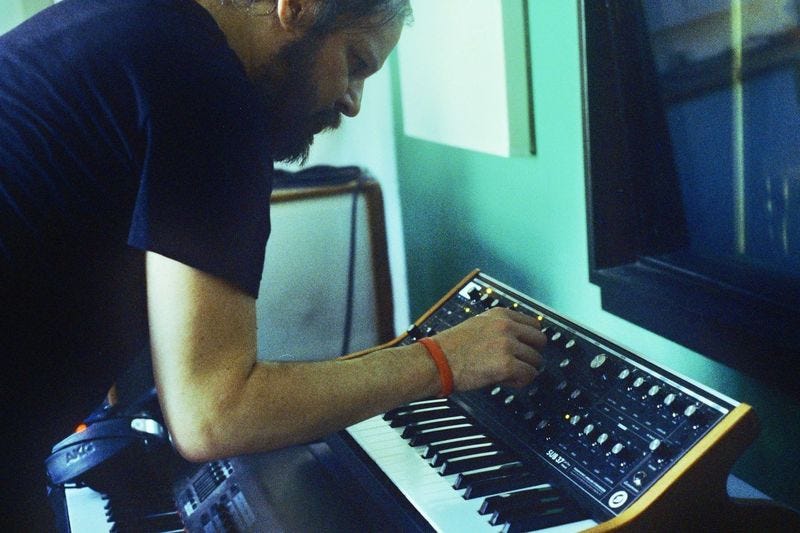
Today we’re listening to Adam Wiltzie, an American ambient musician from New York City. We recommended his solo music in 2024 and his project Stars of the Lid (with the late Brian McBride) twice before. Wiltzie himself has done a number of notable collaborations including The Dead Texan with Christina Vantzou and A Winged Victory for the Sullen with Dustin O’Halloran. In 2013, Wiltzie entered the studio with Jóhann Jóhannsson, and over a few years the two would create several “orchestral psychedelic drone compositions.”1 In 2018, Jóhannsson passed away, and after some years passed, Wiltzie returned to the project with the blessing of Jóhannsson’s family. He re-recorded guitar parts with Steve Albini in Chicago, electronics with Tim Hecker, and orchestral strings in Budapest. “The one thing I still feel listening to this,” Wiltzie told us, “is that JJ still sounds so alive to me.” We’re also revisiting And Their Refinement… by Stars of the Lid. A conversation with Adam follows the streaming links.
Friendship Survival Guide - Adam Wiltzie & Jóhann Jóhannsson (43m, no vocals)
Bandcamp / Spotify / Apple Music / YouTube Music / Amazon Music / Tidal
And Their Refinement of the Decline - Stars of the Lid (120m, no vocals)
Bandcamp / Spotify / Apple Music / YouTube Music / Amazon Music / Tidal
What’s your earliest memory of music?
It would have been the spring of 1972. I was playing around the apartment in the upper east side of Manhattan & fell in my parents bedroom hitting the corner of their bed severely cutting my bottom lip, as my mother took me down & jumped in a taxi to the emergency room I remember the driver blasting “Rocket Man” by Elton John, I will never forget it…
What were your first recordings like? What did you use to make them?
My four-track tape machine at the dawn of the 1990s cost $300, and that was a fortune for me considering I lived in squalor. The sounds we created on these recorders were essential to the sounds we were creating at the time & was the catalyst for Stars of the Lid’s early textural aura.
How did you first get into ambient music?
My first love & major influence was Brian Eno, hard to say there was anyone else that taught me conceptually about how to get in the middle of your ideas, let go of your option paralysis move forward, than the great bald one.
You’ve collaborated with several composers best known for their film scores – Jóhannsson but also Dustin O’Halloran. Stars of the Lid music has been used in film and TV as well. Was Stars of the Lid and your other work influenced by scores?
No, not at all. I am guessing by your question you have never listened to Stars of the Lid? I would also propose that Friendship Survival Guide was not either, it just happened to be the catalyst that started our collaboration. Most of the time when you are scoring films it can be really uninspiring & what was originally going to be this specific sounding entity usually turns into this strange sculpture that is cobbled together by different producers pushing through arbitrary ideas that they feel are an important part of the storytelling process.
What are some similarities and differences in composing for film versus making standalone records?
The biggest difference is composing for film will always fall in the category of “commissioned work,” so essentially it will never be just for yourself. There is always another sentient being that will have a say in the final outcome. This is not always a negative, but the sooner you let go & realise this, you will spend less time fretting about the occasional rejection of your work & ideas.
One of the moving things about Friendship Survival Guide is that listening to it now, knowing the context, it evokes loss, grief, memory, and nostalgia. Yet most of the original material was recorded with Jóhannsson himself. What was your experience revisiting the original recording with not only his memory but also Steve Albini’s in mind?
There was a bit of anxiety leading up to the moment I dived back in but once I started creating again from the palette of sounds we made all those years ago I would say the experience was mostly pleasant, inspiring & rather cathartic. Not sad at all, as the one thing I still feel listening to this is that JJ still sounds so alive to me.
What were the first and second studio setups for this record? What instruments/gear/software did you use during the original collaboration and later completion of the record?
I suppose there were 4 major events to the recording.
#1 was the initial ideas that were recorded between 2013-2017. A lot of these were tape loops that were recorded on a Studer 2 inch 16 track machine, so that we could have our initial loops with multitracks of layers. Then next step was bouncing the loops down to another Studer machine but this one was 2 track 1/2 inch. This also gave us the ability to crush the multitracks a bit. A final bounce was then activated to Johann’s Revox 1/4inch machine & these ended with another layer of tape compression as it starts to get really nasty sounding by the time you shrink the bandwidth from 2 inch to 1/4 inch. Then we digitised & this is what you hear on the recording
#2 was a few years ago when I started to put the pieces together & started to create the arcs that would finish the pieces. This next major event was recording the guitars & re-amping of the tape loops in Chicago with Steve Albini @ Electrical Audio. We used Sovtek MIG 50’s heads through Marshall cabinets with Coles STC 4038 Ribbon mics for the close & Josephson C 617 condensers for the rooms & Steve laid them on the floor, which is a technique I never attempted but they sound incredible for my ears.
#3 was orchestrating the strings & recording in Budapest. We used 24 players & recorded everything in 4 hours.
#4 is the final & most essential which was the final mix with my long time collaborator Francesco Donadello (won a Grammy for his work on the Chernobyl series soundtrack)
How do you discover new music these days? Any recent notable finds?
I am basically forever an inveterate used record collector. I don’t engage in actively seeking out new music from this era, but I am continually fascinated by how much music still exists from the past I have never listened to.
A couple recent finds from the past few years as I am in the middle of some kind of jazz resurgence in my head are Donald Byrd / Electric Byrd & Freddie Hubbard / Red Clay.
Name an underrated artist from the past 50 years.
I am not exactly sure what underrated means as it is forever being used in sports analogy, but for music in my collection it would have to be Robert Hampson.
What are you working on next?
For the moment it is the new A Winged Victory for the Sullen, hopefully it will be released before the end of 2027.