

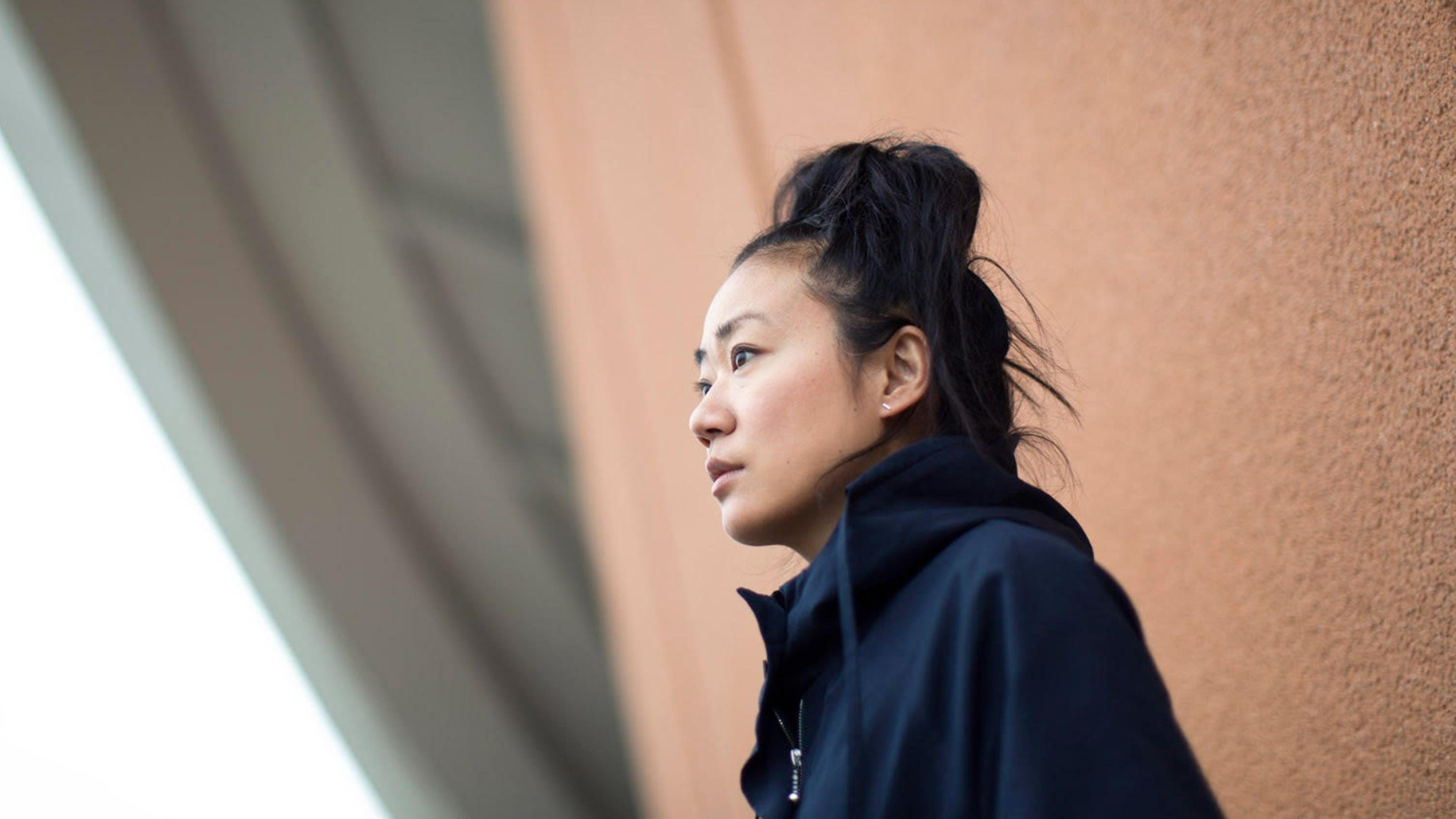
Today we’re listening to Midori Hirano, a Japanese composer and pianist based in Berlin. The last time we recommended her music was in 2021. She uses synth and piano to create electroacoustic pieces that reflect her classical training as well as interest in more experimental compositional techniques. Her latest record is a new score for The Juniper Tree, the 1990 film by Nietzchka Keene set in Iceland and starring Björk. Reflecting on the process of making the score, she told us, “I think this film has a lot of ambiguity showing different kinds of emotions and you can’t really define who is good or bad actually. And I think that electronic sounds are well suited to expressing subtle aspects of human psychology, while an acoustic instrument like the piano, the nature of the instrument can be quite strong, so I feel it can sometimes limit the kind of impression or feeling it creates.” We’re also revisiting her 2020 record, Invisible Island, whose piano pieces are complex and processed through a range of effects. A conversation with Midori follows the streaming links.
The Juniper Tree - Midori Hirano (39m, no vocals)
Bandcamp / Spotify / Apple Music / YouTube Music / Amazon Music / Tidal
Invisible Island - Midori Hirano (41m, no vocals)
Bandcamp / Spotify / Apple Music / YouTube Music / Amazon Music / Tidal
What’s your earliest memory of music?
When I was growing up in Japan in the ‘80s, it was still the bubble era, and there were many children around me who were taking piano lessons.
So whenever I went to play at neighbor’s house, I often heard someone playing the piano. But at the same time, my grandparents bought my brother and me a Super Famicom, which had just been released back then. I often played games like Super Mario with my brother and friends, and the music from those games gradually became embedded in my memory, without me even realizing it. So when I think back on it, both the sound of the piano and the sounds of video games are equally part of my earliest musical memories.
How did you get started with piano? What was the first piece that you learned that felt like a real accomplishment?
As I mentioned above, so many children around me were taking piano lessons when I was a child, so I just became interested in playing it as well. Even in my small hometown, there seemed to be someone giving piano lessons on almost every block in my neighbourhood at that time. But before I started playing piano when I was around six, we had a small pump organ at home, and I remember just playing around on it, making whatever sound I felt like.
I don’t really remember what the first piece I managed to play properly was, but I think it was probably one of those standard little pieces by Bach or Mozart.
What were the artists/albums that early on helped point you in the direction of your own sound?
When I started making electronic music in early 2000s, glitch and all kinds of experimental electronic music were thriving at the time. So I’m sure I was inspired by a lot of those music. But if I had to pick just one, it would have to be Tujiko Noriko’s Shojo Toshi, which was released on Mego. I found it very refreshing how freely field recordings, sampled sounds, and noise were arranged, yet somehow they all came together well as a pop song.
The Juniper Tree is an interesting blend of synth and piano. How do you think about using either instrument – does a musical idea occur to you along with the instrument, or do you tend to find the musical idea once at the instrument?
It really depends, but when speaking about producing the score for The Juniper Tree, I naturally came to the idea of using synthesizers for most of the score, and the piano should stay as occasional use, after watching the film. Because I think this film has a lot of ambiguity showing different kinds of emotions and you can’t really define who is good or bad actually. And I think that electronic sounds are well suited to expressing subtle aspects of human psychology, while an acoustic instrument like the piano, the nature of the instrument can be quite strong, so I feel it can sometimes limit the kind of impression or feeling it creates. So I kept the use of the piano to a minimum, using it instead at key points in the story, and I think it worked quite well.
What was your studio setup for Juniper Tree? What instruments/gear/software did you use to make the album?
Since the music was specifically composed to be performed live as a solo piece, the setup was quite minimal as listed below:
- Arturia MiniFreak
- Small modular setup - Mutable Instruments’ oscillator Plaits, Doepfer’s LFO A-145 and Morphagene by Make Noise
- Strymon Bigsky reverb pedal
- Acoustic piano
Around 60% of the album was made using only with MiniFreak, with 9-10 different presets. I altered their sound characteristics using the filters. For track 8 “Take Me With You,“ I used only Plaits as the sound source. I connected a sine-wave LFO to Plaits’ Level input and used the LFO’s dynamics and intervals to slowly evolve the timbre.
And at the beginning of the track 9 “Mother’s Path,“ I kept a piano phrase recorded with Morphagene looping, while using its granular capabilities to significantly transform the sound. All sounds from both modules were routed through the Bigsky.
To produce the album, I recorded everything in Abelton Live and made some subtle EQ adjustments there, while also adding a minimum amount of reverb using Valhalla plugins. As I was already happy with my initial compositions I’ve made for the premiere concert, I tried not to change them too much and instead focused more on mixing, especially with the last track “Forever In The Sky“ where I used Plugin Boutique’s Stereo Savage to expand and deepen the stereo panning.
What's it like composing for a film, versus creating your own original music?
When composing for a film, you usually have a director who often has certain musical ideas that you need to realize. But when creating your own music, you can do whatever you want, so this is obviously the main difference. But for me, sometimes having musical limitations or being asked to work within someone else’s ideas can actually help me find a new way of approaching things, both technically and creatively.
But the situation with The Juniper Tree was a little different from a usual scoring project, as the music was composed genuinely for live performance. I had complete creative freedom, while the music of course still needed to work well with the story. That was actually the only real limitation I had, and it gave me a lot of inspiration. I’m very thankful to VIERNULVIER for giving me this special opportunity.
How do you discover new music these days? Any recent notable finds?
I often discover new music while exploring Bandcamp or some random websites, or otherwise at concerts or record stores. The record I recently stumbled upon and bought is Helen Money’s Atomic. This album is already a couple of years old, but I’m happy I found it now, thanks to the shop Bis Aufs Messer in Berlin. I really enjoyed the beautiful, massive sound of her cello.
Name an underrated artist from the past 50 years.
I think everyone has a different idea of what makes someone underrated, but if I had to name one, I’d say Natalie Beridze. There’s always a real strength at the core of her sound, and at times, it also has a sense of spaciousness and warmth. I enjoy almost everything she makes.
What are you working on next?
Since I’m releasing two albums this year, and I’ve released quite a few albums and worked on several scoring projects over the past few years as well, I feel like I’d like to focus more on playing live as much as possible for a while, rather than making new music.
Hola , Fantástica Entrevista. Me Fascina La Música De Midori Hirano. Un Saludo.