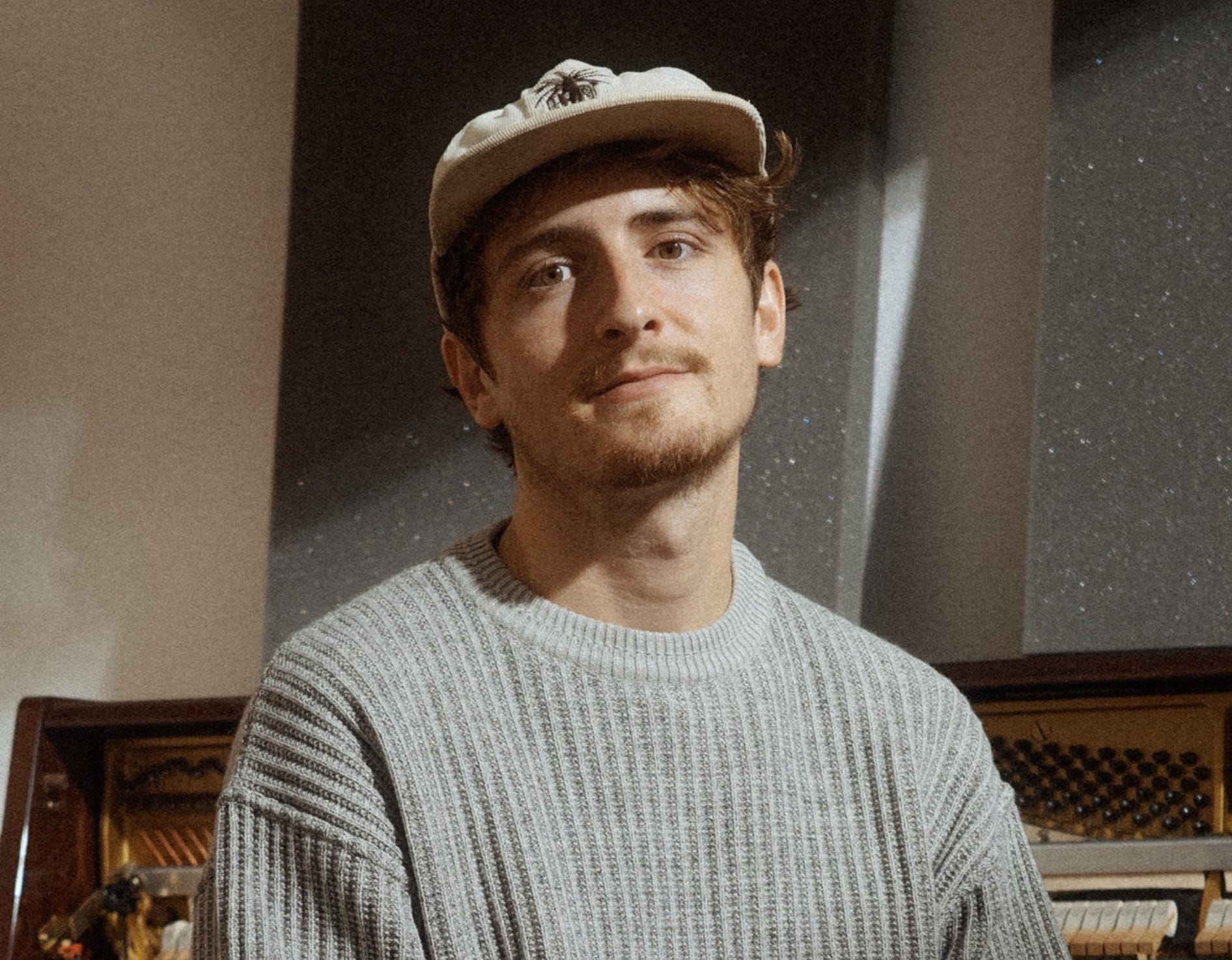
Today we’re back and listening to Linus Alberg, a German pianist and composer from Augsburg. He started piano lessons at age nine on a Yamaha upright, which he still plays to this day. He’s classically trained, and began putting out his own original music in the late 2010s. We’re first playing his new album, UON, which came out in April. Its soft acoustic piano is reminiscent of his influences Ólafur Arnalds and Nils Frahm. Second we’re playing Living on a Planet Full of Empty Life from the end of 2020, which is similarly gentle but also includes rich arpeggios such as on “Orthosie” and “Sinope.” One track, “Jupiter,” includes four on the floor drums. On both records his close-up, multi-mic recording setup creates a kind of surround sound, as if you were listening to the pieces from inside the piano. A conversation with Linus follows the streaming links.
UON - Linus Alberg (35m, no vocals)
Spotify / Apple Music / YouTube Music / Amazon Music / Bandcamp / Tidal
Living on a Planet Full of Empty Life - Linus Alberg (66m, no vocals)
Spotify / Apple Music / YouTube Music / Amazon Music / Bandcamp / Tidal
What was your earliest memory of music?
As far as I can remember, I’ve always been surrounded by music. My dad used to play the guitar, bass, and keys in a band when he was a young adult. When my sisters and I were born, he played around the house all the time, and my mother sang beautiful lullabies to us. So music and instruments have always been part of my life.
Tell us about your start with piano and the first instrument you played on. What was the first piece or two that you learned and felt like a real achievement?
The first instrument I learned to play at the age of six was the drums, while my older sisters played the cello and piano. At first, I found it annoying when my sister practiced the piano at home, but when I was nine years old, I joined on one of her lessons, and after that I immediately stopped playing the drums and took lessons in classical piano. I think what fascinated me most was not just being able to play melodies, but also realizing that it’s about how you express or articulate each note and how you connect them with each other. And through that, being able to build and convey emotions or even tell an entire story – that really inspired me from the very beginning.
The piano on which I played my first notes is the exact same one I still play on today. It’s the piano my parents bought for us kids and has been in our house ever since. It’s a Yamaha M1J, and although I’ve played on many different pianos over the years and it’s starting to show its age, I’m still in love with the sound of this particular piano.
I would say that Debussy’s “Clair de Lune” and Chopin’s “Nocturne, Op. 9, No. 2” are definitely among my earliest “achievements.” Along with Beethoven’s music, their compositions were some of my favorites and the ones to which I felt the strongest emotional connection during my years of studying classical piano.
Who were the composers that most helped you find your own sound?
A major source of inspiration on my journey from classical piano to finding my own sound was discovering the music of Ólafur Arnalds; in particular, his album Living Room Songs from 2011 remains one of my favorite albums. And, of course, my first encounter with the music of Nils Frahm, starting with the first time I heard his album Felt. The two of them were kind of role models growing up, who changed my perspective on the piano as an instrument. They have also broadened my horizons when it comes to composing for classical acoustic instruments in combination with electronic and modern elements.
But also, composers like Max Richter, Hania Rani, Philip Glass, and Büşra Kayıkçı are huge inspirations to me and still help me figure out what I love about music in general and in detail and that’s definitely influenced the way my own music has evolved up to now.
Tell us about your studio setup for UON. What instruments/gear/software did you use to make the record? How specifically do you capture the sound from the piano?
My new album, UON, is a collection of ten tracks created over the past few years in various studio setups and locations. So I recorded some of the tracks at my parents’ house, others in my old home studio, and still others in my current studio using different setups.
At the heart of most of my setups are the Yamaha piano from my childhood and an old Mannborg pedal harmonium, both of which I’ve recorded with various microphones into Ableton – the DAW of choice on my computer. As well as an old Wurlitzer Electric Piano, a Moog Grandmother I mostly use for subs as well as a Prophet 12, which was the first ever synthesizer I owned, for pads and synth textures.
When recording my piano, I usually play around with different sorts, thicknesses, and sometimes layers of fabrics to soften the sound. Plus, a lot of the time, I experiment with microphone placement. Normally I use more than one stereo pair of KM184 mics in front of the piano mechanic. Sometimes going up to five or even seven mics in total, recording different parts like the back or front-bottom of the piano simultaneously.
In post-production, I like to have more freedom and bring the microphone signals together, depending on which microphone characteristics, frequencies, or position I like the most for the specific piece.
What’s your composition process like? How much is deliberately written before recording versus improvised or added later in Ableton?
My compositional process depends on the specific project I’m working on. However, most ideas come to me while I’m just playing around freely, experimenting, and improvising on the piano. This often leads to initial sketches, simple short melodies, and eventually more elaborate compositions. I try to capture short melodic ideas – which quickly feel like one of many layers or loops – and record them right away so that I can continue adding ideas while still in the same state of flow, allowing me to build a basic framework for a piece from a small idea relatively quickly.
Other pieces evolve into a complete story or a distinct composition for the piano as I play them. These usually take shape within a few hours or a day, and I initially record them provisionally just on my phone or in my head. Over the following days, sometimes weeks or even months, I continue to refine the composition until it feels complete and ready to be recorded as the final version. Sometimes, while working on such a composition – which was originally intended primarily for a single instrument like the piano – ideas for additional elements emerge, such as subtle accents at certain points with bass notes or additional harmonies played by harmonium or synthesizer layers.
And other pieces simply emerge as a first take, capturing the very moment when the idea takes shape as I play freely on the piano and improvise. In fact, those are my favorite moments – when they happen, it can feel almost magical. But they’re also the rarest moments, because many different factors and circumstances have to coincide and be in harmony for them to occur – things that can’t be forced, planned, or controlled.
How do you discover new music these days? Any recent notable finds?
To be honest, I don’t really actively look for a lot of new music, especially when I’m working on my own projects. But I always love discovering the latest releases or news from artists I know and admire. Sometimes I come across similar music or composers directly on streaming platforms, but also on social media, in magazines, or through people or labels I follow. So, no big surprises :)
Among my latest discoveries that I really enjoyed listening to are Seven by Felix Rösch, Are We Alive? by Natalia Tsupryk, and Nowhere Sessions by Snorri Hallgrímsson.
Name an underrated artist from the past 50 years.
That’s a tough one… Off the top of my head, one composer whose music can’t get enough attention is Hanakiv, who, in my opinion, creates extraordinary and uniquely beautiful music that stands out from most I know.
What are you working on next?
Since the beginning of the year, I’ve been working on two new projects and am currently in the process of recording and gathering a lot of new ideas. I’m really enjoying the process at the moment, even though I’m not quite sure yet what format they will ultimately take or how they’ll unfold. However, my plan is to finish both of the projects till the end of this year. And maybe work on visual concepts for both of them and start building my first live program around some of these new ideas.