

Today we’re listening to Jeremiah Chiu, a Taiwanese-American synthesist and composer from Chicago. He took up piano and violin at age five, and went on to play keys in bands (pop punk), leading to an interest in synths. Now based in Los Angeles, Chiu creates fascinating synth compositions, often on interesting instruments. His 2023 album, In Electric Time, was made at the Vintage Synthesizer Museum in Los Angeles.1 He’s a member of the electro-jazz quintet SML, contributing modular synths to the group’s virtuosic live improvisations (see example on YouTube), or their “five-person dialogues” as he called them. On his new album, Edge Conditions, he mixes arpeggiated synth with drum machines, acoustic drums (by Booker Stardrum and Ben Lumsdaine), viola (Marta Sofia Honer), saxophone (Patrick Shiroishi), and more. “A large part of the studio process is experimenting by taking improvisations or other performances and using them as material for new pieces,” he told us. “I also use these samples to re-synthesize things – i.e. as a carrier voice for a vocoder or as an envelope follower or any other idiosyncratic way of taking one thing and using it to transform something else.” A conversation with Jeremiah follows the streaming links.
Edge Conditions - Jeremiah Chiu (42m, no vocals)
Bandcamp / Spotify / Apple Music / YouTube Music / Amazon Music / Tidal
In Electric Time - Jeremiah Chiu (38m, vocals at the start of “For Voices”)
Bandcamp / Spotify / Apple Music / YouTube Music / Amazon Music / Tidal
What’s your earliest memory of music?
It was very cute. I remember my parents and I would call my grandparents on holidays or to occasionally catch up – I must have been 3 or 4 – and at the end of each call I would sing Stevie Wonder’s “I Just Called to Say I Love You” to them. Because of that, the song has a permanent spot in my memory and life. As a teenager, I remember learning this song to cover in my pop punk band. Maybe it’s time I do a switched on version.
What was your first instrument and how did you get started with synths?
I started playing piano and violin at age five or so. I took private lessons on both instruments and eventually joined the junior high orchestra as well as a regional youth orchestra in the Chicagoland area. In high school, I decided not to continue playing in orchestra. It’s something I regret now, but at the time, I started learning guitar and bass and wanted to hang out with my peers in punk bands – a pretty normal desire for a highschooler in the suburbs, I assume.
Near the end of high school, all of the friends I had were in bands and equally into punk, emo, and rave culture. Chicago House and Detroit Techno were hugely inspirational and analog (vintage) synthesizers were cheap and plentiful. We were playing in emo punk bands – starting to incorporate synths – and also learning how to beatmatch drum machines to tracks on a turntable. At the time, you could buy a synth (something like a Roland Juno-106) for $100. It provided us with the opportunity to try out a bunch of different synthesizers and sell and trade them easily. A friend, Mike Bingaman, lent me his MC-505 Groovebox and that really got me interested in sequencing, programming synths, and connecting the instruments to each other through MIDI and CV/Gate.
In retrospect, it was a unique experience to have so many teenagers in a community that was really open to a lot of music and art.
What were your first recordings like? What did you use to make them?
My sister had this Casio WK-1200 that wasn’t being used. It sat in our dining room, next to the kitchen. When my parents would be fixing dinner, I would sit on that thing and make songs. It had the ability to record up to six parts using internal sounds. So I learned to make a drum part, bass part, chords, and lead parts. It really taught me how to put parts of a song together. I also spent a lot of time making mixtapes by recording snippets of radio onto boombox that had a record function. I still work like this quite a bit, except I use live performance as my “radio.”
Once I was in bands, we – like so many people – had a Tascam 4-track recorder and a single microphone. We learned how to record parts and bus them down to single tracks to add more tracks. From there, the evolution went a bit like this: a 16-track minidisc recorder, a Fostex digital recorder, a Compaq computer with Cubase controlled by a 12-track MIDI console, a Pro Tools MBox with that goofy dongle. All of the early recording experiments were done on cassette tape or CD.
What early artists/albums were most influential to you finding your own sound?
Isotope 217, Tortoise, and the whole “post rock” Chicago scene were and still are huge influences. I’m grateful and honestly in disbelief that I call a lot of those people friends and collaborators now. Beyond the sound of the albums and music, the proliferation of different groups within a community reminded me of other thriving music scenes, like ‘70s Dusseldorf, Cologne, and Berlin scenes and ‘80s downtown New York scenes.
I love looking at liner notes and personnel on albums and seeing a rotating cast of similar characters – especially when those relationships traverse mediums. In particular, I remember being in art school and finding out that Steve Reich and Sol Lewitt were close friends. Moments like that blew my mind because I grew up in a culture where everything seemed to have a defined boundary. Music was Genre, Art was Movements. But the actuality was much more fluid, hybrid, and boundaryless.
Ultimately, the goal is to participate in, and support a thriving artistic community where artists can come together, be in dialogue with each other and contribute positively to our understanding and experience of the world.
What was your studio setup for Edge Conditions? What instruments/gear/software did you use to make it?
I work in Ableton. All of the contributors on the album recorded remotely and then I edited and arranged the material. More than once, a drum take would get resampled or sliced and it would form an entirely new track. For me, a large part of the studio process is experimenting by taking improvisations or other performances and using them as material for new pieces. I also use these samples to re-synthesize things – i.e. as a carrier voice for a vocoder or as an envelope follower or any other idiosyncratic way of taking one thing and using it to transform something else.
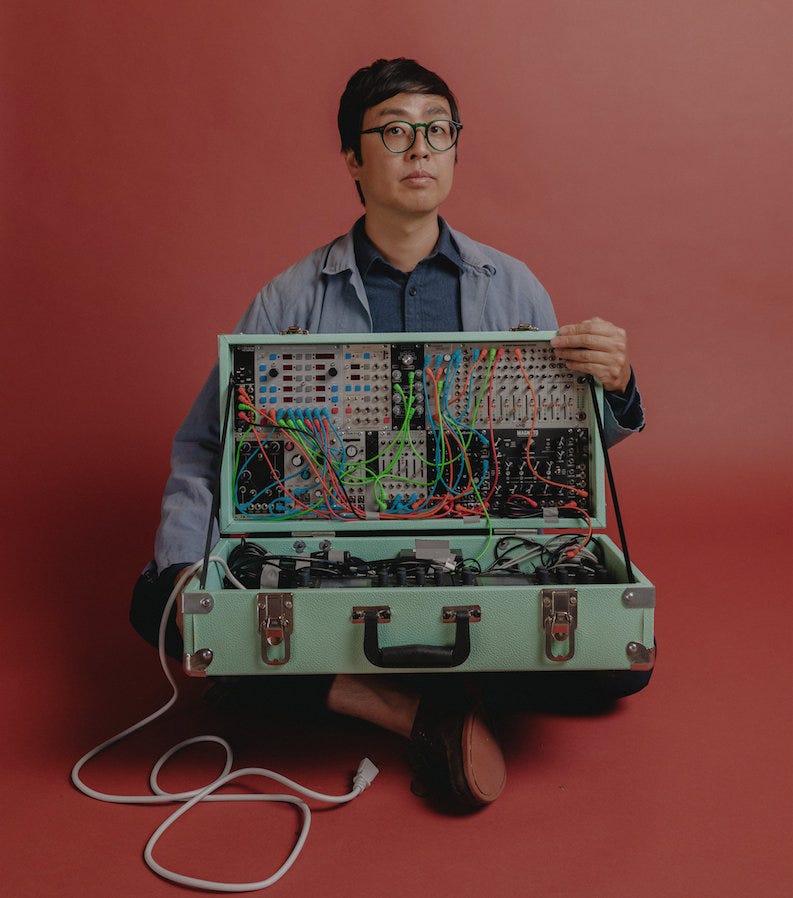
In my modular rig, I have several samplers and oscillators that I use to create percussion and melody. The samplers are all routed via my mixer’s aux send, so at any given moment, I can sample something and work with that.
Only recently have I started to incorporate software synths as a way to work out some of the compositions in MIDI before recording them again with analog synthesizers. On this record, I used my modular synth rig, Roland gear (101, 202, 303, 606, 808), Moog Matriarch, and a few sample-based organs or pads that I made. Beyond that, Marta Sofia Honer (viola), Marquis Hill (trumpet), Patrick Shiroishi (saxophone), Ben Lumsdaine (drums), Booker Stardrum (drums), Takako Minekawa (voice & field recordings), and Will Miller (EVI) all contributed to the album.
How did your experience with SML affect your solo work?
SML has been a great experience in listening and making intentional moves. Josh (in SML) has talked about it as being a mode of self-producing, or live producing. I think what he means is that when we’re playing live, it’s all improvised, but since it’s a performance, we’re balancing risk-taking with intentionality. Every sound each of us brings to the table is a part of a five-person dialogue. However, each of us has the opportunity to shift the conversation as it’s moving, because we all respond.
In my solo work, I improvise a lot in performances. This is usually done with live-sampling and sequencing. With sequencers in my modular rig, I often have a sequence sequencing a sequence. To clarify, instead of sending a sequencer a steady clock pulse, I’m sending it a rhythmic sequence. This starts to articulate and move the sequence I’ve written in ways that are unexpected and forces me to listen, adjust, and react. What I’m interested in is having some volatility in the performance. An opportunity to have things go awry that force me to be present.
With my previous solo album, In Electric Time, it felt very close to how SML currently operates. It was collection of improvisations that was then edited down into an album. With Edge Conditions I intentionally swung the pendulum in the other direction. Instead of build the record based on improvisations, I wanted to compose some pieces from the ground up. Some of the songs were still born out of an improvisation, but I challenged myself to explore the album in a way that I hadn’t been doing with my other groups (SML, Marta Sofia Honer duo, and Jeff Parker Expansion Trio).
You’re also a graphic designer and educator. What are some examples, if any, of your work in those disciplines affecting your music, or vice versa?
When people ask if there’s overlap between my art, design, and music practice, I always talk about the vocabulary as a way to understand how similar they are. In all of the creative fields, we can talk about composition, narrative, contrast, tensions, rhythmic, dynamics, etc… While we generally pin art and design towards a more visual realm, and music to be more sonic, I don’t really separate them that way. When I make an album, I always approach it like a film, or narrative work. I’m thinking about the pacing from the beginning to the end. I’m thinking about the tension and release and the changes between songs as opportunities to carry a listener through a series of ideas tethered to one larger concept.
In a more direct example, some years ago I was commissioned by The Getty Center in LA to create a score for a player piano as part of their performance, Pianographs. The player piano score rolls vertically across the face of the piano as the music is played. Holes punched in the paper scroll activate notes. Because the scroll was such a visual part of the performance, my approach to the composition was to compose the score by drawing images and words onto the scroll. I was less worried about the exact harmony, melody, or counterpoint, and more interested in hearing how these images and text came to life through sound.
Name an underrated artist from the past 50 years.
I’m not sure if Franco Battiato classifies as underrated as he became one of Italy’s most famous singers. However, his early experimental records Fetus, Clic, Pollution, etc. are all so incredible, and I’m always surprised that they’re not more widely recognized by today’s selectors. Go listen to them!
What are you working on next?
I feel so grateful to have the support of International Anthem and to be collaborating with so many incredible artists in our wonderful community. In the coming year, I’m continuing the work with SML, Marta, and Jeff Parker in hopes that one or more of those will finish another album. At this very moment, I’m about to send this interview off and record on an amazing track for Marquis Hill.
Futurism Restated, whose (longer) interview with Chiu is also worth reading if you enjoyed this one