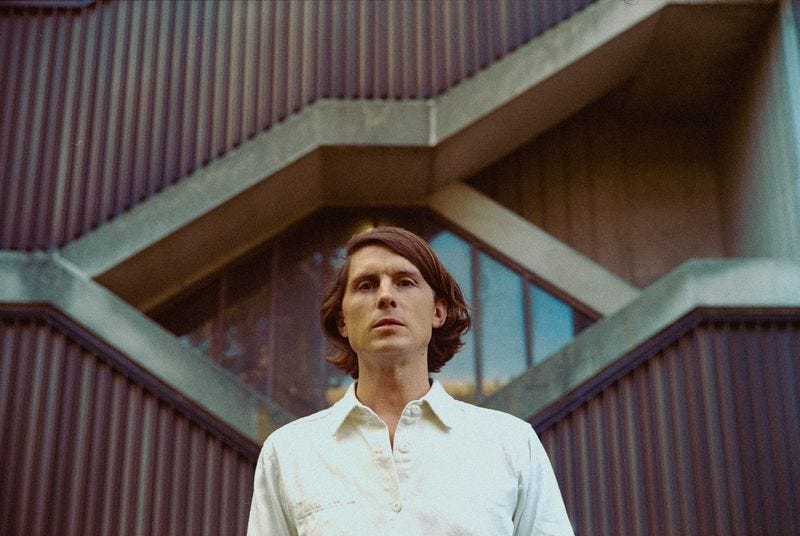
Today we’re listening to Erik Hall, an American multi-instrumentalist from Chicago. He grew up playing piano and guitar, and was drawn to “music that takes time to fully unfold” by listening to Steve Reich, Arvo Pärt, Brian Eno, and Stars of the Lid. We’ve recommended Hall’s music twice before, including his stunning rendition of Reich’s Music for 18 Musicians, on which he recorded every part himself. On his new album, Solo Three, he gives the same one-man-band treatment to works by Glenn Branca, Charlemagne Palestine, Laurie Spiegel, and Reich. A conversation with Erik follows the streaming links.
Solo Three - Erik Hall (37m, no vocals)
Spotify / Apple Music / YouTube Music / Amazon Music / Bandcamp / Tidal
Music for 18 Musicians - Erik Hall (60m, no vocals)
Spotify / Apple Music / YouTube Music / Amazon Music / Bandcamp / Tidal
What’s your earliest memory of music?
I grew up in Chicago, but we spent a lot of time in Michigan, and I recall my dad playing a lot of music in the car: everything from The Beach Boys to the Dirty Dancing soundtrack to Andrew Lloyd Webber musicals.
How did you start playing music? What was your first instrument?
At some point when I was about eight years old, I remember having a distinct desire to start piano lessons. I learned on my mom’s Knabe upright, eventually inheriting our old family Steinway Model O. Right around this same time I also took a heavy interest in guitar and drums, both of which I picked up more casually on my own. My dad had a lot of old guitars laying around, including a ‘60s Martin 000-18 and a ‘59 Fender Musicmaster, both of which I learned on and still have.
What were some early pieces you learned to play that felt like real achievements to you?
On piano I loved learning Scott Joplin rags, and eventually I was able to tackle George Gershwin’s piano preludes. Meanwhile on guitar I was getting every Metallica riff under my belt that I could. It was a dynamic set of interests :)
What drew you to minimalist music? What was the music that led you there?
In music school I learned about Steve Reich when we covered his piece Come Out in my freshman year musicology course. A bit later, flipping through CDs at the school library I discovered Music for 18 Musicians, which had a profound impact on the course of my musical interests. From there I discovered the ECM label, Arvo Pärt, the Hilliard Ensemble, and more, including many other works of Reich’s that I loved. Meanwhile I also started diving deep into Brian Eno, krautrock, and U.S. bands like Low and Stars of the Lid via the Kranky label. I realize looking back that I was consistently drawn to music that takes time to fully unfold.
Your rendition of Reich’s Music for 18 Musicians is probably one of our most played records of the 2020s. What was the experience like recording all parts yourself? How did that experience affect your subsequent work?
Well, thank you! That means a lot, and the process of recording it was immensely fulfilling. I’d spent years listening to the piece, so I pretty much knew it by heart. But obtaining and reading the score was eye-opening, because it filled in the gaps of my understanding of what was happening compositionally and structurally.
I spent a couple weeks experimenting with different instrumentations, as well as microphone choices and placement. Once I felt I had a grasp of the full palette, I simply started at the beginning and recorded one part at a time. The piece exists in 14 total sections, so I decided to tackle one section per day, picking up each morning where I’d left off and cleaning up the edits between sections. The first thing I did each day was record the constantly-pulsing piano parts, which was very meditative. After that I started stacking other rhythmic and melodic parts, and it was amazing how quickly it began to feel like I was a member of a live ensemble. So immensely fun.
Tell us about your relationship to the works of Glenn Branca, Charlemagne Palestine, Laurie Spiegel.
Both Spiegel and Palestine are newer to me, probably within the last five to ten years. I found Spiegel via her recordings on the excellent Unseen Worlds label, and Palestine was actually recommended to me by my own label head Brian Sampson at Western Vinyl. Glenn Branca I’ve been listening to for probably 20 years. In the mid-2000s my band NOMO was working a lot with Warren Defever, a Detroit musician/producer who’s recorded under the name His Name Is Alive since the early-’90s days of the 4AD label. (Also the mastering engineer for all of my recent albums!) Warren alerted me to Branca, particularly with an interest in his more far-out, multi-guitar symphonic works. I liked those, but the record that really stuck with me was The World Upside Down, which was an orchestral ballet score. In puzzling through the music for this new album of mine, each of these composers’ respective works emerged as pieces that could both stand alone as well as flow together as one complete program.
What was your studio setup for Solo Three? What instruments/gear/software did you use to record it?
My studio is built from a collection of instruments and a good analog recording front end. Instruments-wise, I have a 1910 Steinway grand piano, a ‘70s Yamaha spinet piano that’s felted, a ‘60s Hammond M-101 organ, a Rhodes Mark II electric piano, many guitars and amps, a few synths, and lots of vintage drums and percussion. For recording I have Neumann and Gefell condenser mics, several Beyerdynamic ribbon and dynamic mics, and a pair of Coles 4038 ribbon mics. Preamps are Rupert Neve Designs Shelford Channels and my vintage Studer 269 console. If I’m using compression, it’s either via the Shelfords or the Rupert Neve 5043, which is incredible. Also a pair of 1176s and a pair of Skibbe Red Stripes, which are a re-creation of the LA2A. I like to go through as much of this good circuitry on the way in as I can, after which I pretty much stay in the computer. Conversion is the Apollo x16, and I’ve basically only ever worked in Pro Tools.
Name an underrated artist from the past 50 years.
More in the world of minimalist-leaning indie/outsider folk, my friend Joe O’Connell records under the name Elephant Micah. Incredible artist, lyricist, and producer. Listen to the albums Louder Than Thou, By The Canal, and Genericana.
What are you working on next?
I have a collaborative album with the New York groups Metropolis Ensemble and Sandbox Percussion coming very soon after this new solo record, as well as some tour dates for that release. Meanwhile drumming on tour for my friend Natalie Bergman, who has a new album out on Third Man Records. Later in the year I have a composing commission that I’ll be eager to dig into, for a tentative Chicago performance in December 2026... Stay tuned :)