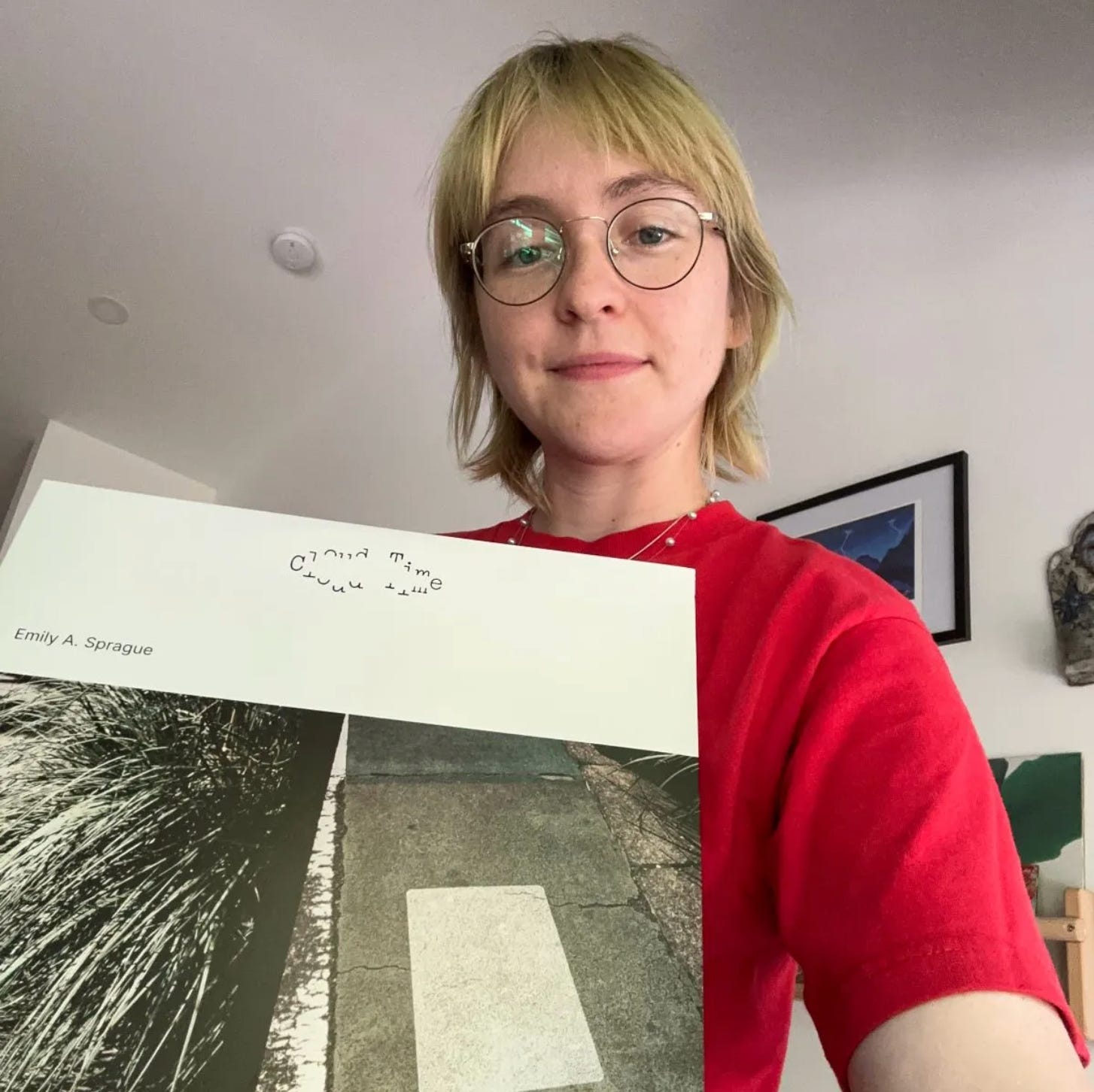
Today we’re listening to Emily A. Sprague, an American synthesist and composer from the Catskills. We previously recommended her music back in 2020. She picked up guitar and keyboard as a teenager, and formed the indie band Florist in the early 2010s. Since 2017 she’s put out ambient music under her own name. She released the LP Cloud Time earlier this month, a collection of gentle synth recordings that create what this newsletter is always seeking: an atmosphere of profundity. “The entire album is improvised recordings from stage during my Japan tour,” she told us. We’re also revisiting Water Memory, her standout solo debut LP from 2017. A conversation with Emily follows the streaming links.
Cloud Time - Emily A. Sprague (47m, no vocals)
Spotify / Apple Music / YouTube Music / Amazon Music / Bandcamp / Tidal
Water Memory - Emily A. Sprague (39m, no vocals)
Spotify / Apple Music / YouTube Music / Amazon Music / Bandcamp / Tidal
What’s your earliest memory of music?
We had a piano in my house when I was a baby, that my mom used to play. One of my earliest memories of music would be my mom playing that piano. Also, during holidays if we had family over to our house everyone used to sing songs together around the piano. Music played in my house every day growing up, so it is hard to pick a memory. Right now I am thinking about that piano being played by family in our little house.
How did you start playing music – what instruments, and what were your first recordings like?
I really started playing music when I began to learn guitar around age 12 or 13. I wanted to play guitar solos and was into rock music at the time. I mostly just learned the basics. By the time I was 15 and 16 I became more interested in folk, alternative, post punk/shoegaze, and tried to find more “chilled out” or “small” types of music (I didn’t really know about ambient yet). This was around the time when I became able to play the guitar and sing at the same time, and write my own songs. My first recordings were either made on Garageband or a basic cassette player with a record function that was at my parent’s house. I got a Casio SK-1 keyboard and would add drone layers to my simple guitar songs.
What artists / albums inspired the sound of your solo music?
I think the earliest inspiration for me to make ambient music would be Erik Satie. I remember the moment I first heard “Gymnopédie No. 1,” and it really did change my life. I was so struck by the emotion in so few notes, and the spaces between them. It really spoke to me, and I knew that I would want to have a similar philosophy to my music making. Later when I started diving into ambient music the albums that inspired me most would be (in no particular order): Eno’s Music For Airports, Haruomi Hosono’s Watering a Flower, Laurie Spiegel’s The Expanding Universe, Hiroshi Yoshimura’s Music For Nine Postcards, Pauline Anna Strom’s Trans Millenia Consort, and JD Emmanual’s Wizards. Nowadays I am inspired by so many of my friends and peers who are contemporary artists.
What was your studio setup for Cloud Time? What gear/instruments did you use to make the record?
I used a subtractive polyphonic synthesizer for a lot of the drones that you hear. Using filter, noise, and changes to the envelopes to get a large range of timbres with simple controls. All manual hardware changes. That was often sent into a 22 second long delay that I could control the feedback to either be essentially a long loop, or to decay over a long period of time and be replaced with new material. I had a second synthesizer, the OP-1, going into a 5 track asynchronous looper, and was also using the tape on the OP-1. So with two synthesizers and a few loopers I could create many layers of phasing melodies and sounds. Then there was a long reverb that everything could be sent to. It was a very simple setup with very open ended routing and looping possibilities that gave me a really inspiring canvas to work with every night. The entire album is improvised recordings from stage during my Japan tour. I recorded into a field recorder so there was no computer involved either.
How do you find new music these days? Any recent notable finds?
Every few months I scan through the Kankyo records website, listening to previews of everything that I have not heard, and I end up buying a lot of albums on Bandcamp from that. The curation at Kankyo is incredible. It leads me to learn about new labels and artists to follow.
Name an underrated artist from the past 50 years.
I have no idea if this band would be considered underrated, but almost every time I mention Woo to someone, they have never heard of them, and it is always a surprise because to me they are legendary.
What are you working on next?
I’m not sure – I have been very inspired lately which is nice. Music for me has never quite been a current or a next kind of journey. It is ever present and eventually something materializes as long as I continue seeking out the mystery of it. I will be working on new music for as long as I am able.