

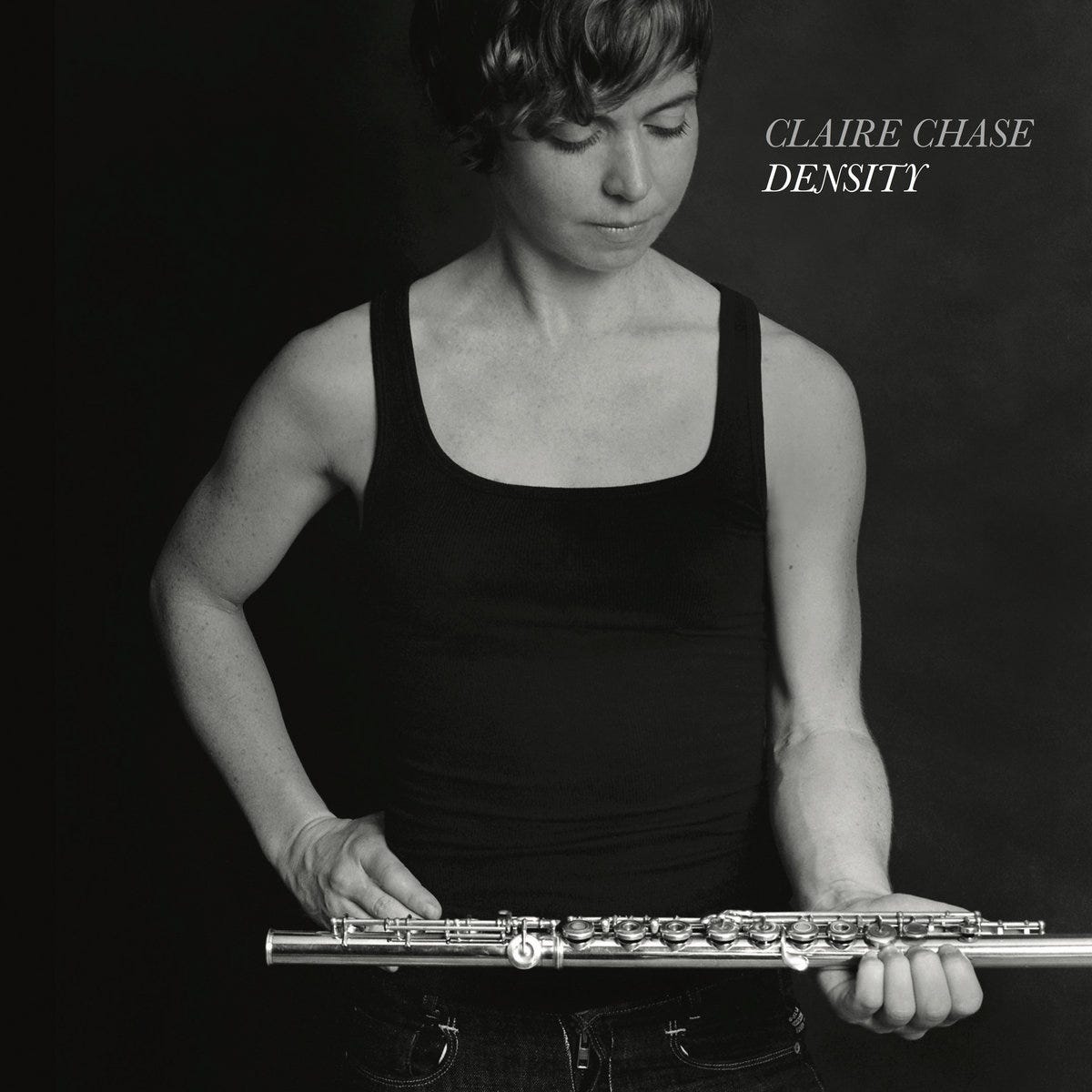
Today we’re listening to Claire Chase, an American flutist and new music advocate from California. She grew up in Leucadia, near San Diego.1 She chose the flute as her instrument, she told us, after seeing a San Diego Symphony performance at age three, and being transfixed by the sounds emitted by the principal flutist. At a flute lesson at age 12, her mind was blown hearing her teacher perform composer Edgard Varèse’s 1936 composition, Density 21.5. Later she committed herself to the project of channeling the piece’s provocative and innovative composition for 21st century ears. Her first effort was 2013’s C. Chase: Density, which arranges pieces by Steve Reich, Philip Glass, and others for flute, plus contains a performance of Varèse’s piece as its coda. We’re also playing her 2020 record, Density 2036, which is a sprawling, 4-hour collection of pieces that express the full, surprising sonic range of the flute. A conversation with Claire follows the streaming links, off the back of her recent appearance at the Ojai Music Festival.
C. Chase: Density - Claire Chase (73m, no vocals)
Spotify / Apple Music / YouTube Music / Amazon Music / Bandcamp / Tidal
Density 2036 - Claire Chase (238m, some rare vocal moments, mainly track 12)
Spotify / Apple Music / YouTube / Amazon Music / Bandcamp / Tidal
What's your earliest memory of music?
My earliest memory of music is one of my favorite memories: the vibration on my mother’s chest as she sang to me. I have no idea how old I was, but this is one of my earliest memories of anything, so I imagine I was preverbal. I have a young child now and she loves to sit on my lap as I play the flute – she tries to get as close as possible to the source of the sound, something that I think all musicians are drawn to do in a very tactile, physical way. I fantasize often about being sound. My earliest musical memory is in many ways the closest I’ve come to this fantasy.
How did you get started with the flute? What hooked you?
I have this vivid memory of attending a San Diego Symphony concert for the first time when I was three. Just before the lights went down, the principal flutist hurried onstage in a sort of dramatic trot – something must have made him late that night! – and I was awestruck by the way the light hit his golden flute and shot shimmering beams around the concert hall. I thought it was the most beautiful thing I’d ever seen. And then when he started to play, I was utterly rapt. I desperately wanted all the other instruments to stop playing so I could hear the instrument alone! I told my mother after the concert that I wanted to play the flute, that I needed a flute right away. My mother, who was a musician and thought that it was advisable to start on the violin or piano, made a note of my interest but got me going on the violin, and then the piano. I hated the violin! I was terrible at it and quit after just a few months. The piano frustrated me to no end, not least because my mother was my teacher. I asked for a flute every year for my birthday for five years in a row, and when I turned eight, I finally got one. All that waiting was worth it, because once that instrument was in my hands I didn’t want to put it down. And I still don’t! I feel that giddy delight when I pick it up in the morning, and when I put it in the case at the end of the day, that deep longing seeps in again. There are never enough hours in the day to play the flute as much as I want to play it.
What pieces of music inspired you the most early on – pieces you played or listened to that pointed you in a musical direction?
As a kid, I was obsessed with baroque music, an obsession that continues to this day. 18th century music is the music that I play in my home, for pleasure, with friends, and that I return to every day as a kind of gut-check on every aspect of playing – craft, phrasing, intention, imagination. I thought I’d be very happy playing that music for the rest of my life – and I still think I very much would be! – but when I was 12, my beloved flute teacher John Fonville walked into my lesson one day with score of Density 21.5 and plopped it onto the music stand. I looked at these two pages of squiggly lines and thought, meh – no fun, no licks, so many long notes, only one trill…what’s the big deal? He asked if I wanted to hear it. Of course I wanted to hear him play anything! He said, “Okay, kiddo, then stand back.” I’d never heard that warning before a piece of flute music, but I followed his directions and stood back.
The next few minutes changed my life. This music, and his performance, shook my bones, made every part of my body come alive, and blew the roof off the ceiling of my imagination. I became utterly devoted to the piece from that point on, practicing it constantly, torturing my parents and neighbors with the screeching high D’s. I even tried to play it at my junior high school graduation (for a public school in Southern California…) – alas, my parents insisted that I play “Danny Boy” at graduation instead! But my devotion only intensified. It had taken hold of me.
Tell us about Density 2036 and the vision behind that project.
The idea stemmed from a series of questions: what might the Density 21.5 of the 21st century be? What might it sound like? When the piece turns 100 in 2036, how far might we have taken the ideas unfurled by Varèse in 1936 and how courageous will we have been about evolving these ideas further as players, composers, and listeners? The original piece – just four and a half minutes in duration and a mere two pages in length, but monolithic in its intensity and uncompromising in its urgency – sort of drop-kicked the flute and its players into new terrain when it was premiered. It was, I like to say, a before-and-after-moment for the history of the flute. It was also a pivotal moment for the genre of music for a solo instrumentalist. Solo instrumental performance is, for me, one of the most powerful and vulnerable acts, a body wordlessly baring its soul through an object. Density is a kind of song, an anthem, transmuted through a piece of dense metal; it grabs you by the innards and doesn’t let go. After Density, the days of the flute as an incidental instrument whose default mode was pure, pleasing lyricism were over. Unleashed was the flute as an agent of power, raw and wild and capable of probing the deepest parts of our souls (and eardrums)!
We think we know what the flute, our most ancient instrument, can sound like. We think we know, in the early 21st century, what the solo performer is capable of. But we have no idea! We are just beginning. So, in a sense the project proposes no answer, and although it ends in 2036 that is by no means a finish line; if anything, 2036 will be another departure point, one even less defined and (I hope!) more porous than the one I started out with. The project is a commitment over these decades to do everything that I can to propel the instrument, to multiply its possibilities, to propel the player, the body of the player, and the body of work made, forward and down, densely, if you will, into the depths of our most urgent unknowns. Lately the project has redoubled its focus on the upcoming generation of players, and we’ve launched the Density Fellows program, which resources emerging artists to take the Density repertoire in their own interpretive directions. I’m deeply excited by what these young folks are doing, and I want to do everything that I can to amplify their work and their ideas.
One of the albums we're featuring for our readers is your 2013 Density record. How'd you select those pieces, and what was the arrangement and recording process like?
Thanks for featuring that old album! When I selected those pieces, all of which are by composers very dear to me personally, I imagined the hour of music as a kind of sonic migration of progressively receding flute-forces beginning with a mass of ten flutes in the Reich and ending with the old warhorse at the end, bare and unadorned. In between, we traverse all kinds of multi-flute sound worlds – six bass flutes in the Balter, five flutes of various sizes in the Lucier, two flutes in Glass’s high-wire duo, and then one flute enhanced with electronics in the heavy metal-inspired Diaz de Leon.
I had recorded all the individual parts of each of these pieces myself – an admittedly torturous exercise! – and I had never imagined that the album, with all its manicured, rhythmic intricacy born of so many fits and starts in the studio, could live compellingly as a live show. But when it was finished, I wanted to see what would happen if I performed the record from start to finish, without breaks, in a kind of woman-versus-machine version, with the solo line from each track performed live over the pre-recorded tracks. Surprisingly, it really worked. It was that experience (at The Kitchen in October 2013) that sealed the deal for me in terms of making an official project out of the Density initiative. The next day, it was clear to me that I needed to waste no more time, and I decided to get this 24-year party started.
We are enthusiastic adopters of Pauline Oliveros' ideas about deep listening. What do you take away from her work – text or music?
One of Pauline's most beautiful teachings is to give unconditional attention to the way that we listen. “How we listen creates our life” and “listening is the basis of all culture” are two of her credos, and I return to these refrains often. I will keep learning from these words, which are themselves invitations to attend, attune, and come alive to the thrilling world that is always around and inside of us, for the rest of my life.
On a personal note, Pauline was my most important musical mentor. I met her when I was very young and she has been a guiding force throughout my life, appearing as a kind of angel in particularly critical and confronting moments. Pauline was the first person to encourage my idea, which I shared a bit timid at first, to start an ensemble and nonprofit organization when I was an undergraduate at Oberlin. She responded to the email I’d sent her within about 15 seconds of receiving it, saying that she thought the notion of the International Contemporary Ensemble was a good one, and that I shouldn’t wait to start it (“The best way to start something is to take a deep breath and begin. How about now?!”) She also said that I could count on her to be a member of the Advisory Board. I didn’t know what an Advisory Board was, so I wrote that down, looked it up, and then started one with the name “Pauline Oliveros” at the top of our first makeshift letterhead. I cannot imagine the project of the ensemble, and the organization that blossomed out of it, without her. I cannot imagine anything that I’m doing creatively, to be honest, without her.
Toward the end of her life, she was especially emphatic about the need to have creative action, creative expression at every level of society without exception. “It’s not available to everyone, and it needs to be,” she said. I take this charge very seriously in everything that I do, and I have her to thank for that.
How do you discover new music these days? Any notable recent discoveries?
I listen to new music constantly, and I go to as many live shows as I possibly can, so I’m constantly searching for new voices and new potential collaborators. One of my most delightful recent discoveries is the music of a young Indigenous Mexican composer named Eduardo Aguilar, who was introduced to me by Jay Campbell from the JACK Quartet. I’m absolutely blown away by Eduardo’s music, by his imagination, and by the community-minded largesse of his vision. He’s someone to watch out for. I am also hugely enthusiastic about the music of the young Iranian composer Bahar Royaee. I recently commissioned her for a new work for solo percussion (featuring the extraordinary Ross Karre!) for the Ojai Music Festival, and it was an incredibly moving experience. I want everyone to experience Bahar’s music. She has such a powerful and distinctive voice, and such clarity of intention. I find this so refreshing and inspiring in artists of any age, but especially in the emergent generation of composers. The future is very, very bright in the hands of folks like Eduardo and Bahar.
Name an underrated artist from the past 50 years.
Jocy de Oliveira, a brilliant Brazilian pianist and composer of experimental acoustic and electronic music who will turn 90 next year and who continues to create astonishing multimedia work. I think of her as the Pauline of Brazil. Like Pauline in her lifetime, Jocy has been under-recognized by comparison with her male peers, and yet she has gone on to make bold, no-holds-barred work that quietly but fiercely pushes the field forward. This is the story of so many women of her generation, and we need to wake up to their fabulousness!
What are you working on next?
So many things! Next week, I’ll head to Darmstadt to begin work on a new concerto for contrabass flute by Chaya Czernowin. The next big project is the newest Density work – a collaboration with the magical 86-year-old composer Annea Lockwood. The piece is called Elwha! and it deals with the Elwha River in the Olympic National Forest, one of the largest ecosystem restoration projects in National Parks history.
The Elwha is a rare environmental success story, a river recently liberated from its dams. We are excited about telling this story through sound – specifically, through the sounds of this exuberant river and the many, many wild musics that it contains. Annea and I have been recording along the river for the past year, shaping the piece around the rich pitched, textural, rhythmic, and melodic material of this extraordinarily alive body of water. The piece, which we’re thinking about as a three-way collaboration between Annea, me, and the river, will be scored for seven flutes – bamboo water flutes, glissando flutes, alto flutes, bass flutes, and contrabass flutes – with a 7.1 mix of the river’s sounds that we’ve lovingly collected and layered We’ll workshop the piece at Tippet Rise Art Center in Montana in October, and we’ll give it its first spin at The Kitchen in New York in December.
Great music and great interview! She sounds like she lives in awe of music and beauty, as every being should. Thank you!
My 'heart' awarded before even listening on account of the interview. Glad I started reading it, and I read all of it. Listening to 'Vermont Counterpoint' now, and appreciating how the arrangement of notes expands and textures the space around me.