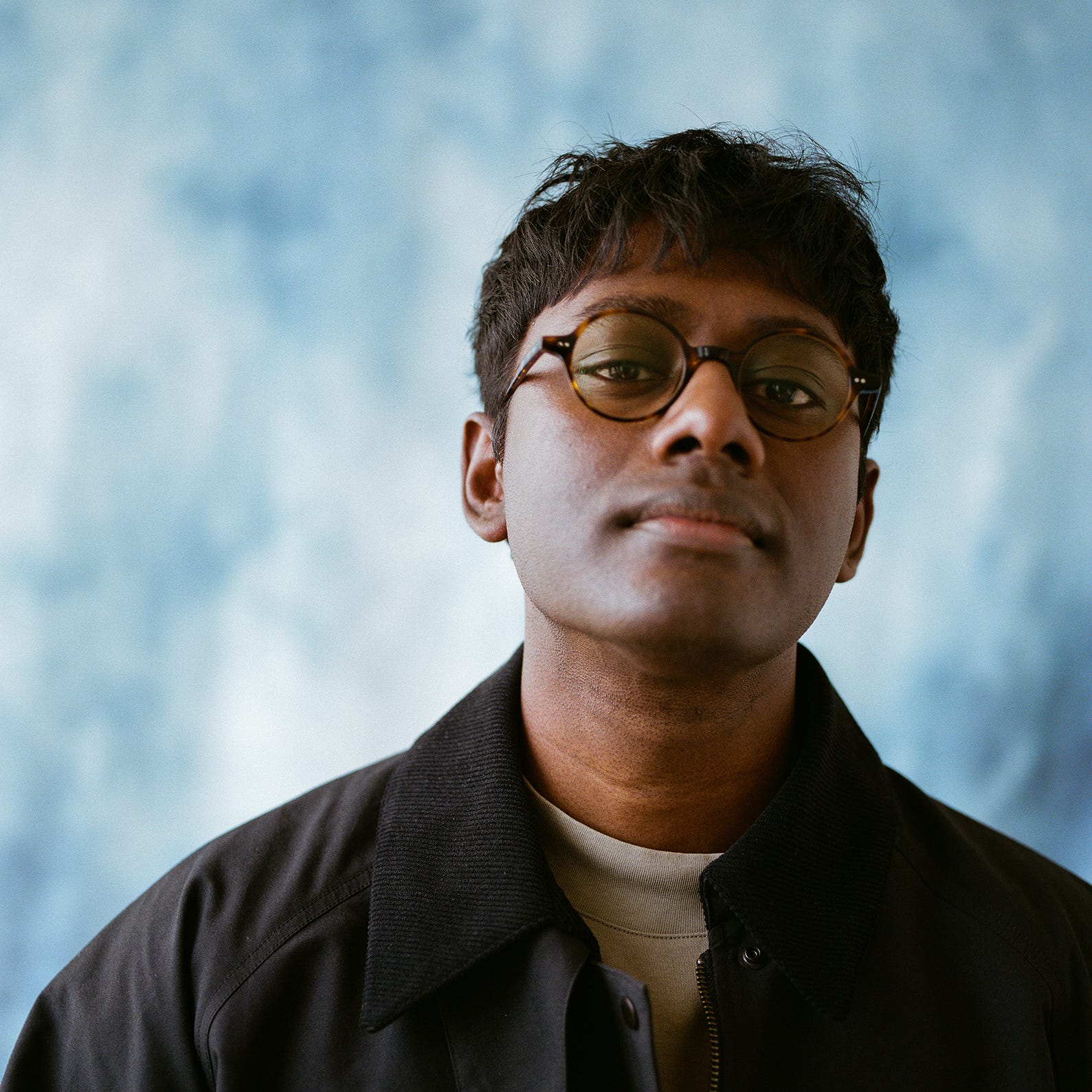
Today we’re listening to Cephas Azariah, an Indian-born British composer based in Brighton. He grew up in a musical household, listening to Indian classical and church/gospel music. Film scores were his first major inspiration as a musician. He studied Music Theology and the Arts at Middlesex. These varied influences came together on his first album, Joy Paradox, which we recommended shortly after it came out in 2024. That record was mainly felt piano, like Nils Frahm or Ólafur Arnalds, with synth accompaniment. His new album is Conditions for Observing Light, which came out last Thursday. Through a broader range of instrumentation and effects, it achieves more of the cinematic feeling of the earlier influences – he cites Hans Zimmer’s Interstellar as particularly formative. A conversation with Cephas follows the streaming links.
Conditions for Observing Light - Cephas Azariah (40m, no vocals)
Bandcamp / Spotify / Apple Music / YouTube Music / Amazon Music / Tidal
Joy Paradox - Cephas Azariah (52m, no vocals)
Bandcamp / Spotify / Apple Music / YouTube Music / Amazon Music / Tidal
What’s your earliest memory of music?
My grandad (on my dad’s side) used to play Mridangam – a South Indian classical percussion instrument – at home. My other grandad used to play harmonium and lead the church choir. Both of them were very musical and traditional church songs were a part of home life from a young age.
What were your first recordings like? What did you use to make them?
The first time I recorded music as an artist & composer was on an old (very tired) MacBook using Omnisphere. I bought a license to explore sound design as a new composer on the film & tv scene – it was great to have a variety of high quality sampled sounds to get the ball rolling. I’m big on putting ideas down when they arrive, Omnisphere was perfect for that!
Which were the artists / albums that most influenced your sound early on?
Interstellar soundtrack (2014) and film music in general. Anything with orchestral synth hybrid sounds. Tony Anderson was good at this too. Lots of emphasis on low mids and clarity around warm synth & piano combinations. Something about his music just sits so well.
Also I grew up in a home where gospel/christian music was always played so that stuck with me too. Mum had artists like Ron Kenoly and Darlene Zschech on repeat. Dad was into Karnatik (Indian classical) – AR Rahman’s film scores were also popular.
Your first record was felt piano-led, with orchestral / synth accompaniment. This new record seems to lean more into that extra-piano aspect, the synths and the strings especially. We’re curious how your compositional approach changed since Joy Paradox.
Joy Paradox was special in the sense that it was the first. I had to arrive and set the scene quickly as a new artist, giving new listeners the lay of the land. CFOL was an evolution of that, more towards the cinematic end of the spectrum. It’s nice to push the boat out and broaden the lane I’m in. In turn we have a more dynamic project where the quieter songs are smaller in personality and the bigger songs have a lot more going on. Minimal piano to broad-paint-brush strokes on synths.
I also think instruments play a big part in this. The first record was written when I only had my upright piano and the rest was written in the DAW with very selective sounds. Between writing Joy Paradox and eventually writing the second, I fell in love with analog synthesis – especially the Moog. This has been a significant factor in shaping the new project.
We loved this quote you gave to 15Questions: “I only listen to music on Mondays and in the mornings, while making coffee, I put on one side of a record. My ears are then preserved to hear my ideas and keep them far from sonic fatigue.” Is that still your routine? Also,do you find inspiration from other artistic media, if so what pieces most affected you while making Conditions?
Ahhh yes! This is a product of my Type C personality. In an alternative life, I’m working in a monastery somewhere peaceful (whilst being married and making music). The music Monday routine came from being overstimulated in general. Over COVID I had the chance to address some of this and return to one of my favourite hobbies which is listening to music! I understand the difficulties with this being a music artist, however it is possible to simply enjoy another person’s song without trying to gain something from it besides beauty. I’m not trying to learn production techniques or analyse intricate compositional aspects to mimic. Just the joy of hearing someone else’s good work. That requires intention. Monday morning is that time & place. In turn, yes, I have the ear space & headspace to carve out my own ideas as much as possible. I don’t care that I have limitations - musical, aural, skill, equipment, location - I can’t know it all and frankly don’t want to. I create with what I know and have – if it’s done well, that alone is enough.
Songs/Films/Books that have influenced my sound:
Grace by Tony Anderson
Perfect Days by Wim Wenders
Prayers by Dobrawa Czocher
Empires by Hillsong United
Mind of the Maker by Dorothy Sayers
Immunity by Jon Hopkins
Loom by Ólafur Arnalds ft. Bonobo
Interstellar Soundtrack by Hans Zimmer
What’s your studio setup? What instruments/gear/software did you use to make Conditions?
Okay. My wife & I have recently moved so we took the opportunity to put a small studio in the garden.
Here’s a comprehensive gear list.
Instruments:
Small Upright / Pianette from 1980s
Nord Grand 2
Moog Matriarch
Moog Subsequent 37
Pedals:
Strymon Timeline
Meris Mercury 7
Walrus Audio Qi Etherealizer
Hardware:
Antelope Discrete 8 Synergy Core
Neumann KH 120 monitors
Coles 4038 (for piano)
Shure SM7B (for general audio)
Heritage Audio Synth Buddy
Ableton on MacBook M1 Pro Max
10 Plugins/VSTs I use the most
Landforms by Slate & Ash
Stratus by Spitfire Audio
Soundtoys Echoboy
Valhalla Shimmer
Omnisphere
TAL Chorus
Shapr by Battersea Audio
BEAM by Lunacy Audio
Soft Piano by LABS
CLAIRE by Native Instruments
CFOL was written mostly with what I have above, plus a couple pieces of gear I don’t have anymore – Sequential TAKE5 & Hologram Microcosm.
What are some records that you’ve spun recently that stuck with you?
Temporary Coexistence of Humans by Peter Sandberg
The Space in Between by Dâmares Gomes
Ain’t it Beautiful by Ivan Theva
Desert by Lara Somogyi, Jean-Michel Blais
Are We There Yet by Hillsong United
Hemisphere West by Toulouse
Name an underrated artist from the past 50 years.
There’s two: Büşra Kayıkçı and Jacob David.
What are you working on next?
Couple of scoring projects and a minimal piano record to contrast with CFOL. I’d also love to write a record that’s fully hardware – piano, couple of synths and my pedal chain. Let’s see what happens!