

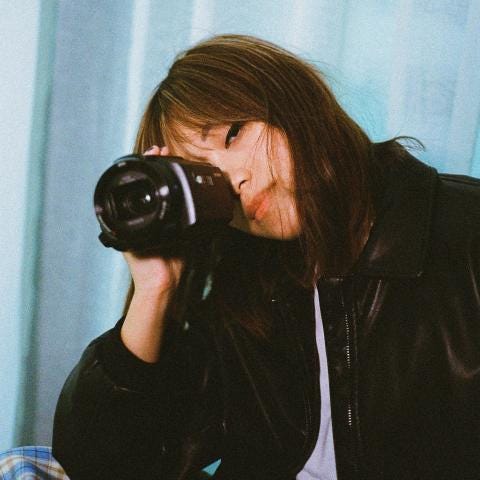
It’s Friday so we’re listening to something more upbeat. Today we’re listening to cehryl, a singer-songwriter and producer from Hong Kong. Growing up she played piano and guitar, eventually writing her own songs and recording them on Audacity. She attended Berklee College of Music, studying music production & engineering and continuing to hone her skills as a singer-songwriter.1 After a stint in LA, she moved back home to Hong Kong, where she began working on film scores and, more recently, the album You Win Some, You Lose A Lot. The record’s 24 tracks cover many styles, from twitchy electronic to mellow ambient. She cited Bogdan Raczynski, Ryuichi Sakamoto, and Oneohtrix Point Never as influences. The track titles and embedded voice notes make it feel like a kind of musical diary – “I made it late at night at home,” she told us. A conversation with cehryl follows the streaming links.
You Win Some, You Lose A Lot - cehryl (51m, voice notes / singing on some songs)
Spotify / Apple Music / YouTube Music / Amazon Music / Bandcamp / Tidal
What’s your earliest memory of music?
I can’t place it! For poetic purposes can I say a past life?
What were the first instruments you played, and what were your first recordings like?
First instrument was piano, took classical lessons when I was maybe 8, and then learnt guitar via YouTube when I was around 12. There was one summer when I played for eight hours every day and became somewhat “fluent.” My first recordings were all on Audacity. I didn’t know you could monitor a track while recording on another track so I would record harmonies without listening to the other vocal tracks and then line up the waveforms by looking at it. I made so many shitty songs on Audacity when I was young! My first written songs were not recorded though – I found stacks of lyrics on graph paper from 2009; my first song was about a cow. And there were of course a lot of imaginary break up songs even though I knew nothing about crushes or love or heartbreak at that age of course.
Tell us the most important lessons about music production / engineering you learned in school or during that period of your life.
Listening (to what’s being said by other instruments or other players) is more important than flexing your ideas. I think making good music is about emotional intelligence and sensitivity – to people in the physical room, or to the emotion that you wanna express… All the takeaways I’ve learnt throughout my career in music are applicable to both music and life. There seems to be some sort of universal truth underneath all of it – the process of making art and the process of navigating life – that is from the same thing. The same aesthetic / moral compass or something. It’s a way of discerning – whether it’s in the process of workshopping a good arrangement or in the process of navigating a relationship conflict. So much of both life and music/art-making is about contrast, balance, honesty, authenticity, etc.
Many of your previous records are singer/songwriter records. On You Win Some, You Lose A Lot, it’s mostly instrumental productions with field recordings, voice notes, and some singing. What drew you to making music in this style?
I wanted to make an album that was very tied to a time and place. A hyper localized, documentary style album. Hence all the track titles and field recordings that reference Hong Kong, where I’m from and where I’ve been based for the last six years. I was working on a lot of film scoring the last few years – in another life I’d like to be a filmmaker – so I thought I might as well make an instrumental album as if it were a score to an imaginary film in my head. I’ve always put out music as a songwriter, but then I thought about the unspoken obligation we all feel, to continue “living up to” who we told the world we were yesterday. Making an instrumental album is not that crazy of a left turn, but I resent the idea of being a genre artist. I think a lot of musicians in this era work really hard on a project and feel underwhelmed when it’s released – because there’s just SO much music out there and so many forces that dictate whether or not an album is well-received commercially. I was feeling that way too – feeling like no one really cared or listened to my music in an enduring or sustainable way – but it freed me too. It was liberating to realize I can release any style (or length, or form) of music I want; I don’t have anyone’s expectations to fulfill. What mattered to me was good compositions, good melodies, good scenes. I wanted to make music that excited me to make. I wanted to go outside of my tendencies and try something new. I wanted to play! This album to me was all about practice and play.
What would you say were the greatest influences on this album – artists, albums?
Bogdan Raczynski, Ryuichi Sakamoto, OPN, Susumu Yokota, but also the less obvious influences are The Jesus and Mary Chain, Yo La Tengo.
What is your studio setup like? What gear/instruments did you use to make You Win Some…?
My OP1 pulled a lot of weight for this album. I made this pretty much all on headphones too because I made it late at night at home. Used my SP404 for a couple tracks too. Big fan of doing things in audio these days as opposed to MIDI. Forces me to record better takes, think about each take as a performance, leaving in all the rubato.
Name an underrated artist from the past 50 years.
Scott James
What are you working on next?
SO MUCH MUSIC! I’m singing on my next album, I’m back to writing songs. I’ve got a new band too - stay tuned @officiallatenightpictureshow ;-) So much music, and so much life.
"the unspoken obligation we all feel, to continue 'living up to' who we told the world we were yesterday": freeing oneself from that is tremendous. What a lovely take on art and life. And super cool music. Thanks!