

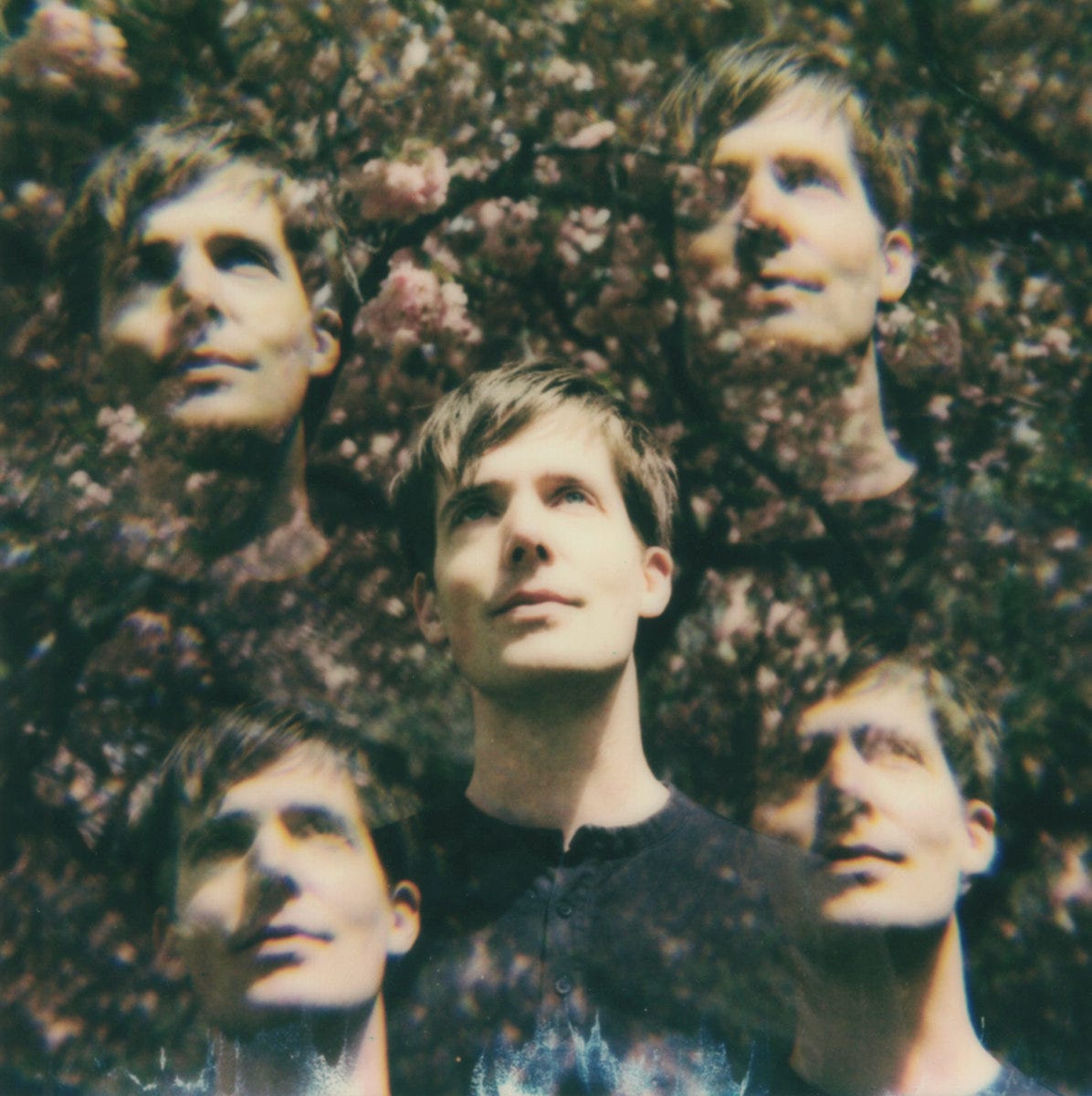
Today we’re back and listening to Benoît Pioulard, an American ambient musician from Michigan. We featured him previously, in early 2024. He grew up playing a few different instruments: piano, guitar, and drums. Inspired by artists like Aphex Twin, Boards of Canada, and The Microphones, he started looping guitars on tape recorders, developing a richly textured and shoegazy ambient sound. We’re listening to his Stanza series. Stanza IV, the latest volume, just came out this past Friday. Its first disc contains four 11-minute ambient compositions, while disc two contains six remixes by artists such as James Devane, MJ Guider, and Clarice Jensen. We’re also playing Stanza I-III, the triptych from 2016. A conversation with Benoît follows the streaming links, in which we discuss his musical influences, compositional techniques, and how he came up with his moniker.
Stanza IV - Benoît Pioulard (80m, legato vocal notes, no lyrics)
Spotify / Apple Music / YouTube Music / Amazon Music / Bandcamp / Tidal
Stanza I-III - Benoît Pioulard (90m, no vocals)
Spotify / Apple Music / YouTube Music / Amazon Music / Bandcamp / Tidal
Where'd you grow up?
I'm from Michigan originally. Technically I was born in Davenport, Iowa, but I only lived there for the first nine months of my life. My dad was a chiropractor, and he was going to chiropractic school when I was born. I grew up in Michigan and went to school at the University of Michigan, so I was there until I was 22. Then I moved to Portland, Oregon for four years, then to Seattle for six, and I’ve been living in Brooklyn since 2019.
But yeah, growing up in Michigan in the late ‘80s, when I was like five I first tried to play piano. My mom's best friend since college is a very accomplished piano teacher and super talented. My mom wanted to start me with her early but I couldn't reach the pedals with my feet and I didn't have the finger span to do much. So I put it off to ‘til I was like seven. I took piano for six years. By the time I was in my early teens, my mom was like, all right, either we keep the piano or we sell it and get a computer instead. Obviously being 13 in 1997, I said, “Let's get a computer.”
I was also more interested in playing drums and guitar at that point. I got a four-track and started recording myself right around then, ‘97-‘98, when I was in my mid-teens. That's where my earliest, rudimentary recordings came from. I still have a big box of tapes that I may never open.
How did you pick four-track for recording?
Just by necessity. It's the only thing I knew about. I can't remember how I found out about it. It might have been reading about K Records artists or Guided By Voices. Somehow I was aware what a four-track was. And at the time it was the most accessible, affordable way for a teenager to record himself at home.
I switched over to a laptop in 2004, which was the same year GarageBand came out. That was mind-blowing at the time, because when I was recording on a four-track, I’d rub my hands and spend a lot of effort trying to work within the limitations, involving as many instruments or parts as I could on a given track. Like I’d use one track for five or six different things. That was kind of fun, but going over to a laptop situation where I could have 16-plus tracks in the song was far preferable for the way that I like to layer things.
Were those first recordings original pieces or covers?
The first couple of tapes I recorded were very bad instrumental covers of the band Hum. They had one radio hit in ‘95 called “Stars,” but they also released a ridiculously amazing record called Downward is Heavenward in 1998.
I think at the time it was just guitar and drums in my cover. I didn't sing until probably like 2000 or 2001 on one of my original recordings. I had written some poetry and of course buried the vocals way down deep.
But yeah, there were crappy covers like that. I got a drum machine around that time, which I bought off my friend Zack, and had fun programming that. That was around the time I was getting super into Aphex Twin and fancied myself an electronic producer, but I was terrible at it.
What drum machine?
I do not remember. It was a Dr. Rhythm, probably. I remember it being rectangular. It had a little dot matrix screen and a lot of buttons.
What was your Aphex Twin journey like?
That started with seeing the “Come To Daddy” video on 120 Minutes in ‘97 or whenever it came out. I did not care for it at the time. This is way back when they had CD listening stations at the record store. Something about that song intrigued me enough that I was like, what else does this guy do? The second track on that record is “Flim,” which is one of my all-time favorite tracks. It's a totally gorgeous, intricately programmed, hyper melodic thing. Listening to that, something clicked for me.
That's when the whole electronica thing was blowing up. So I was aware of non-gitar music, but that was the first track that made me buy a record. I think I bought I Care Because You Do off of BMG Music Service. At the time, you could still mail-order things like that. I listened to that CD until I had scratched it up, taking it in and out of the CD player and my Case Logic sleeve until it was unlistenable.
From there, I explored Warp Records which taught me what it meant to be on a label. I hadn’t yet appreciated how a label can be a house for a certain style or level of quality. Once I discovered Warp through Aphex Twin, all bets were off. I got really into Autechre and Squarepusher and Boards of Canada, who are still my favorite group of all time.
They’re still not widely appreciated enough, in our opinion. Music Has The Right To Children is probably our number one, Campfire Headphase a close second.
Yeah, it's a tough call.
Of the artists you mentioned, Boards of Canada would be the one that we’d most closely associate with your stuff. Your records are pretty drum-free.
I have drums on five of the six records I did for Kranky and on the one that I did for Morr Music a couple of years ago called Eidetic. There's more straightforward songwriting with vocal lyrical arrangements and percussion. But yeah, by and large over the last 10 years, I've done more drifty, percussionless, instrumental stuff. That's what most people seem to be aware of.
You've been pretty prolific. But yeah, when we think of Benoît Pioulard we think smeared shoegazy, richly textured, ambient stuff.
That's a fair way to put it. There's a point you have there because take that record Eidetic from two years ago: the way it's structured – or the way I conceptualize album structures a lot of the time – is heavily based on records like Music Has The Right To Children. There are 10 what you might call “full songs,” but then a bunch of interterludes interspersed to kind of flesh it out. It's meant to be a front-to-back listen and not necessarily a single-based record.
Where did the name Benoît Pioulard come from?
The best I can say is that I was taking a bunch of French classes in college, and I’d recorded a couple tracks that I was going to give to a friend for a compilation. Up to that point, I didn't operate under a name at all. When I was in French learning mode, I woke up in the middle of the night and wrote that name down in the notebook by my bed. I found it the next day and was like, “All right, I guess I'll use that. It's better than nothing.”
It's a pretty cool name.
I'm glad you think so. It's confused a lot of people over the years with the circumflex over the “i.” It really messes up metadata.
For your more ambient stuff, aside from the Warp artists, who have you listened to the most that inspired that sound?
Back in high school, the first artists that really made me think I would love to make something that maybe not “sounds like this,” but instead “affects me like this” was Fennesz, specifically his Endless Summer record. There's that song “Year in a Minute,” the third track. That one – however long it is, I wish it were five times longer. I have a lot of fond memories with that one.
And then from there, I discovered a lot of other artists – speaking of labels, a lot of the stuff on Editions Mego. Not long after that was when The Disintegration Loops came out. I bought all the CDs, and that was about the only thing I listened to for a full year. It must have been my junior year of college. It almost ruined any other music for me. Weirdly, though, that’s the time when I was most focused on writing songs with lyrics and pop structures, which is kind of funny because I was not listening to any traditional kind of folk or songwriter-y stuff. But that's probably worked to my advantage, to be in a bubble of other stuff and focused more on atmosphere and texture.
Anybody else?
As far as songwriters, I think probably my favorite pop – well, I don’t know if “pop” is the right word, but pop-oriented band of all time is Broadcast. They’re also on Warp. Trish Keenan is a hero of mine. What they managed to create as far as atmosphere was pretty remarkable. I'm continually sad anytime I think about how their career got cut so short, but what they left is pretty incredible.
Also, in the very early 2000s, I was a huge fan of Phil Elverum’s Microphones and Mount Eerie records. I remember reading interviews with Phil, how he spoke about taking a DIY approach to songs, making them from what you have lying around the house. That’s kind of how I've had to operate, just using what I've got. My setup is still pretty simple. I make everything with a couple tape machines and a couple guitars and like six or seven guitar pedals.
For Stanza IV, we read you were practicing daily composition. How did that start and what was that experience like?
That's been the common thread for the Stanza records. That started at a point when I had a really difficult year with my ex-partner in 2014, so a while ago. But 2015 is when I started focusing on making this kind of work. I was writing songs every so often, but had defocused from that process, and started to use music as more of a meditative thing, a way to just wake up and focus. I'd have my little studio space to myself. This is when I lived in Seattle. I was working afternoons and evenings, for the most part. So I'd spend the whole morning recording the pieces that became the first and second volumes of Stanza. Then the third volume – I can’t remember what precipitated that one.
But last year, I made a career change and got married and I committed myself to sobriety and not long before that, my dad died. So it's been a lot of pretty big changes in the last few years. I found a sweet spot last August when things calmed down for a month or so in advance of a show I was playing in Chile of all places.
I just started recording every day – not with any project in mind necessarily, but what started to come out was just very satisfying. And by the time I was a week or so into recording, I'd made the first two pieces that ended up on the record. I woke up one of those mornings and thought about making an LP. I've been thinking about actually pressing my own record for a long time.
Mathematically, it made sense in my head to do four tracks of 11 minutes each. The consistent track length element is also part of the Stanza series. The first set were four minutes each, second set was six, third set was nine, so 11 minutes made sense for the fourth. Once I settled on that and started mapping out the rest of what I wanted to do and retroactively going back and developing the first two pieces, it all kind of came together pretty quick.
The first ones from 10 years ago or so were intentionally very simple, taking a single guitar loop and then doubling it on tape. In the case of Stanza IV, there are a lot of other elements. There's melodica and bells and bass and vocals and vocal loops (not lyrics). I developed them a lot more in terms of the arc of the composition, because I'm trying to bear in mind that you can get away with a single bare loop for four minutes, but like 11 minutes of that – unless it’s a really exceptional loop – is a bit much without anything else going on. I see these tracks more as – well, I hate the word journey. What's a better word for that?
Adventure.
More involved, more compelling was the idea. And to have each one be its own self-contained environment, but hopefully making sense together.
What percentage of the stuff that you recorded made it onto the album? How much is still sitting in your drafts folder?
There were two other 11-minute pieces that I set aside, one of which I posted to my Bandcamp subscribers one month after I'd finished it. The other one I'm planning to repurpose into something else. With a lot of stuff I've done over the years, there are elements that I want to cherry-pick out and use for something else. But yeah, the four that ended up on the album were the ones that I thought hung together pretty well.
My wife, Molly, was telling me last year, “I'd really love to see you create a project that involves other people.” She’s seen me accept a lot of commissions and that sort of thing over the years and be a part of other people's projects. She's very sweet and encouraged me to reach out to people. So I conceived the idea of doing the remix side of the record. And that became its own project. My tracks were recorded throughout August and then by September/October, I was reaching out to friends and colleagues and pulled that part of it together as well.
I was really thrilled with the response I got from people. The way that it came together was pretty insanely perfect in my mind. I'm very flattered by all those reworks.
What are you working on next?
Nothing musically, actually. Back in June, I played a show in Asheville, North Carolina, and three release shows in New York, Providence, and Philly.
But literally the day after those on June 30th, I started a master's program in special education. So I'm going to be pretty busy with that for a while.
So, no big plans. I mean, I'm sure once I settle into that schedule, I will make room for music because spiritually I have to. I have to make stuff in order to keep my soul in place. My assumption is that a lot of that is going to end up being Bandcamp subscriber material as my meditative emotional release catharsis kind of thing. But as far as full-fledged projects, this is the big one I've been working on for the past year.
And you’re self-releasing it?
Yeah, I've had a boutique or mini-label, and it's been all just my own releases with the exception of one over the last 10 years. This is the 10th release on it, and I felt I should do something special.
A full vinyl pressing is not as much work as I expected, but… That's not fair. It's about as much as work as I expected.
Luckily, my wife is an art director for record labels, so she helped me out with a lot of stuff. She designed the whole sleeve and everything.
In the realms of True Neutral; I guess there is a place for that. I am not sure if it welcomes me or if I welcome it, but I'm listening and keeping on-task so there's that. 'Fog dialect' swells out and is more luminous than prior tracks on 'Stanza IV'.
Thank you for this interview. I have been a fan of Pioulard for several years now. Interesting to see the influences and process for an artist like this.