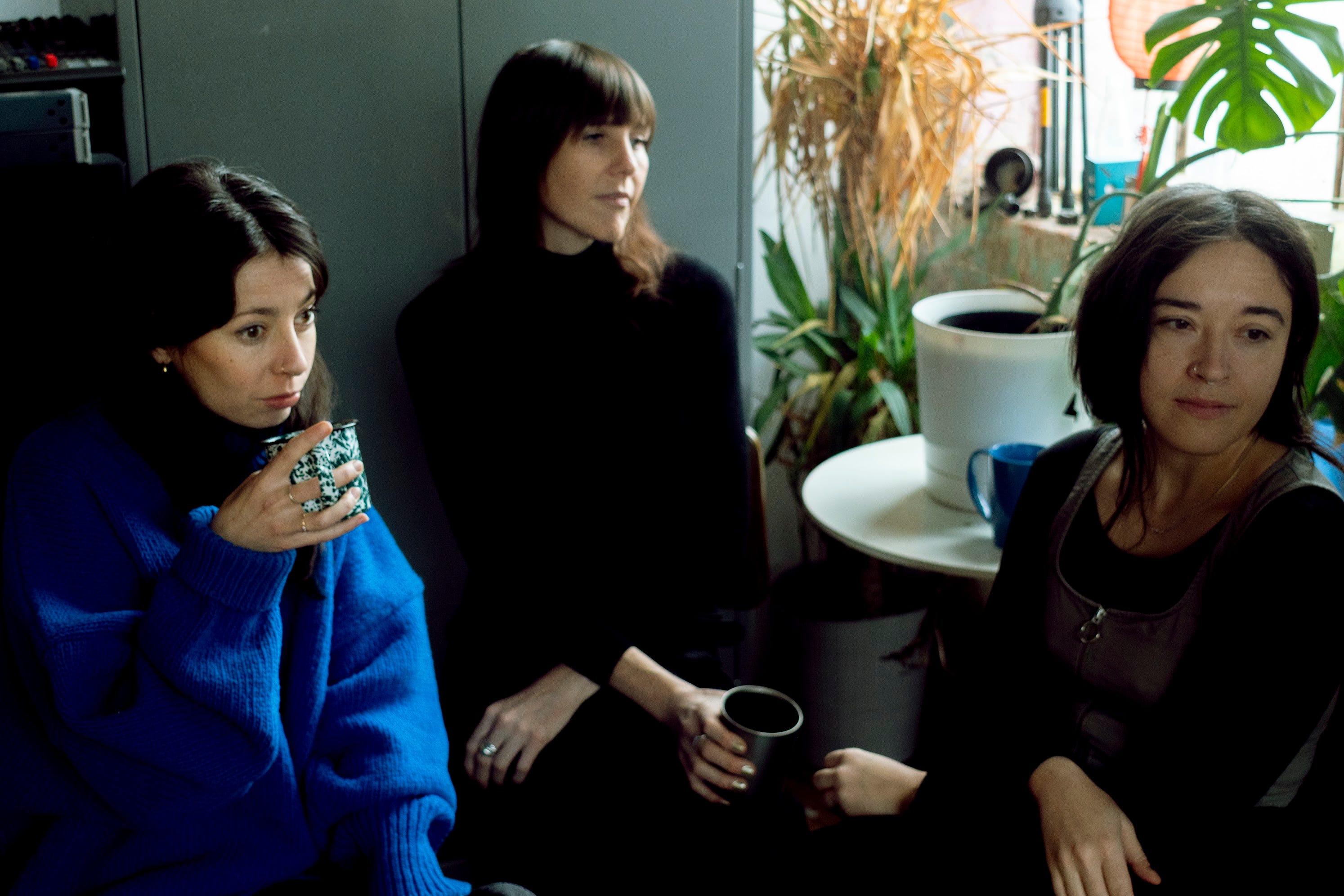
Whitney Johnson, Lia Kohl, Macie Stewart (Interview)
Today we’re listening to Whitney Johnson, Lia Kohl, and Macie Stewart, a trio of Americans musicians based in Chicago. They’ve been part of the Chicago music scene for years and first played together circa 2017. They recently released BODY SOUND, a collection of largely improvised pieces with Johnson on viola, Kohl on cello, and Stewart on violin. The pieces were recorded to tape and then slowed down, looped, and layered. We’re also revisiting two albums we previously featured by Johnson and Kohl, respectively: Hav is a sequence of minimalist and sustained synth lines; Normal Sounds builds tracks around mundane audio (tennis court lights, car alarm), suggesting music is latent everywhere. A conversation with Whitney, Lia, and Macie follows the streaming links.
BODY SOUND - Whitney Johnson, Lia Kohl, Macie Stewart (40m, light vocals)
Spotify / Apple Music / YouTube Music / Amazon Music / Bandcamp / Tidal
Hav - Whitney Johnson (40m, no vocals)
Spotify / Apple Music / YouTube Music / Amazon Music / Bandcamp / Tidal
Normal Sounds - Lia Kohl (40m, background spoken vocals on track 3)
Spotify / Apple Music / YouTube Music / Amazon Music / Bandcamp / Tidal
What’s your earliest memory of music?
Macie Stewart: I can’t tell if it’s a memory, or just a video I’m attributing to memory, but I used to make up songs on the piano as a very small child – three or four years old. I would write them on the spot and accompany myself – but to be honest it’s hard to formulate an “earliest memory of music” because it has always been around me. I have photos of me in a baby carrier on the piano bench next to my mom as she played in piano bars in Chicago. It’s been beautifully omnipresent in my life in many different ways, from my mom playing piano and singing at work, to me asking her to play me songs at home as I leaned over the piano from the couch, to banging away on my own tiny instruments at home or at my mom’s work.
Whitney Johnson: I don’t remember much from my early childhood in Pennsylvania, but when I came back to visit at age seven, my best friend Lindsay asked if I was still making up songs!
Lia Kohl: My mom went to a concert while she was in labor with me, does that count? My first actual memories are of sitting with her at the piano and singing – we had an incredible book from the Met Museum full of folk songs paired with paintings from their collection. My mom (she and my dad are both musicians) would let me pick a song and we would sing it together.
What were the formative albums/artists for you personally?
MS: My formative albums run a… wide gamut. When I was 11 I used to fall asleep listening to a greatest hits compilation of Simon and Garfunkel. I just loved those songs – but the first artist that I dove deeply into was David Bowie. My dad helped me find his whole discography, and from there I also fell in love with Brian Eno’s music and production. Kate Bush is another formative artist for me, as well as Kraftwerk – and I was also very deeply into the piano playing of Bill Evans and Thelonious Monk, and my favorite composers at the time were Scriabin and Ravel. The most formative thing for me I’m realizing as I type this out is that my parents, my friends, and my mentors, all had a very different music taste but I was deeply interested in all of it, so it helped me be open to so many different ways of making and listening to music.
WJ: One of my favorite albums is World of Echo by Arthur Russell. I’m not sure when I encountered it, but it remains a strong influence on my solo practice.
LK: I grew up listening to a lot of classical music, and I still love Haydn and Beethoven and Arvo Part. I also grew up singing in the Orthodox Church, and was completely steeped in Byzantine Chant and Carpatho-Russian chant and Georgian polyphony. I know those harmonies really affect my composition and improvisation practices. My first introduction to experimental music was The Books, in college, and I fell totally head over heels for their playful way of using tape.
What were your first compositions or recordings? What did you use to make them?
MS: As a child I used to improvise on the piano in order to “trick” my mom into thinking I was practicing the piano when I was avoiding practicing my assigned pieces. I think she knew, but was just happy I was playing. My first time I remember writing something was actually an orchestra piece for the DePaul youth orchestra I was in as a kid. It was just a string orchestra, but I wrote out a piece by hand for everyone to play, and they were kind enough to have us perform it! It was kind of monumental for me. My first foray into composition. But my first recordings were made in Garageband in the basement of my parents house. I had taught myself to play guitar, so I decided to record full covers of my favorite songs. Actually – one that stands out to me was a cover of St.Vincent’s “Laughing with a Mouth of Blood” that I made in high school. I played all the parts and tried to recreate it as best as I could. It was a good exercise in learning production/ear training/recording skills/etc.
WJ: In middle and high school, I wrote out compositions by hand on 5-line staves. Later I went into scoring software such as Finale and Sibelius, but I have a strong memory of the pencil on page. I still use Sibelius to make scores more quickly, but I prefer pencil on paper when possible.
LK: When I was really young I would make up stories and songs, and sometimes my mom would put a tape recorder nearby (with my permission), so I have some great and very weird recordings of myself as a four-year-old. A favorite is a story about a farmer visiting the Statue of Liberty with all his animals. It’s full of songs sung by cows. Once I started studying cello at age eight I didn’t really make my own music again until after college, when I started improvising. In spite of my extensive classical training, I don’t love making or reading traditional scores – I prefer to learn and teach things by ear, or make graphic or text scores.
How did you three meet? When did you start playing together, and how did you decide to make an album together?
MS: We’ve all circled around each other in various ways throughout the Chicago music scene. That’s a beautiful part of being in that city – it often feels like a small town in that way even though there is such a wide variety of music and art being created. We played our first show together in… 2017? 2018? At Elastic Arts which is a really wonderful venue in Avondale/Logan Square. It’s definitely stuck in my mind as an important performance to me, and I think the three of us all felt it. Since that moment we tried to get together at least once a year, and finally decided around 2023 that we should make this a real thing and make a record together. I just admire Lia and Whitney’s music so much – and I’ve realized how rare it is to have such a deep connection in this way, so it felt like a no-brainer to pursue this in a deeper way.
WJ: The improvised music community in Chicago is so strong, and so many of us play with one another for single shows. This trio first performed in a one-off setting but it wasn’t until more recently that we decided to make a solid ensemble out of it.
LK: There was a show sometime in late 2024 – one of these one-offs – that had a really special energy. I think we all came off stage feeling like “this is why we make music.” It’s important to follow those impulses, and we did! I think that’s when we decided to make a record.
What music (or other media) were you listening to while working on Body Sound, and which ones showed up in the work?
MS: We’ve talked about this a lot – it’s very hard to draw direct musical references for us with this record. We found that we were much more influenced by visual art, books, and textures rather than other albums. I also think very few things were intentional references and rather things we look back on and can see how they influenced us in the moment. The work of James Turrell, Pauline Oliveros’s music/practice/text scores, Irish fiddle music, The Bulgarian State TV Choir…
WJ: My listening desires are quite diverse, and I try to push at the edges as often as possible. I remember listening to a couple heavier noise records on the way to a recording session – Merzbow and Wolf Eyes – but I also gravitate toward the subtle timbral relationships in Éliane Radigue’s compositions. I don’t really listen to rock or country music, but pretty much every other genre pops up in my daily listening.
LK: I am often more inspired by visual art than by music – I tend to experience music very visually/architecturally. Magali Lara’s large scale abstract paintings come to mind as inspiration for this work: organic and intuitive and detailed. Helen Frankenthaler, Hilma af Kint. Artists who are working with bold colors and find this balance between being super exact and also very alive.
Your approach to Body Sound emphasized improvisation. Tell us about your personal experience of improvising – we imagine much of it is instinctual, but perhaps your instincts have changed as you’ve rehearsed together more or listened back to recordings.
WJ: For me, improvising is a listening practice more than a sound-making practice. The incredible percussionist and composer Jon Mueller said once in an artist talk, “It’s less about what I’m doing and more about what’s happening.” That turn of phrase really stuck with me.
LK: I love that, Whitney! Very much resonates with my own experience. Improvising is one of the most profound experiences of present-ness, for me. And all the more profound because we’re doing it together, moving through time in community. This trio is such an exciting balance of comfort, trust, and surprise. I do feel that I can rely on instinct, intuiting the choices of my collaborators in advance, but I also am so often surprised and delighted by their unexpected choices. It’s a very alive creative relationship.
MS: Yes! What Whitney and Lia said definitely resonates with me. Something that struck me is how our familiarity with improvising can extend beyond our individual string instruments and voices – and into this process of making a record. I think it expanded a lot of our shared vocabulary, and allowed us to stretch in ways we had not anticipated before making this record. Being present, listening, and making something with people you love… with anyone in fact, is one of the most profound and guiding forces in my life.
How did the final record come together, in terms of original improvised recordings versus layers added later?
WJ: Most of the tracks are excerpts of live free improvisation that we brought into the studio with the expert production of Dave Vettraino for tape manipulation and mixing. On one of the tracks, we overlaid two live improvisations that fit together well. Can you guess which one?
LK: We actually didn’t do any traditional overdubbing. All the studio magic is another layer of improvisation and composition with tape machines: running our recorded improvisations through tape machines and slowing them down, speeding them up, and looping them. But we think of everything on the record as improvised in different senses of the word.
MS: I like to conceptualize the record as layers of improvisation layered on top of improvisation, whether it is one of tape manipulation, or of two separate improvisations on top of each other, or of segments of another improvisation cut and manipulated. We had a day of cassette looping which was really fun and stands out to me as part of translating our improvisatory practice to an instrument like a tape machine where we played the four-track faders and different loops. Our process is very intuitive, so it feels like every step of the process is one where we are improvising as a group.
Name an underrated artist from the past 50 years.
WJ: I feel out of touch with the widely held ratings of artists! For instance, I love Michael Asher’s sound installations from 1969 to 1979 and I don’t hear people talking about them very often. He used architecture and acoustics with such precision and hidden speakers to interact with materials and angular reflections. Masterpieces!
What are you working on next?
WJ: It’s time for our trio to start recording some more improvisations! Just when an album is released, I realize how long it will take for another one to go through the process of composition/improvisation, recording, production, and then the material process of pressing vinyl, printing artwork, and making videos. I hope it won’t be too long until we start working on something new!
LK: We’ve talked about making something with drum machines, how fun would that be? And we’re always looking for inspiring spaces to work in – get in touch if you own an empty grain silo/cathedral/marble ballroom!
MS: Searching for interesting spaces! Interesting textures! We definitely have some ideas in mind, but don’t have anything nailed down at the moment.