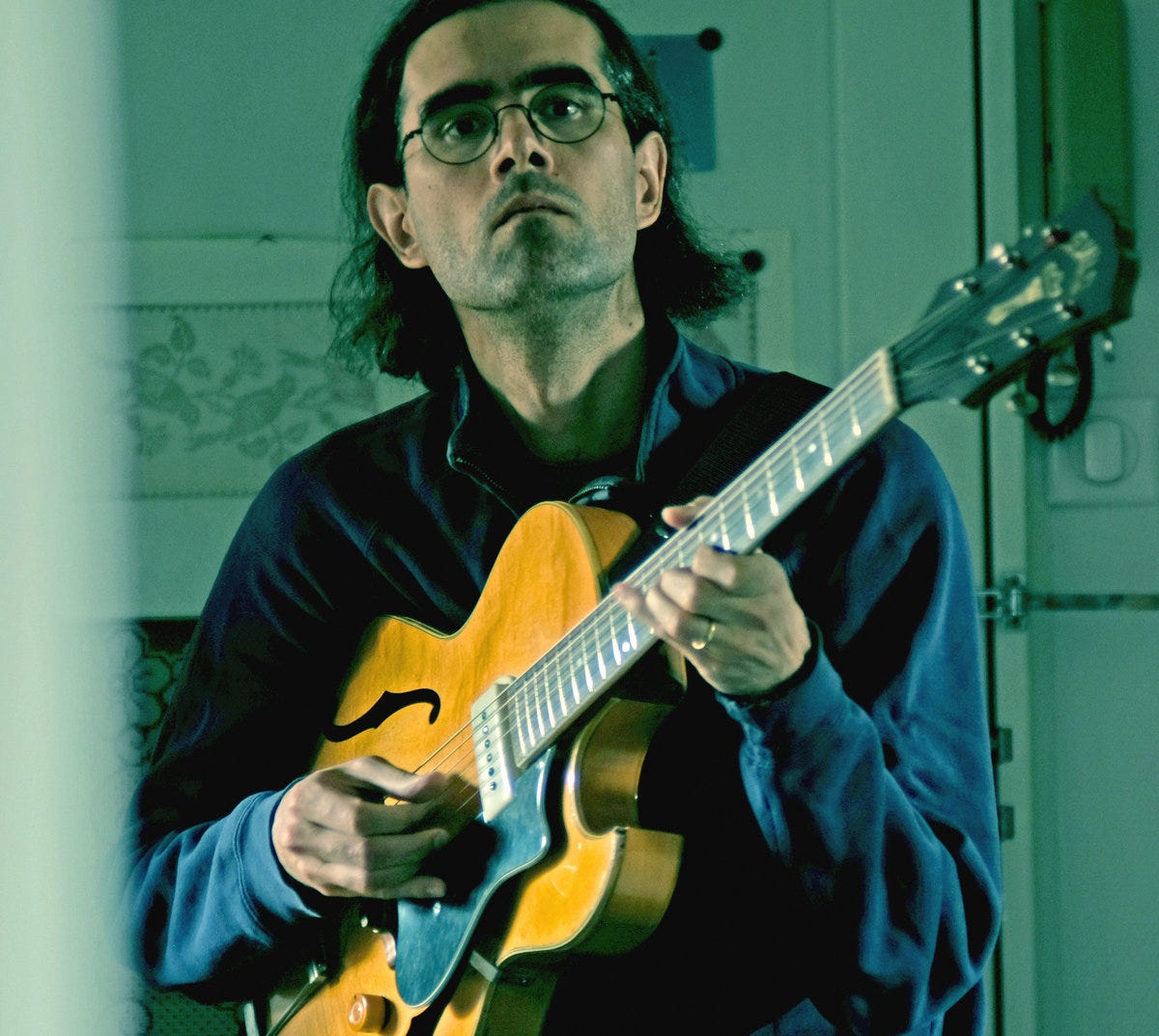
Today we’re listening to Unchained, an American guitarist from Providence, RI. Nate Davis grew up playing guitar (a ‘60s Fender Mustang) and listening to experimental noise music. When he moved to Paris in 2012, he had his “guitar and not much else,” which led him to record humble barely-modified guitar to tape, a style that defines the Unchained project. His latest LP, Frontalier, came out a few weeks ago. It’s a series of mellow jazz guitar impromptus with some drum machine accompaniments. We’re also playing his previous record Pic from 2020, which consists of stripped-down guitar recordings and occasional bass. A conversation with Nate follows the streaming links.
Frontalier - Unchained (42m, no vocals)
Spotify / Apple Music / YouTube Music / Amazon Music / Bandcamp / Tidal
Pic - Unchained (43m, no vocals)
Spotify / Apple Music / YouTube Music / Amazon Music / Bandcamp / Tidal
What’s your earliest memory of music?
My parents are musicians and performed as a classical mandolin and guitar duo throughout my childhood. I have strong memories of accompanying them on European tours as they performed in dank, cavernous medieval churches in small towns in Spain, Italy, and France, and this probably explains my attachment to plucked strings and reverb.
How’d you pick up and learn guitar? What were your first recordings like?
My dad is a guitarist and was always scoping deals on vintage guitars, so I was given a 60s Fender Mustang for my eighth birthday. I was just playing power chords at first but began learning jazz and fingerstyle guitar as a teenager, partly through lessons but mostly self-taught. The first original music I recorded as a teenager were experiments using the SoundEdit 16 wave-editor program on the family Mac desktop, cutting and pasting samples of bass and piano recorded with the computer mic. This was in the late 90s and I posted some primitive electroacoustic and IDM tracks on a site called MP3.com. My first proper CDR and tape releases came in college after I found the noise scene in my hometown of Providence and started a project called Knifestorm based around a trio of test oscillators that I would run through a no-input mixer.
What artists/albums most inspired your musical sound early on?
In the first Unchained releases in the mid-00s I began integrating guitar back into my noise setup, and while I was responding to peers like Kites and Forcefield, I was mostly listening to psych and prog records. Some early Unchained recordings and concerts sounded like Blue Cheer or Pescado Rabioso processed through a wall of harsh noise, but there were also calmer moments in the vein of Vibracathedral Orchestra or the Skaters that were digesting the influence of acid folk like Maitreya Kali and Agincourt. Over subsequent years it was like I was gradually turning down the gain, filtering out the noise and revealing a slightly fried musical romanticism.
Tell us about your move to France, and how that affected your music.
I moved to Paris in 2012, and at first I had my guitar and not much else, so I began recording pared-down guitar compositions direct to 4-track or computer. The separation from U.S. scenes allowed me space to carve out a new musical practice that integrated influences of jazz, Brazilian MPB, and ethereal guitar rock like Felt. The music I made then (N.D. Visitor up through Pic) reflects this approach, as well as a kind of impressionistic aesthetic of nostalgic European melancholy that I cultivated on long walks around Paris or road trips in the Massif Central.
You use “experimental recording and mixing techniques” – tell us about those. What instruments/gear do you use?
I like it when recordings of jazz and instrumental music have weird or interesting sonic characters that bear the imprints of the recording process instead of a clean, neutral studio sound. On earlier releases I achieved this through amateur and willfully lo-fi recording and mixing practices (recording to tape, editing with Audacity), or like playing a drum machine through a guitar amp and recording it with a room mic with the windows open. I have upped my production game on more recent recordings (especially the new LP, Frontalier) with slightly more professional small-studio techniques to emphasize grain/texture in more controlled ways. For example, I use compression and saturation later in my signal chain to shape the background textures of pickup noise, amp hiss, and reverb tails to create an atmosphere that one listener described as “humid.” I think my noise years instilled a focus on pure sonic texture that remains with me even when I am basically playing solo jazz guitar.
Name an underrated artist from the past 50 years.
Since Lô Borges just died, I would say the entire Clube da Esquina scene from Minas Gerais. Milton Nascimento is a star, but the group as a whole deserves more attention outside of Brazil. I am constantly stunned by the sheer beauty and ingenuity of records by Lô, Milton, Beto Guedes, Toninho Horta, Flavio Venturini, Fernando Oly, and others. They were able to absorb a huge range of influences from global popular music and distill it into such a novel, earnest, and profoundly moving collective musical practice. Lô and Toninho were especially important influences on how I approach chords, melody, and songwriting on the guitar.
For jazz musicians, I would mention Monk Montgomery (older brother of Wes), who was the first electric jazz bassist and also one of the first to use bass as a lead instrument on his 70s solo records.
What are you working on next?
The Berlin synthesist C.D. Noé and I are working on an album of bass- and synth-led instrumental pieces, and I’m collaborating with producer Pieter Kock on some weird balearic guitar tracks under the name Sports Café. In my solo work, I want to continue experimenting with the MIDI-jazz mode I got into in the title track from Frontalier and incorporating bass more as a melodic element. In 2026 I’m excited about a possible Japan tour with the Stern Records crew and working out a live set playing as a duo with a drummer.