

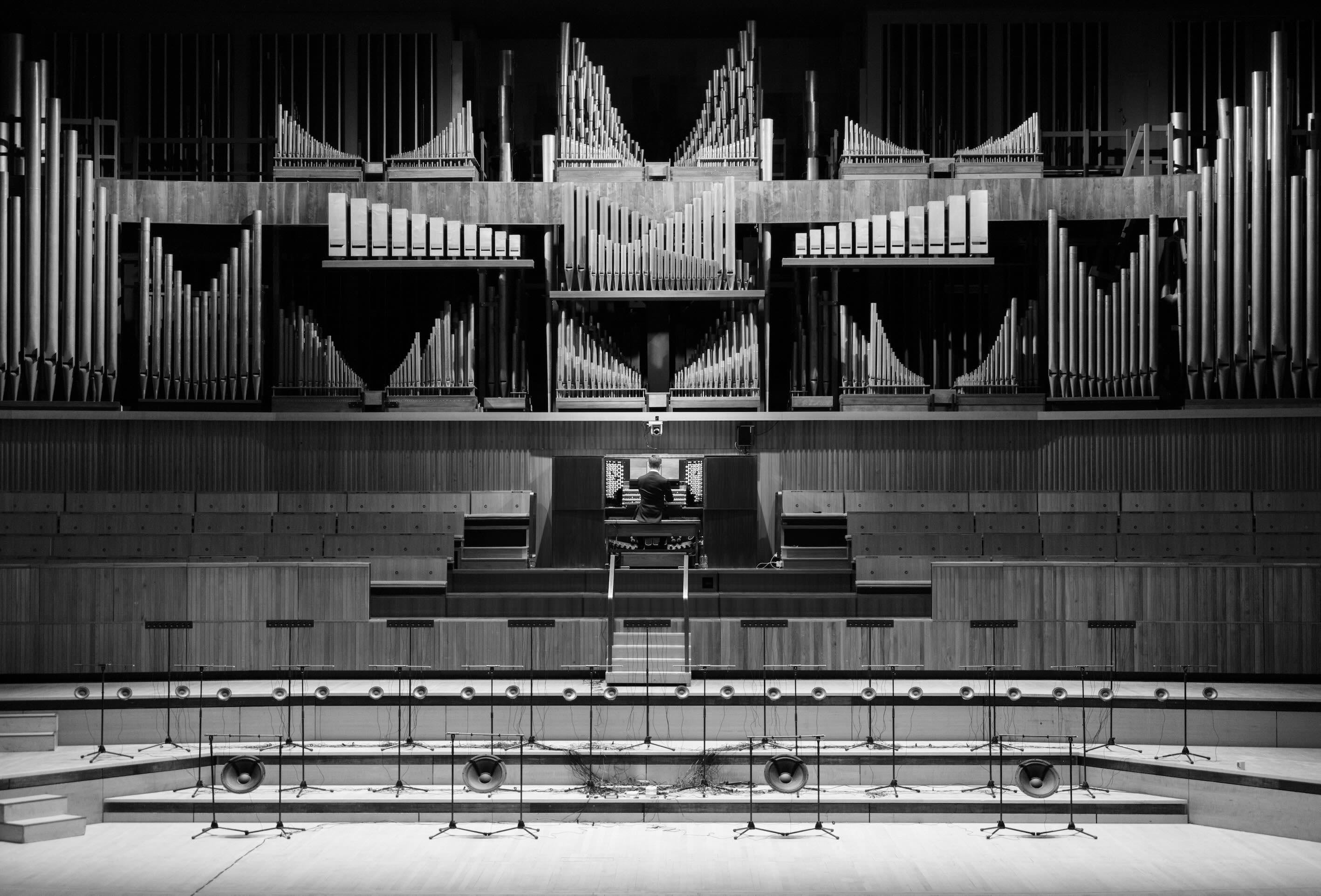
Today we’re listening to Tristan Perich, an American composer from New York. In his house growing up, his parents played a lot of Philip Glass, especially Einstein on the Beach, he told us. Perich studied math, music, and computer science at Columbia, three elements that interplay in his music. He composes for acoustic instruments and 1-bit electronics played live through speakers. His latest record, Infinity Gradient, is a collaboration with organist James McVinnie. It was recorded in London’s Royal Festival Hall on a pipe organ and 100 speakers (see image). It’s a radiant, ecstatic album evocative of Glass (Koyaanisqatsi to our ears). We’re also playing Perich’s 2020 album, Drift Multiply, composed for 50 violins and 50 loudspeakers. A conversation with Tristan, primarily about Infinity Gradient, follows the streaming links.
Infinity Gradient - Tristan Perich & James McVinnie (61m, no vocals)
Spotify / Apple Music / YouTube Music / Amazon Music / Bandcamp / Tidal
Drift Multiply - Tristan Perich & Douglas Perkins (70m, no vocals)
Spotify / Apple Music / YouTube Music / Amazon Music / Bandcamp / Tidal
What’s your earliest memory of music?
The soundtrack of my early memories of childhood is Einstein on the Beach. My parents listened to a lot of Philip Glass when I was young, and I believe I already knew it in the womb. It basically defined what music was for me.
How did you meet Jamie and what was your collaborative process like?
Our collaboration was already set in motion over email by the time we met in person. When we finally got coffee together in NYC, we talked about the pipe organ as an instrument that extends to the building itself, its similarities to 1-bit sound, and the meaning of technology. It was like we had been thinking about the same things but approaching them from two ends of a spectrum. From then on, I worked on the music, sharing ideas with Jamie, which he always played with incredible ease! It’s always a dream to work with musicians like him.
How did your earlier pieces lead to the composition of Infinity Gradient?
Infinity Gradient connects threads from my entire life, from my early composing to my work today. When I was younger I had the opportunity to play on a pipe organ occasionally, before I even started working with electronics. So perhaps everything I’ve done has echoes in it. Harmonic accumulations from my piece Active Field (10 violins, 10 speakers), frenetic shifting movement in Dual Synthesis (harpsichord, 4 speakers), low wind stasis from Telescope (4 low wind instruments, 4 speakers), hocketing unisons from Dimensional Bloom (two pianos, 2 subwoofer speakers). Maybe works like that become studies for these larger pieces like Open Symmetry, Surface Image, Drift Multiply, Infinity Gradient.
Tell us about the construction of the sonic environment (organ and 1-bit electronics), what your first experience of the sound was, and how that space shaped the music.
In terms of the electronics, Infinity Gradient is by far my largest project, the first time I worked with 100 speakers. The largest before was Drift Multiply, for 50 violins and 50 speakers, so it required redesigning and rebuilding my circuitboards for the extra channels and the extra volume. It also is the first time I used these pitch-bending glissandi in the electronics, and that required reprogramming the code. This took a certain amount of time, and it wasn’t until all the code was updated, and I plugged in all the speakers into the new circuitboards and tested that musical idea that I heard it realized. It was awesome, and I knew then that the music would work.
How do you discover new music these days? Any notable recent finds?
I’m trying to see more live shows, especially smaller ones where the work doesn’t need to be as polished and can be more experimental. Christopher Otto’s microtonal string project layered with live string quartet at Public Records for instance. Also seeing other shows at festivals, if I can carve enough time out from my own show prep. Works that stand out are Catherine Lamb’s string quartets with JACK quartet at Big Ears, Gábor Lázár’s solo set at Sonica in Ljubljana, Sophia Jani at Bang on a Can, Clara Levy’s duo at Musica in Strasbourg, Guillaume & the Coutu-Dumont’s zany live performance. Online I’ve been enjoying Molly Herron, Sylvan Esso, Beverly Glenn-Copeland, Kilo Kish, H-Fusion, Carlos Giffoni, Cosmo Sheldrake, Riton + Kah-Lo, The Kiffness lol…
Name an underrated artist from the past 50 years.
Honestly all I wish for is another album by Mark Fell’s side duo SND.
What are you working on next?
Smaller projects! I’m working on some string quartets with significantly less than 100 speakers, and a project for solo bass clarinet in a sea of white noise. And I’m working on the next 1-bit circuit album. Those are a series of projects that I release as a circuitboard with a headphone jack. Those projects continue to be interesting to me because they can be performances in themselves.
I would not have ever thought of 'bright and bubbly' and pipe organ until after listening to 'Infinity Gradient'. Reminds me of 'Rainbow in Curved Air' as much as it does Philip Glass. It circles around but also has motion, traveling in and out of timbre and texture.