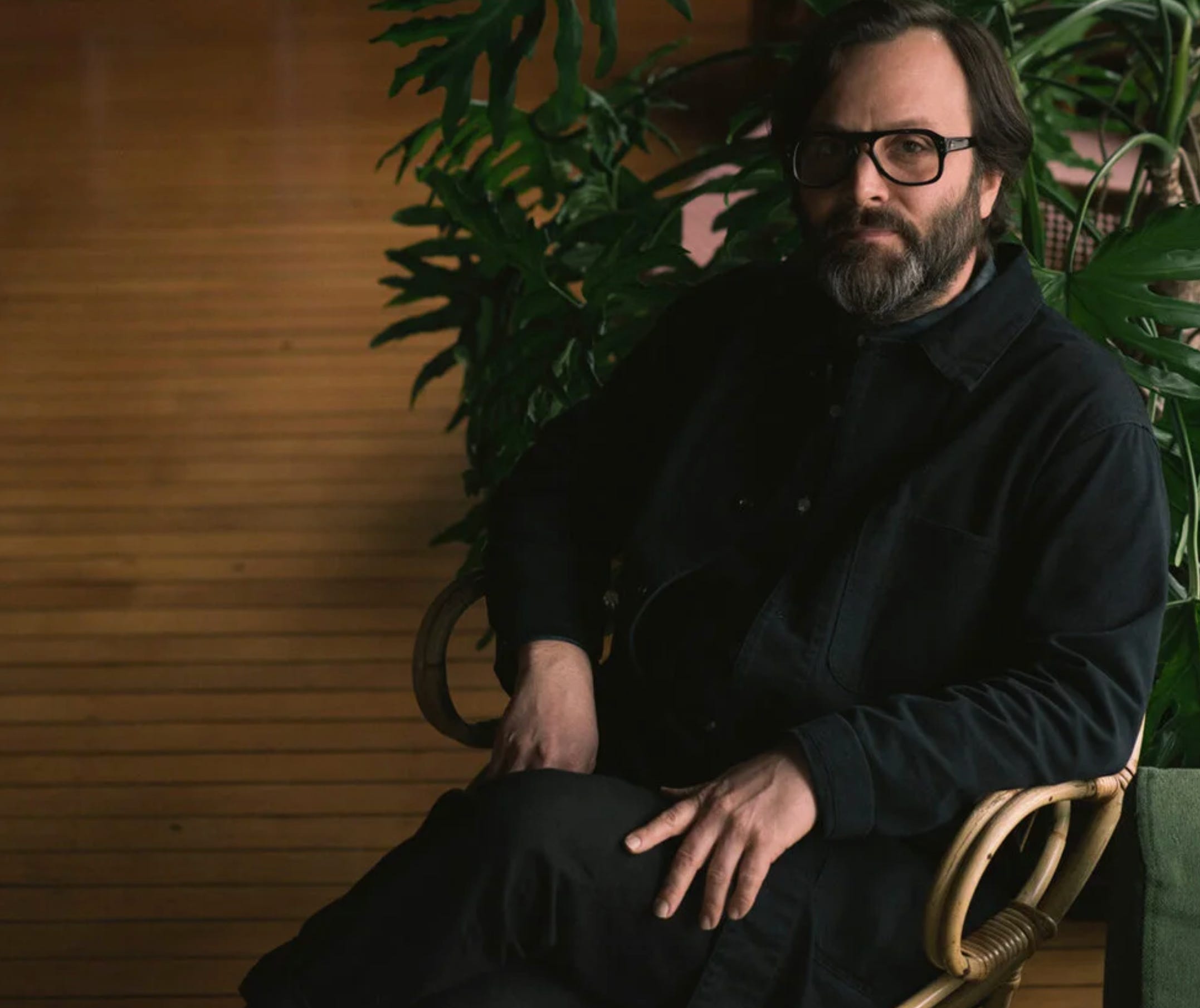
Today we’re listening to Stuart Bogie, an American clarinetist and saxophonist from Illinois. We previously featured his music along with a chat in 2023. The occasion was the release of his album Morningside, two clarinet improvisations over ambient synth tracks provided by James Murphy of LCD Soundsystem. Those pieces came from a morning ritual Bogie began shortly after covid hit. He expanded the ritual in 2024 when he linked up with organist Buck McDaniel. Since 2024, the pair have played regularly and put on annual fall shows called November Variations, which have been released as standalone albums. We’re playing two of those variations today, one from 2025 and the other from 2024. This November they’ll be performing them again. A conversation with Stuart follows the streaming links.
November Variations (2025) Monday 11/17/25 - Stuart Bogie & Buck McDaniel (38m, no vocals)
Bandcamp / Spotify / Apple Music / YouTube Music / Amazon Music / Tidal
November Variations (2024) Wednesday 11/13/24 - Stuart Bogie & Buck McDaniel (32m, no vocals)
Bandcamp / Spotify / Apple Music / YouTube Music / Amazon Music / Tidal
You’re performing with Korey Richey of LCD Soundsystem and comedian Rory Scovel soon.
Korey, Rory, and I have a performance in Denver. We’re going to start workshopping this collaborative improvisational process. We rented a warehouse. The show’s sold out. It’s an exciting collaboration. There’s something so fulfilling about the power of a musical texture. If somebody steps in and just starts illustrating narrative and dramatic and comedic possibilities that exist within it.
I can remember – even if the music is campy or corny or something, as soon as somebody joins it with a narrative context, it can become very affecting. Like if you think about cheap horn samples, some of the hardest music I’ve ever heard has like [horn noises]. It sounds so hard, and it’s like a cheap trumpet patch.
I love to hear music recontextualized. The more true and honest and heartfelt the music is, the funnier it will be. In the same way where when you watch a great standup comedian do an incredible impersonation, it feels hysterical because there’s a virtuosity to the authenticity.
What instruments are Korey and Rory playing?
Korey is doing electronics and guitar. I’m doing woodwinds and electronics. Rory is doing vocals, like comedic – theatrical vocals. We’re exploring different technological possibilities. We’re really just starting off. This is a one way ticket we have together.
And November Variations is in the works.
We’re releasing all of these November Variations from last year again. I’m thrilled with how they turned out. Fritz Myers tweaked the recording process, put some mics in different places, and the fact that we’ve been working together for a year since the first one – you can really hear all of those things in the music. It’s almost like a little miniseries. Like a television miniseries where one thing happens after the other. Over the course of the week it’s like five symphonic movements, with the penultimate one being this depths-of-serenity one and the last one containing the most speed and virtuosity. There’s one in the center that feels kind of angular and confrontational. They all have different aspects and colors. As in the first series, Buck’s motivic stuff – his recurring themes and his memory for melodic information – is fantastic. It gives everything a strong focus.
How did November Variations come about?
Fritz Myers, who produces the event, introduced Buck and me. Fritz is my manager, and early in our relationship, he was like what do you want to do? I said I want to find a place where I can play at 9am every day of the week in a public space. I wanted it to be near my kids’ school, so I can drop them off at school and go and play in front of people, but not necessarily people who expect to see me play. He introduced me to Buck McDaniel, who’s the organist and music director at a church not far from where my kids go to school. We connected immediately musically and artistically and as friends. The music immediately began to unfold from the very first chords.
That came out of your daily playing on Instagram after covid started.
Yes. Also, in my career, I’ve often focused on making one thing and then putting it away and reinventing a whole other thing to do. I go from far extremes one to the other. Before covid, I started looking at art more. I saw this series at the Guggenheim where they show a bunch of works by a particular artist – I saw this series by the sculpture artist Giacometti. I was struck by all the subtlety that emerges when you see someone doing something similar over and over and over again. I went to an exhibit of John Zorn’s sketches, and I thought about his work, how he will exhaustively go through all the little permutations of a subform. It’s beautiful to watch him investigate every corner of these worlds he takes on.
I realized that, in my own way, I needed to have a more repetitive process. I needed to go to the same well for water every day. Through doing that, I’ve gotten a whole new understanding of things, something that I thought was just one approach is dozens of approaches. If I use a rhythm in one piece, now I can use that rhythm in a hundred.
Last time we spoke, you talked about Eno and Indian classical as influences. Was there other music that influenced the daily series?
I have a teacher named W.A. Mathieu. He has a book called Harmonic Experience that I read for years and then in the pandemic, I started studying with him over Zoom – specifically the harmonic lattice, as he describes it. That went to work on the way I play music and the way I understand music.
What did you learn from that?
It increased my understanding of the relationship between the harmonic series, pure intonation, pure ratio, harmonies, and the equal temperament system. I learned a way of moving through different modalities, maintaining the same tonality – what he calls dronality. It’s something that I think most people who’ve taken a long listen and worked on this kind of music experience. His way of describing the subtleties and the tendencies in the melodic and harmonic activity really fit me to a T. It really spoke to me, and I gained a deeper understanding of things, I think. I’m still working on it.
One day he said to me, “Stuart, there’s no success in this. You’re not going to win music.”
It’s an infinite game.
He saw me being hard on myself and he tried to take the pressure off. It’s a beautiful practice studying these things.
Any artists or records that stuck with you in recent years?
Yeah, for sure. I’m always going to back to ‘90s hip-hop. I love all the layering. I love the line of dissonant sound and the looseness of it. I’ve also been working with a looper a lot, so I’m thinking a lot about DJ Premier and El-P and Erick Sermon. Some of my favorites are probably Jeru the Damaja’s The Sun Rises in the East and Gang Starr’s Hard to Earn. Those two records are fantastic, I can’t get enough of them. Nas’s records, anything Q-Tip does.
Gang Starr wasn’t the first artist I’d thought of as an influence, but Oneohtrix Point Never said their track “Robin Hood Theory” had a huge influence on his looping and sampling.
There’s a trial and error in the composition process that is so rigorous – so deeply rigorous that the results are always one of a kind.
You can’t plan the beat or the composition in advance.
You have to have the sound at your fingertips. Music is so elusive. That’s what’s incredible about it to me, because if I listen to something for an hour, I might love it. If I listen to something for two hours, maybe I’ll stop loving it, or I’ll start to doubt its beauty. Maybe the first time I hear it, it hits me sideways. So how do you preserve your sense of what you’re hearing? It’s incredible, I’m in awe of it.
How did you start playing professionally?
In college I had a band with the drummer Andrew Kitchen and the bassist Eric Perney and the saxophonist Colin Stetson. We had a quartet called Transmission, and we would play around Ann Arbor and Detroit. We made it all the way to the Knitting Factory in New York, which a new music Mecca for us. It was a dream come true to play there.
Then I moved to San Francisco, and then Chicago for about six months, and then I moved to New York in 2000. After moving here, I joined a band called Antibalas and I fell in love with the music of Fela Kuti. And I learned to play the saxophone, in order to play that music. The first sound I went for was an afrobeat sound. I bought one of Colin’s old alto saxophones. He stayed in San Francisco. (When I was there, there was no point in me playing a saxophone.) I was working a job in New York, and I got laid off, and I had some time on my hands. So I started learning saxophone. And then I joined Antibalas through a mentor of mine named Michael Herbst, who was an early member of the group. The band was wonderful. They handed me a tenor saxophone and said, “Play this.” I got right to work. For the first time in my life I found I had an aptitude for a certain musical style.
You hadn’t experienced that before?
No, I had always struggled. I couldn’t play jazz, I couldn’t play blues. I wasn’t that good at classical music. I had gotten through musical school and everything, but one of the things I learned in music school was that I’m not good at playing other people’s music. But I hadn’t played Fela’s music yet. When I found Fela’s music, for the first time in my life I felt aligned. He’s an incredible figure.
A few years ago, I went to Lagos and visited the shrine. I performed there with some of my friends from the Antibalas world. The singer Amayo brought us there. He’s the old singer from Antibalas.
The last question, which is usually the first question, is what’s your earliest memory of music?
A lot of ideas I would feel would come out in little songs that I would sing to myself. I remember picking out a Rush record from the department store because it had a doggy on it. I was a little kid and I was like, “Ooh, doggy on the record.” So I wanted that.
The most interesting early memory of music I had was being captivated by a song called “Jam On It” by a band called Newcleus. It planted the seeds for the sort of rhythmic interplay – it set me up to love electric Miles, funk music, electro, hip-hop. It’s an incredible song. I listen to today and get so fired up when I hear it. I’m still chasing the dreams that this song gave me as a little boy. I remember in my school one of the breaking crews had a strobe light and their shadows were cast on the wall. They were doing these fantastic dance moves. I was eight years old, they were all 12 and 13, dealing with the dance floor in a beautiful way. It thrilled me. Also in that song there was a vocoder (I think), and I loved that. I love the robot sounds.