

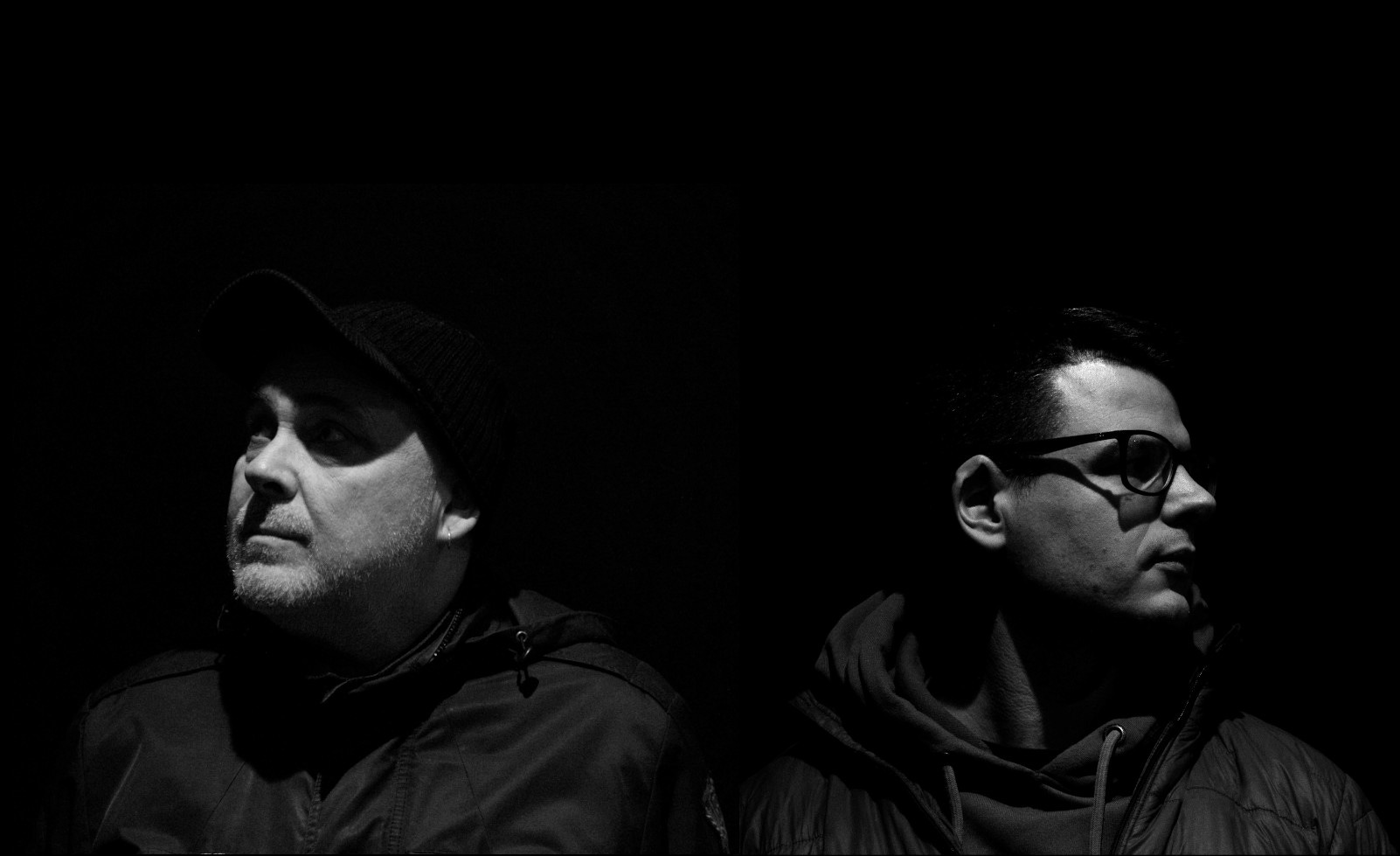
Today we’re listening to Marconi Union, an English electronic group from Manchester. Richard Talbot and Jamie Crossley met in a record shop and formed the group in 2003, later adding Duncan Meadows as a third member; Talbot later stepped away. Their music started out as electroacoustic, with Talbot composing synth pieces and Crossley layering guitars over them. Their sound has shapeshifted over the decades, with their omnivorous listening habits influencing their sound in various directions, including post-rock, ambient techno, dub, and more. Within their discography is a series called Ambient Transmissions, whose three volumes came out in 2011, 2012, and last month. Multiforms is the third volume, taking an Enoian approach to contemporary ambient, with thought-provoking synths and impromptu activity thereupon. We’re also playing the series’ second volume, Weightless, whose first part has been studied by researchers for its clinically observed relaxation properties. You can try this study at home. A conversation with Crossley and Meadows follows the streaming links.
Multiforms: Ambient Transmissions, Vol. 3 - Marconi Union (42m, no vocals)
Spotify / Apple Music / YouTube Music / Amazon Music / Bandcamp / Tidal
Weightless (Ambient Transmission Vol. 2) - Marconi Union (43m, no vocals)
Spotify / Apple Music / YouTube Music / Amazon Music / Bandcamp / Tidal
What’s your earliest memory of music?
Jamie Crossley: Probably at primary school 5/6 years old. One of our teachers played the acoustic guitar and he would sing us folk songs that we all sang along with, of course I didn’t know at the time but we were actually singing songs of Bob Dylan, Donovan, and Pete Seeger.
Duncan Meadows: My Dad had a Bix Beiderbecke cassette in the car when I was young, though I can’t remember how old I was. There was music before then but nothing I have specific recollections of, though it would have been classical music as that was what was generally played at home. My first memory of live music was hearing Bach being played on a church organ when I was five.
What were your first recordings like? What did you use to make them?
JC: Our first album was recorded on an Akai DR16 which I acquired from a previous band I’d been in. Richard would create various textures and burn them to CD, then I would start to build the rhythms and music around those textures, using electric, acoustic, and bass guitars. Programming the drums using Cubase triggering an Akai S3200 sampler and a few keyboard plugins. Most of it was just played live with a little editing, I’ve always liked the combination of electronic sounds with “real” instruments and still apply that to our music now.
What were the albums/artists early on that most pointed you in the direction of your sound?
JC: Me and my friend who was older than me use to write music together and he would play me lots of albums introducing me to likes of Miles Davis, Penguin Cafe, Harold Budd, Bowie’s Low and “Heroes,” Beach Boys’ Pet Sounds. I guess that’s when I started thinking and hearing music in a different way.
DM: Similar to Jamie really. In A Silent Way showed me the less is more approach. Aspects of Steve Reich and Philip Glass also had an influence.
You’ve always been interested in ambient music, and you’ve taken detours into post-rock, ambient techno, dub, and more… How do you feel your musical output has evolved over the 20 plus years you’ve been making music as MU? What experiences, if any, stick out to you as catalysing certain moments of change?
JC: I think our development has been a natural process really. When you have an eclectic taste in what you listen to, that must influence you along the way, subconsciously or consciously. I think all of the genres you mention have appeared in all our albums one way or the other. The melody, chord structures, etc. are just the natural aspect to how we play and I think that’s what bonds all our albums and gives us our sound and identity.
DM: I’d just add that for me personally playing piano to a track called “Blue Lights” that we wrote with Giorgio Li Calzi was an significant point in time. The piano was semi-improvised and it was the first time I contributed creatively; it was the moment where things clicked for me.
What’s your current studio setup? What instruments/gear/software do you use to make music now?
JC: We are currently using Ableton to trigger midi to various bits of kit, Moog, Prophet, Electron, etc., and that all comes back through an Audient mixing console. I’m not precious about equipment and never have been. I don’t get attached to gear like some do, it’s just a means to an end for me. The computer is becoming less important to our writing and is now being used more like a tape machine. In some ways I’m getting back to how I first started to make music, mixing through a console and looking less at the screen.
DM: Over the last few years I’ve sold most of the hardware gear I had at home so now everything I make is done at the studio through the Audient. I don’t use software at home either anymore other than to try things out. I have an upright piano at home which I play and sometimes write on (and occasionally record). All I have is the gear I use live, a Nord and Novation Peak. I like the simplicity of that set up.
How does it feel to have made the most anxiety-reducing track of all time as proven by science?
JC: It’s not something I think about really and it’s certainly not a claim that we would ever have made.
DM: It’s a track which doesn’t feel as though it belongs to us really. We didn’t write it thinking it was a particularly important piece of music, but I understand that for some people it has a significance.
Name an underrated artist from the past 50 years.
JC: Apart from ourselves (ah ah), it would have to be one of my favourite bands from Manchester, MAGAZINE.
What are you working on next?
JC: Nothing specific, just more music.
Love love love Marconi Union - thank you for this.
Marconi Union are definitely one of the most underrated electronic bands. Every album has been quite different and superb in its own way. Massively under the radar. They never compromise or play the industry game.