

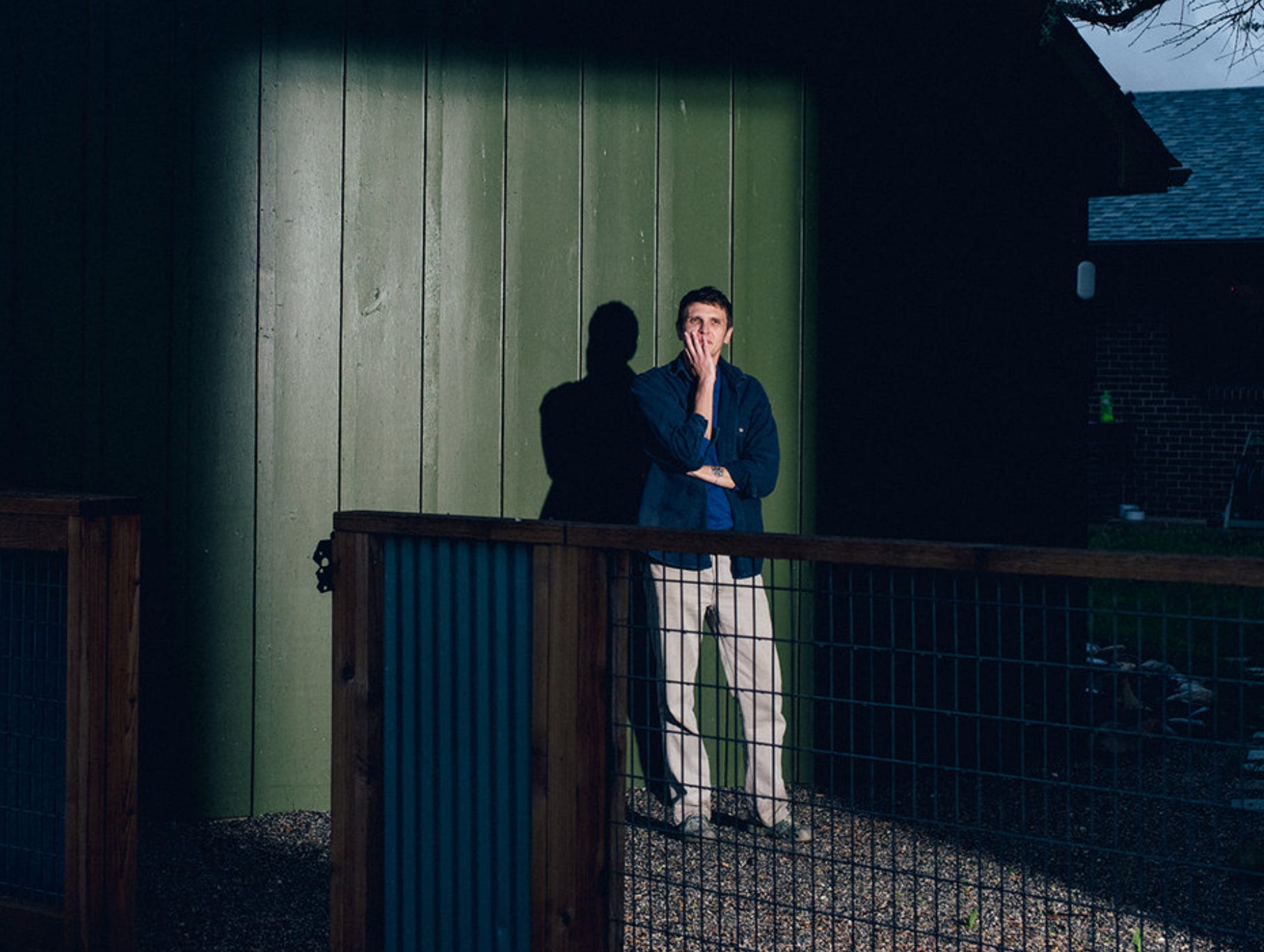
Today we’re listening to M. Sage, an American multi-instrumentalist and composer from Colorado. He got a drum kit at age seven and then picked up bass, guitar, synths, and more somewhat serendipitously. After getting the internet in high school, he discovered “Godspeed You! Black Emperor, Black Dice, Lightning Bolt, Tortoise, Rachel’s, and Stars of the Lid all in like a one month span of time,” he told us. He started putting out his own music in the mid-2010s; he typically plays all the instruments, laying down peaceful one-man jam sessions. His latest record, Tender / Wading, just came out on Friday and was recorded in and around the Colorado farmhouse he recently moved into, after years living in Chicago. We’re also playing his 2023 record, Paradise Crick. Both records convey a kind of “radical softness,” as he put it, with the music blending with field recordings from his environs. A conversation with Matthew follows the streaming links.
Tender / Wading - M. Sage (43m, no vocals)
Spotify / Apple Music / YouTube Music / Amazon Music / Bandcamp / Tidal
Paradise Crick - M. Sage (40m, lyricless vocals on track 6)
Spotify / Apple Music / YouTube Music / Amazon Music / Bandcamp / Tidal
What’s your earliest memory of music?
I very vividly remember “Don’t Worry, Be Happy” by Bobby McFerrin getting stuck in my head as a really young kid, like age 2 or 3, and driving my family crazy singing it for several days on end.
When did you start playing instruments – which ones, and how did you get started with each one?
My grandparents got me a muppet babies drum set for Christmas when I was very young and it kind of set a tone for the rest of my life. But I didn’t really start playing instruments with any kind of intention until I was 7, when I got a real drum set. It was a Pearl kit, and my parents got it for me shortly after I was diagnosed with type 1 diabetes because I nearly died and I think they wanted to make me feel seen and heard and lean into things I liked. In junior high I got an electric bass and took lessons (the only formal musical training I’ve had) for a few months to learn scales and stuff. We had a piano in our house when I was in junior high too, which the previous folks left behind when they sold us the house, and I spent a lot of time playing on that piano, but never really formally, just having fun plunking around. Guitar happened in high school… and friends in my early bands had synths and things that I started to tinker on. My parents’ basement became a kind of practice space free-for-all – they were very supportive of my musical endeavors and let me and all my various punk band friends practice there – and a lot of gear was left there between practices, so after band practice I would hole up and play the gear my friends and bandmates had left behind.
I don’t think I am the kind of musician that plays any one instrument especially well, but more that I just like to play instruments. Any and all instruments. Whatever I can find I have fun learning and trying.
What were the artists and albums that pointed you in your personal musical direction?
My older brother was into grunge and heavy rock from the 90s, and that had a huge influence on my earlier taste, which led me to stuff like Green Day when I was in elementary school. I grew up in Evangelical church, so that meant I grew up around Christian bands (though I also listened to lots of secular music too). I got into this wild Christian horror punk band Blaster the Rocket Boy / Blaster the Rocket Man in 8th grade or so, and that felt really pivotal in discovering DIY culture, seeing artists make bold choices, and also… those Blaster records have some wild sound design and strange narrative moments and stuff throughout. The Monster Who Ate Jesus is a wild ride.
In late junior high and early high school I gained access to early internet and fell into websites like Epitonic and file sharing spaces like Soulseek and that is kind of when my eggs got cracked. I remember discovering Godspeed You! Black Emperor, Black Dice, Lightning Bolt, Tortoise, Rachel’s, and Stars of the Lid all in like a one month span of time. I think that was sort of the deciding moment for me discovering my musical identity. Colorado has a pretty strong counter culture, but it is very punk oriented, and thanks to the internet I could hang with the punks and counterculture, but listen to music that I found a bit more engaging. Nothing against punk… I just didn’t really feel moved by a lot of the punk music that was dominant in our little college town music culture here.
I always kind of entertained a rookie’s interest in jazz, but when we moved to Chicago in 2014, I really had a chance to fall in and explore jazz, and that felt like a gateway to me finding my place now where I absorb jazz and improvisation influence, mix it with punk spirit, and mash it up with DIY post rock/classical/ambient/electronic stuff.
You grew up Colorado and recorded the new album there. Tell us about your relationship with that place and how it may have affected Tender / Wading.
Colorado is a beautiful place, but like all beautiful places there are drawbacks. I love the landscape here; the Rocky Mountains are special, and I am really thankful to have grown up with their rugged intensity. It feels like all of the seasons are turned up a few notches compared to everywhere else I’ve visited. Summers are hot, autumn is colorful, winter is cold and bright, spring is super dynamic.
But Colorado is super culturally isolated. Denver/Boulder is our main hub, and they have stuff happening there, but we are 7-10 hours from almost every other major city. It kind of feels like an outpost between the midwest and the west coast here, and for that reason it can feel a little stuck or isolated. I think my 8 years in Chicago informed my understanding of art and culture so much and it was a little bit of culture shock to move back to Colorado and feel a little bit like an alien here.
I think that is kind of at the heart of the record; the human scale of the landscape here has changed while I have been gone – Colorado is undergoing a pretty intense development – but also the mountains haven’t perceptibly changed at all. In that way, I changed kind of intensely in my 8 years in Chicago, but I also came back and felt in touch with this place still. This kind of stasis and dynamism is at the heart of the album.
You’ve been putting out LPs for over a decade now. How has your sound and musical approach changed over that period of time?
I think in part due to how I interacted with so much of the music culture I loved – predominantly online – I kind of assumed the role of making music for the internet. What I did wasn’t super well received or understood in my home town, or even in Denver really. So, I made stuff at home in whatever studio arrangement I could put together, and then put it on the internet.
Moving to Chicago made me think very differently about all this, and I think it also had to do with the fact that I’ve been doing it for so long, so I could let my own maturation inform my process. I grew up as an artist by living in the arts community in Chicago and being able to slow down, feel more and think more, explore, see a lot of wonderful stuff, and most of all just kind of feel like I fit into the arts community there.
I used to crank out records and post new stuff to my bandcamp almost serially. It felt necessary to make quickly, ferociously, and to share everything I made. That was the only way, it felt, to get ears on my music where I was when I was growing up.
I still love to make constantly, but I am leaning into the power that not sharing can have. I still record and play almost every day, but I spend a lot more time refining, curating, reworking, or just playing instead of sharing what I am working on. I think it had a huge impact on my sound and approach, and I don’t think it’s easy to pinpoint exactly why.
What was your studio setup for Tender / Wading? What instruments/gear did you use to make the album?
When we moved into our house out here, the former tenants left behind a piano (an echo of that same experience I had in junior high I guess!). It is a Hamilton piano, made in Chicago, from the early 1900s. There was a beat up old pole barn from the 1970s that my buddy, a great contractor, helped convert into a studio space for me. The piano was moved in, and from there I kind of just unpacked and installed my studio gear. That old piano is the heart of the record.
There is a great flea market in the small town near our house and I got a YCL-20 Yamaha clarinet there. That became my go-to instrument to bring around the property with me while I was working on projects or taking breaks.
The piano and clarinet are kind of the elemental fundament that I built the album around. I use my usual tricks to add color and depth and texture. I have a Moog Matriarch that is, at least right now, my favorite synthesizer. I used the Matriarch a lot. I also rely heavily on a Crumar Mojo, a great hammond organ emulating keyboard that also has a really really nice rhodes piano voice. I have a Korg OPSIX fm synth too that I really love. I have a eurorack modular set up that is mostly built around granular synthesis and sampling – QuBit Nebulae and Stardust – and signal processing. I used those a lot to warp and smash and flutter everything. I don’t really write on modular, but I love to write a set of changes on the piano and then come back in with synths and electronics and add color and texture to a set of chord changes.
Drums were my first instrument and are kind of my first love, and it was very nice to get the drum kit set up out here. I haven’t really featured a full drum kit in M. Sage music before, but I had the kit set up doing a Fuubutsushi song and one day it just locked in and that’s when “Open Space Properties” happened. I also really love little hand percussion stuff; jujube shakers, rain sticks, claves, wood blocks, bells… that stuff appears on this record pretty forwardly.
I use both a Tascam and a Zoom hand held field recorder, and carried them around with me pretty religiously in our first year or two here and got a LOT of field recordings that are stacked in a library on my hard drive now. I use those at my discretion into the eurorack or right into tracks.
I record to DAW – Ableton live – most of the time. A Universal Audio Arrow is my go-to interface; it’s simple and not too expensive and sounds very good. I don’t use a lot of the features in Ableton, but I appreciate how complicated it can get while also feeling accessible. I use relatively cheap MXL condenser mics, and of course a Shure SM58.
Name an underrated artist from the past 50 years.
My favorite poet is George Oppen. I think his poetry, and also his activism, are pretty critically underrated when it comes to recognizing great American poets/artists. He is an American socialist icon, and a visionary writer and thinker. Everyone should read more George Oppen.
I am a huge fan of the band/project Rachel’s. They were relatively acclaimed, I think, but their sort of punk or DIY approach to making what is essentially classical music really had a huge impact on how I make my work. Music for Egon Schiele is an autumn music masterpiece.
What are you working on next?
Building a yurt in our pasture to turn into an arts/residency space. Waiting for tomatoes to ripen. There are a lot of new Fuubutsushi demos being accumulated. I have some ideas for my next M. Sage record, but I am going to take my time getting there…
The influence of muppet babies drum kits on popular music should be investigated!
Gorgeous album! Loved the bits where he's talking about the dichotomy of making music for the internet and/or in a local scene. Super interesting topic.