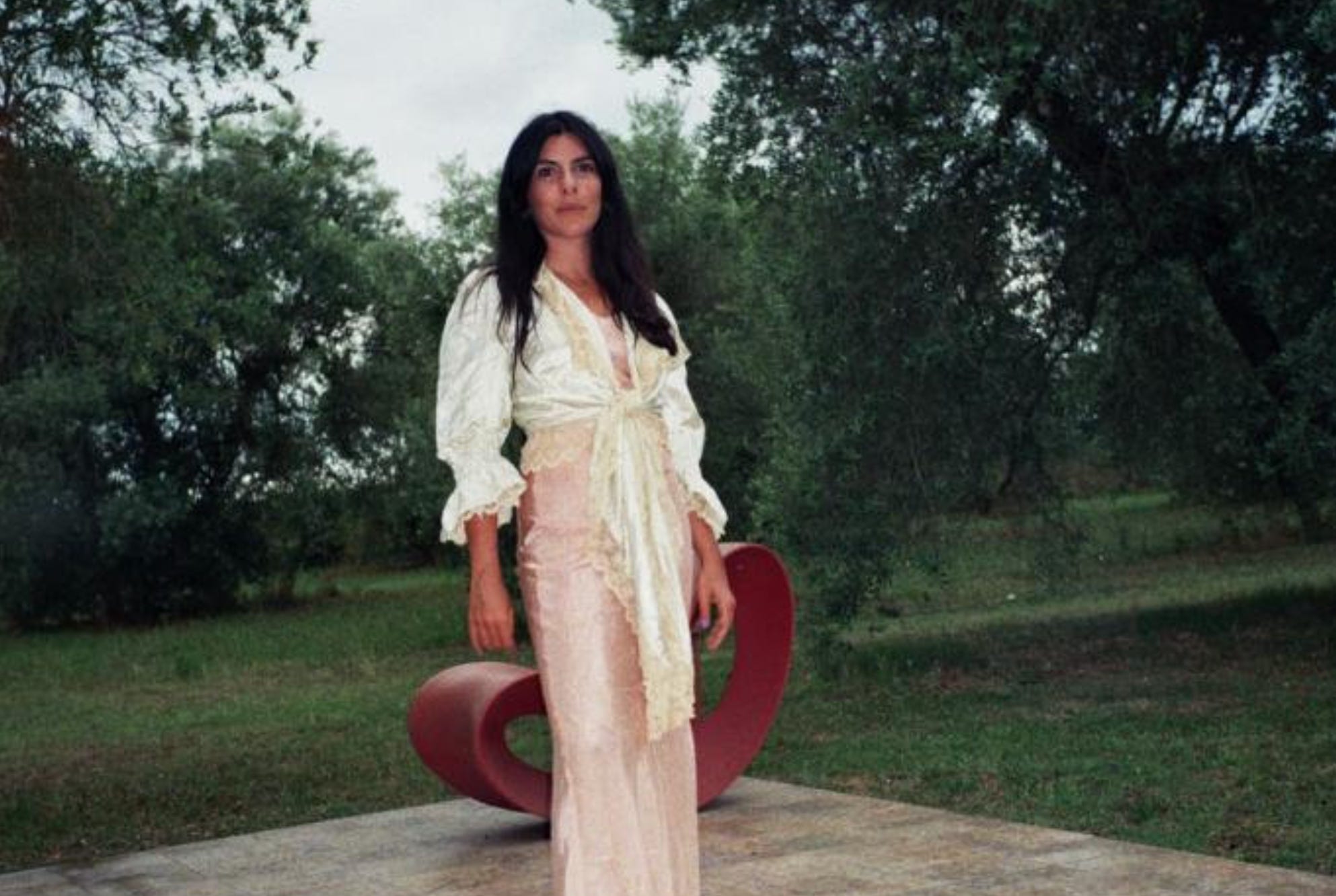
Today we have a guest interview conducted by Virginia Vigliar, a cultural curator, writer, and editor who publishes the newsletter Waves .
Two weeks ago I had an intimate conversation with my friend Francesca Heart, a composer and sound artist working across electronic music, performance, and sonic world-building. It was incredible to get to know her better and understand the depth behind the work she created. Francesca’s work weaves mythology, ritual, ecology, and speculative futures into immersive soundscapes that function as narrative worlds, spaces where inner transformation meets wider questions of power and belonging. My practice centres on creating thoughtful cultural conversations and learning spaces that bridge inner life with collective and planetary concerns. Together, we explore how music, imagination, and world-building can become tools for sense-making, resistance, and re-orientation in uncertain times.
Cognitive Silk - Francesca Heart (31m, occasional vocals)
Bandcamp
Eurybia - Francesca Heart (32m, basically no vocals)
Spotify / Apple Music / YouTube Music / Amazon Music / Bandcamp / Tidal
Virginia: What’s your earliest memory of music?
Francesca: My first memory of music would be the CDs that my parents played in the car. I remember especially these 90s compilations that had Kate Bush’s “Wuthering Heights” on them, and a lot of Enya. These are like the ones that come really strong. And my brother had these dance compilations with Eurodance and hardcore music.
I can hear the Enya influence in your music….
Definitely. And also the music from video games. Me and my brother used to play a lot of video games together – we have six years difference. So I think I was five or six, and he was 11 or 12 and we used to play FIFA, Crash Bandicoot, a lot of early PlayStation games that had super cool soundtracks. It was one of the only ways we could bond because we had this gender and a significant age difference, but with the games, we were on the same page.
How did you start making music? What were your first recordings like?
It started from the curiosity to make music for my own dance when I was studying with Anna Halprin. I started making music with Polonius when we were working on a dance performance together. It was out of necessity, but also out of a desire to explore music in a more abstract way. Because in dance and theatre there are always really interesting music pieces that are not in the form of a song, where you can be abstract. You can have a repetitive sound of a stick on a metal bar, and that would already make the dance piece really powerful. And then it naturally developed into music for listening, not in service of a performance. I’m very drawn to creating sonic narratives and building worlds people can fully immerse themselves in. For me, the narrative or conceptual element is very important.
And was it playful? Because your records feel so playful and whimsical. I wonder if that was also the process; because you’ve told me that someone can hear this whimsical world, but sometimes you were actually in a really dark place while creating it.
A little bit of contrast, yes. The whimsical side has always been part of my way of relating to technology, to escape a utilitarian use of technology and get into the more fun side of it. Maybe because of video game influence, it has that tone. But it’s strange because no matter how dark the period was, the music has this enchanting and inspiring message. Sometimes it’s coming not only from us, but from something that tries to communicate from a higher place.
And there is a bit of tradition in terms of this connection with sound?
Yes! For instance, in the music of spiritual jazz, or 80s American cosmic/ambient, Italian psychedelia and the Berlin School, people who approach music in a more occult sense; a connection with a divine element.
How does your music develop as a mirror to your own self-development?
I tend to think of my work in phases, each album reflecting a different stage. In the earlier records, there was a strong sense of escapism. Creating became a way of stepping into softness, of building an inner refuge. Music can function like that, as a place to rest, to process experiences that feel too heavy or unresolved at the time. Over the years, that relationship is shifting.
And now?
It feels like the end of a cycle, and the beginning of a more visceral, embodied phase. This work moves away from retreat and toward physical presence. Eurybia traced a return to origins, to southern, coastal, and ancient landscapes, as a way of reconnecting with something elemental. There’s a strong resonance with Pasolini’s way of thinking: revisiting ritual, folklore, and pre-modern symbols as tools for surviving modern alienation. In a world shaped by isolation and extractive systems, these older forms of knowledge offer another way of relating to nature, to mystery, and to ourselves.
Tell me more.
Contemporary life pushes us toward constant explanation and control. We’re encouraged to resolve everything, to know everything, leaving little room for uncertainty. Yet the unknown is often where imagination and transformation take place. There’s a growing fear of that space. Eurybia engages with a mythical dimension, the idea of setting out on a journey without guarantees, letting go of certainty, and entering a process that might lead to freedom of the mind, which is cyclically bound to re-cage itself.
Bird Bath draws from Beato Angelico’s Christian paintings in Florence, which were meant to be observed slowly, over long periods, as an aid to contemplation for the monks. Sphinx Nouvelle, on the other hand, was inspired by contemporary architecture like the Katara Towers in Qatar, and became a reflection on opulence, desire, and the symbols that guard power.
Tell me more about the sphinx.
The sphinx has historically stood at thresholds, at the entrances to cities, palaces, and centers of power. It’s tied to imperialism and authority, but also to exclusion. In a contemporary sense, it echoes how capitalism produces desire for lives, spaces, and luxuries that remain inaccessible to most people. These images circulate endlessly, especially online, and the sphinx becomes a kind of guardian of those fantasies.
I love that the Sphinx is a shapeshifter….
Exactly, I think Jung talks about when the psyche imagines itself as multiple, hybrid, or in flux, it loosens the grip of socially imposed identities. In mythology, the Sphinx poses riddles rather than answers. It embodies ambiguity, especially around femininity, sexuality, and animality. Hybrid figures like this may reflect a time when human life was more closely entangled with the animal world, when dreams and symbols flowed more freely between species. Sphinx Nouvelle also draws The Abyss by James Cameron and the animated series Nadia: The Secret of Blue Water , where themes of imperialism, destruction, friendship, and love intersect within speculative worlds.
So it’s more like ancient futurism, which is really interesting. It’s futurist, but it’s kind of going back.
I was working with more metallic, tactile textures and trying to imagine what a “sphynx-like” sound could be. I listened a lot to Art of Noise during that period, the way they use industrial, sculptural sounds felt close to that hybrid quality, something ancient but also synthetic.
There are many ways people discuss why empires and imperialism continue.
One way of thinking about it is through chaos and control. Building societies is inherently unstable, and in response to that instability, systems often try to impose order. When that order becomes too rigid, it can slide into authoritarianism and fascism, into forms of control that promise stability but end up suppressing life itself.
Your work to me is worldbuilding, which is something I deal with a lot in my work, especially looking at political movement. What draws you to building worlds?
Imagining alternative worlds creates space to breathe. It allows for other trajectories, ways of existing that aren’t dictated solely by the structures we’ve inherited. In times of crisis or violence, that imaginative work can be grounding, especially when it’s shared and becomes collective rather than solitary. At the same time, it can be isolating. It often happens alone, in speculative or fictional spaces, and the challenge is finding how those visions translate into everyday life. That’s where small, concrete practices matter. Acts like kindness and care become ways of bringing those imagined worlds into the present, forms of resistance against systems that thrive on alienation.
Ok, rapid fire questions: describe a music-making session setup.
It’s usually quite chaotic. Home studios tend to be that way… machines misbehave, software crashes, cables get lost. The process often starts with imagining a scene or atmosphere and following it intuitively. If something resonates, it gets recorded immediately. The tools can vary, voice, shells, flutes, small wind instruments, and the workflow isn’t linear. Ideas overlap, multiple pieces unfold at once, and sometimes the only option is to step away and return later.
Very DIY.
I really like the DIY process. While highly polished productions are impressive, a DIY approach allows for a more direct relationship with the material. It leaves room for imperfection.
How do you find new music these days?
I listen to the radio in the morning, and buy a lot of CDs when I travel or when I go to the market. The last great finds were in a shop in Ocean Beach in San Diego.
Name an underrated artist from the past 50 years.
Paul Lansky. Because he is a pioneer in computer music, and not a lot of people know him. It was very poetic the way he worked with the voice, manipulating his wife’s voice. He has amazing progressions and playful computer stuff.
What are you working on next?
I’m preparing a self-produced CD to bring along in the US soon as I’m going there soon for a collaboration with Carlos Niño, Saul Williams and other collaborators. The CD is called Cognitive Silk and it’s a mix of new atmospheric pieces designed for installation, following explorations with the conch shell and its many voices.
You are nominated for a Grammy!
Yes, we are nominated in the spoken word and poetry section.
Amazing.
It was a beautiful surprise because we recorded it live during a show. They were supposed to go into a studio and make the album, Saul and Carlos, but when they heard the recording they thought it was perfect to release like that. There was a beautiful ensemble with incredible people I admire: Aja Monet, Maya, a wonderful vibraphone player, and others.