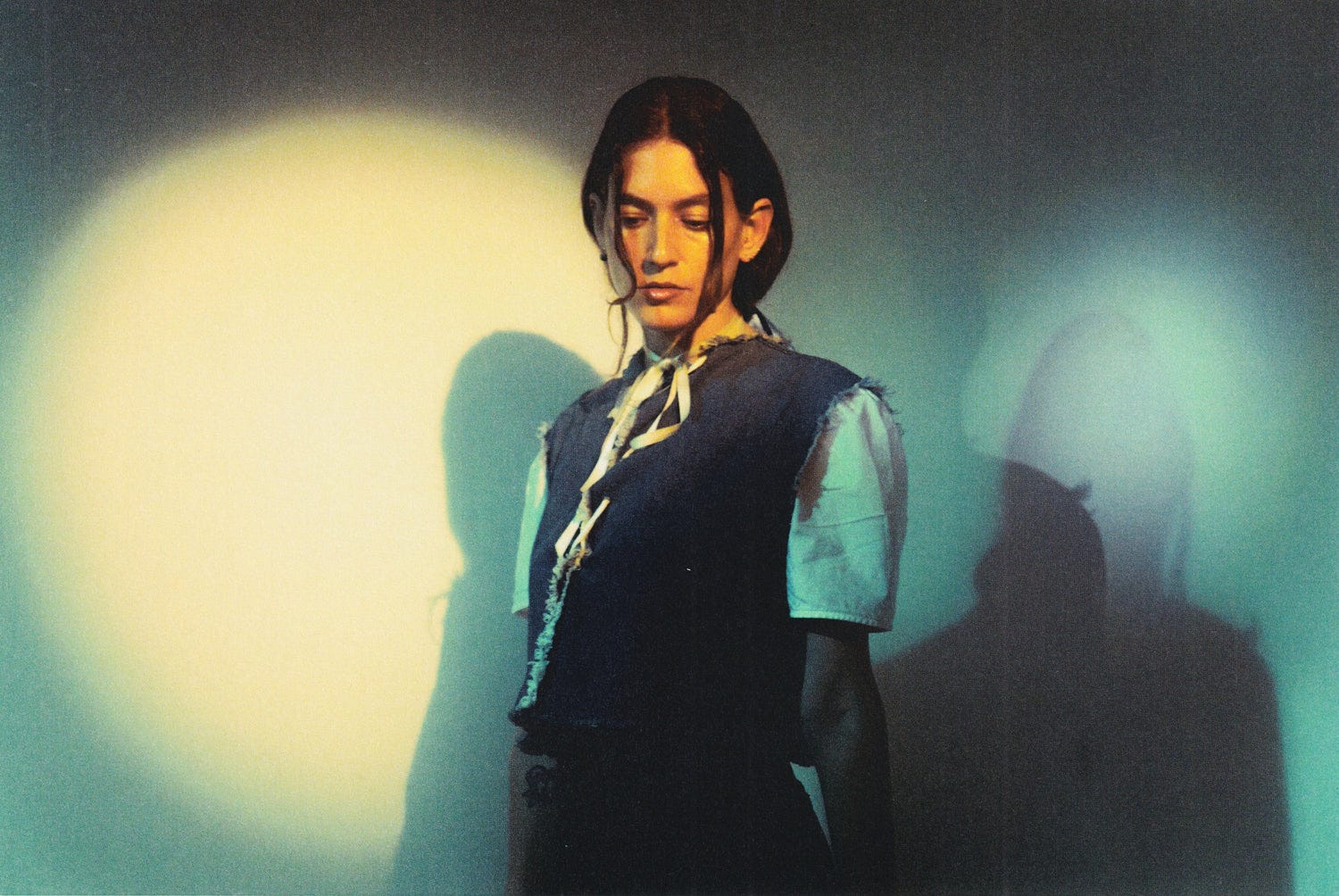
Today we’re listening to Discovery Zone, a project from American musician JJ Weihl. She was born and raised in New York, and grew up playing a bunch of different instruments, making music in GarageBand. After college she moved to Berlin and co-founded the band Fenster. She peeled off and formed Discovery Zone as a multimedia solo project, exploring themes of contemporary life and designing sounds inspired by Laurie Anderson, krautrock, and synth-pop. “The paradox of finding the infinite within the finite is the core concept of Discovery Zone,” she said, “falling through rabbit holes that emerge out of the plastic environs of corporate ad libraries.” Her latest record is Library Copy Do Not Remove, a collection of atmospheric pieces and intriguing synth compositions, recorded in spatial audio for an experience at the Zeiss-Groß Planetarium. We’re also listening to Quantum Web from 2024, which includes some pop tracks with vocals and subtle ambient pieces with meditative arpeggio loops. A conversation with JJ follows the streaming links.
Library Copy Do Not Remove - Discovery Zone (46m, spoken vocals on tracks 3 and 7)
Spotify / Apple Music / YouTube Music / Amazon Music / Bandcamp / Tidal
Quantum Web - Discovery Zone (45m, vocals on almost half the tracks)
Spotify / Apple Music / YouTube Music / Amazon Music / Bandcamp / Tidal
What’s your earliest memory of music?
I have quite a few core memories when it comes to music that happened before the age of 10 or so.
Taking some piano lessons when I was really little, and not being able to concentrate and needing to constantly get up and run around in between practicing songs.
My older brother dressing me up in various outfits to play the role of his “backup dancer” in homemade music video shoots while he sang songs by Whitney Houston, Mariah Carey, and Madonna
Ordering songs on “The Box” TV channel and watching them in my bedroom
Listening to Nirvana on my discman on family car trips
Listening to the Art of Noise from a little boombox while doing contact improv at dance class in the basement of a church in the West Village.
What were your first recordings like? What did you use to make them?
My first recordings were made with GarageBand in high school. I had a little Larrivée acoustic guitar that I bought at Chelsea guitars around the corner from where I grew up. I would write songs and sing and play them at the mic on my computer. I would put lots of effects on the master until it sounded kinda warbled and hazy – delay, chorus, whatever. I was always a little impatient with recordings. I just wanted to get the idea out – the melody – and didn’t really seem to care / notice if everything sounded completely distorted or whatever. It was more about capturing the feeling.
What were the early albums/artists that helped you find your sound?
I have always carried a love for the Art of Noise from early childhood days. Laurie Anderson’s catalog and interdisciplinary practice, especially pieces like Home of the Brave made a big impact on me, and gave me a reference point for the path of creating work that exists between music, video, and conceptual art.
I was in a band called Fenster before I started Discovery Zone. We released 4 LPs and made a lot of videos and toured a bunch from around 2012-2018 and even made a feature length film. That experience was certainly a jumping off point for me in terms of experimenting, learning how to play and sing live, figuring out how to record, and distilling what I liked aesthetically. Discovery Zone was born out of a desire to find my own taste and inclinations separate from the context of the band.
Living in Berlin I got really into Kraftwerk, Neu!, Can and their various solo projects (Holger Czukay, Irmin Schmidt, etc), as well as the experimental pop scene happening around me at the time. Artists on the Berlin based label that releases my music Mansions and Millions were all playing shows at DIY venues like Internet Explorer, Loophole, Sameheads and Tennis Bar, from around 2016-2022, and that felt really inspiring and fun and supportive.
Tell us about your relationship with the work of Borges and Gleick. What stories or passages have stuck with you the most?
Borges writes the kind of parabolic fiction that exists outside of time and space. It feels like he is channeling something directly from the source. Most of the time the characters and scenarios appear like perfectly formed worlds that you would find leafing through a stack of photographs – zooming in on precise coordinates that serve as portals to the concepts underneath the images. He leads you slowly to the ideas he has laid out, as if uncovering brilliant patterns on the walls of dusty corridors by throwing candle light across them. There is something both deeply familiar and inscrutable to me about his writing - like walking around in the labyrinth of a mind behind my own mind, linked to an infinite chain of shared minds.
There are certainly themes that Borges is circling around that have influenced my work. The paradox of finding the infinite within the finite is the core concept of Discovery Zone – falling through rabbit holes that emerge out of the plastic environs of corporate ad libraries.
One of my favorite Borges stories is “The Aleph” in which he finds a point under a set of stairs that contains the entire universe. There is an extremely beautiful and long passage describing it, the conclusion of which is:
I saw the coupling of love and the modification of death; I saw the Aleph from every point and angle, and in the Aleph I saw the earth and in the earth the Aleph and in the Aleph the earth; I saw my own face and my own bowels; I saw your face; and I felt dizzy and wept, for my eyes had seen that secret and conjectured object whose name is common to all men but which no man has looked upon – the unimaginable universe.
Another passage of Borges I love is from the “The Library of Babel”
Perhaps my old age and fearfulness deceive me, but I suspect that the human species – the unique species – is about to be extinguished, but the Library will endure: illuminated, solitary, infinite, perfectly motionless, equipped with precious volumes, useless, incorruptible, secret.
****
James Gleick wrote this book Chaos which I found a copy of in a used bookstore while I was doing research for the original LCDNR performance for the planetarium back in 2023. As a person who struggled with the equation side of math and physics my whole life, I was always drawn to the concepts anyhow, and his book takes a more literary and philosophical approach to exploring chaos theory, illustrating concepts like the “butterfly effect” (sensitive dependence on initial conditions), strange attractors, and fractals. Many different scientists working in disparate fields began finding that there is a hidden underlying order to be found in seemingly random unpredictable systems.
Gleick writes,
Nature forms patterns. Some are orderly in space but disorderly in time, others orderly in time but disorderly in space. Some patterns are fractal, exhibiting structures self-similar in scale. Others give rise to steady states or oscillating ones. Pattern formation has become a branch of physics and of materials science, allowing scientists to model the aggregation of particles into clusters, the fractured spread of electrical discharges, and the growth of crystals in ice and metal alloys. The dynamics seem so basic – shapes changing in space and time – yet only now are the tools available to understand them.
–Chaos: Making a New Science
The intersecting influence of Gleick and Borges in LCDNR lies in this relationship between chaos and order and the finite / infinite duality of the library as a metaphor for the universe and its potential trail of infinite copies. Borges gives us a finite system of letters that can create infinite meaning contained in the universe. But within that infinite meaning, there is infinite randomness, chaos. The patterns we use to construct meaning are created alongside infinite disorder – meaning needs meaninglessness and vice versa. Gleick writes, “Everything we care about lies somewhere in the middle, where pattern and randomness interlace.”
In the text I wrote for the title track “Library Copy Do Not Remove” I was attempting to create a parable or creation myth for a simulated universe – a copy of the source material. I wanted it to be both familiar and alienating, dipping into the uncanny valley of (re) creation and the feeling of originality within infinite syndication.
It is certainly a nod to Borges’ library, but taken into the realm of cybernetic recursion and Baudrillardian simulacra. We zoom out of the hexagonal galleries and dusty book jackets into the hyperreal.
Most of the tracks on Library Copy are collaborations with World Brain. How’d you link up, and how did the collaboration work?
World Brain (Lucas Chantre) is the solo project of one of my bandmates from Fenster. At the time when I was writing LCDNR in 2023, I was also in the process of finishing my second album, Quantum Web, preparing for live solo DZ shows as well as working on some recordings and rehearsing for live shows with Fenster. I felt overwhelmed at times, but determined to create entirely new music to be performed in spatial audio for this one performance at the planetarium. Lucas was in town for the Fenster stuff, so he ended up hanging at the studio with me and working on the music as well. He was a great sounding board and helped me to flesh out a lot of the demos I had already started working on, as well creating some of the pieces with me from scratch. The whole process of learning about Ambisonics is thanks to Andrew Rahman and Timo Bittner, who gave me a crash course in composing for spatial audio, as well as implementing and arranging the piece for the live performance, played through 49 speakers.
What was your studio setup for Library Copy? What instruments/gear/software did you use to make the record?
In the studio, I was using my Arp 2600 (the original teaching model from the 1970s which was given to me as a gift by my brother many years ago), a Korg Triton, my Gibson short scale bass, various vocoder VSTs, my hardware vocoders, an SP-404 sampler, as well as a bunch of soft synths. Once all of the musical elements were created as “mono objects” in Logic, they were imported into the Ambisonics template which works with Reaper. I also used a fair amount of sound collage and field recordings as well as some tactile percussion elements for the live performance. Andrew and Timo and I met at their studio a few times so I could learn about the various effect plugins that work with Ambisonics. We were only able to go to the planetarium to test out the material through the system in the space a day before the show. During the performance Andrew and Timo were playing with live effects and recorded the elements I played live as well. That performance lives on in the LCDNR Spatial audio version that can be heard in Dolby Atmos on certain platforms. If you listen to both the stereo and spatial versions you’ll be able to hear a lot of differences between them in the details I reckon.
How do you discover new music these days? Any recent notable finds?
I’ve been listening to a lot of internet radio – The Lot and NTS mainly. Also I feel like lots of friends are putting out great new music at the moment. Cate Kennan who opened for me in LA has a great new record coming out in June called Shadows. I also love asking friends for recommendations especially when I’m travelling far away. If you have any please send em my way :)
Name an underrated artist from the past 50 years.
Wow so many. I think Laurie Spiegel is a genius. While working at Bell Labs, she created the incredible early electronic computer instrument Music Mouse. Her album The Expanding Universe, which was actually sent into space, was a big inspiration for LCDNR.
I think Negativland are also pretty underrated. They are certainly pioneers of conceptual sound collage and “Culture Jamming.”
What are you working on next?
I’m on tour at the moment and I’m looking forward to going home in July and working on new music back home in New York. I’m planning on recording some new material with my trusted producer E/T back in Berlin in September. I’ve also slowly been working on and collecting notes and ideas for a Discovery Zone book for over two years now (!) and I’ve been thinking about the evolution of the visual dimension to accompany the next record for both videos and live performance. I’m also excited about working on my live set, touring in Europe in the fall and playing bass in my boyfriend’s project Paint.