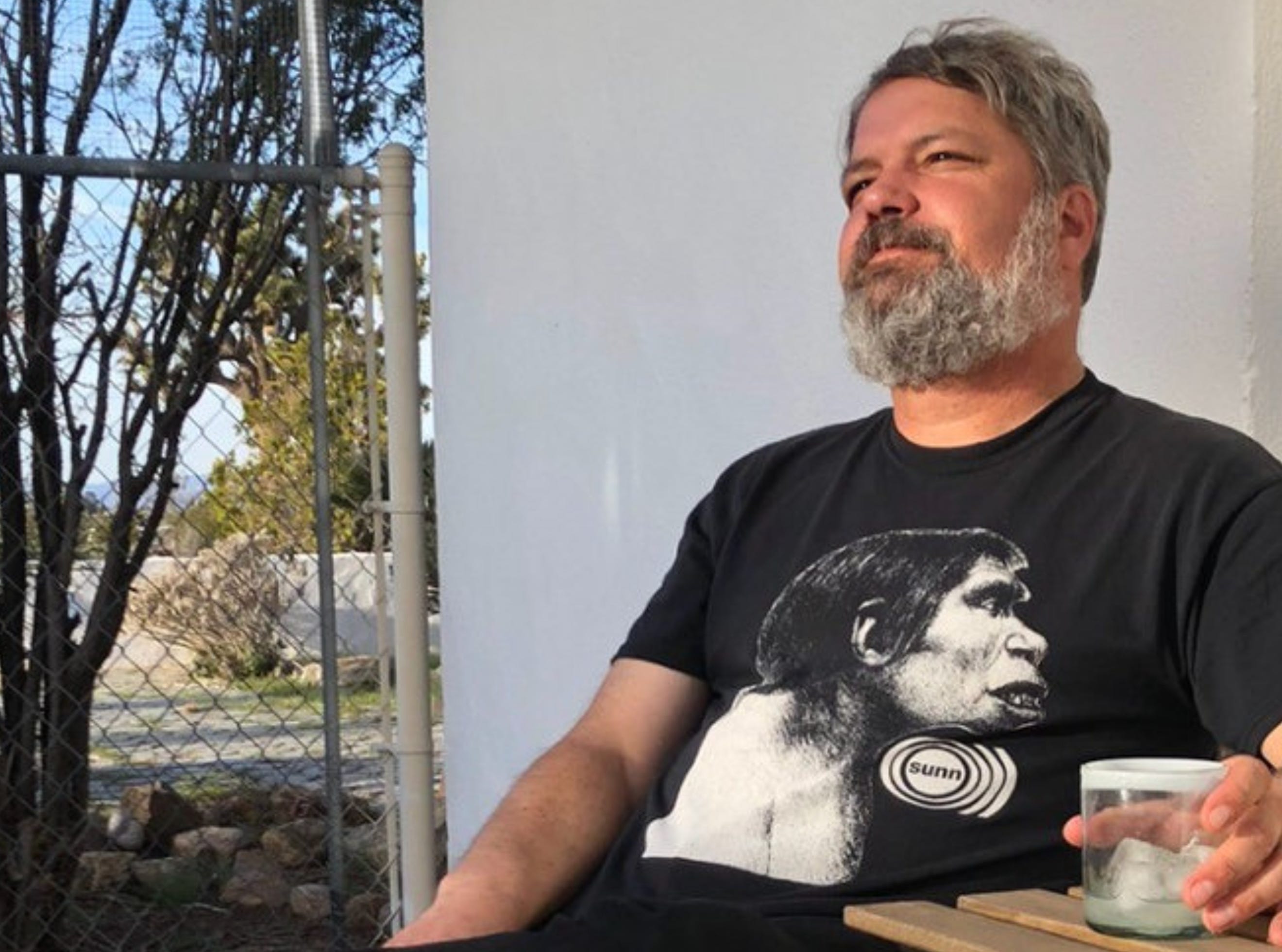
Today we’re listening to Derek Monypeny, an American guitarist and composer based in Joshua Tree. He grew up in Arizona and gravitated early on to bands like the Meat Puppets and Black Sun Ensemble. He later found threads between the rock he liked and composers such as Elaine Radigue and Terry Riley. In his own music he uses the guitar to create atmospheres of intrigue and profundity. The Oppositional Imagination from 2024 is a great example, as is Unjust Intonation from 2021. Of the latter he said, “I was kind of making fun of some of the buzzwords in the ambient/minimalist music world,” and it turned out wonderfully. A conversation with Derek follows the streaming links.
The Oppositional Imagination - Derek Monypeny (38m, no vocals)
Spotify / Apple Music / YouTube Music / Amazon Music / Bandcamp / Tidal
Unjust Intonation - Derek Monypeny (37m, no vocals)
Spotify / Apple Music / YouTube Music / Amazon Music / Bandcamp / Tidal
What’s your earliest memory of music?
That would be with my parents and my two brothers (I’m a middle child) at the drive-in movie theater sometime in the early ‘70s, seeing a movie that Disney now wants to pretend doesn’t exist: Song of the South. I would’ve been 4 years old or so.
There were some good songs in that movie. My parents eventually got us the soundtrack LP, along with the Robin Hood soundtrack which I also loved.
The songs on the Robin Hood soundtrack were written and performed by the great American songwriter Roger Miller, who wrote the song with my favorite lyrics of any song ever, “King of the Road.”
Where did you grow up and how’d you find your way to Joshua Tree?
I was born and raised in Yuma, Arizona. Between my early life in Yuma and my current dwelling place of Joshua Tree, I lived in Los Angeles, Riverside, Tempe, Tucson, Oakland, and Portland.
Moving to Joshua Tree from Portland in 2018 was a pretty impulsive decision that my partner Heidi made after spending one day and night out here. We were both ready to leave Portland, and I didn’t really realize how much I missed the desert since my formative years in the Sonoran desert of Arizona.
Coming here coincided with me deciding that I didn’t want to try to be in bands again (although I think I would if the right people asked me – I definitely don’t want to ever start a band again). It has led to a real outpouring of creativity in my solo music practice. I’ve recorded and put out 5 or 6 records since moving here, with one of those being a double-LP. I have a great little studio where I can watch roadrunners, wild rabbits, quail, etc. This spring and summer have been particularly special, as we have been visited multiple times on our property by a small family of Mojave bobcats.
Which artists/albums inspired you in the direction of the sound you’ve created?
I would say the artists and records that inspired my own music the most would be (listed in alphabetical order by artist’s first name):
Catherine Christer Hennix, Solo for Tamburium
Debashish Bhattacharaya, Hindustani Slide Guitar
Don Cherry, Eternal Now
Elaine Radigue, Jetsun Mila
Folke Rabe, Wha??
Fripp/Eno, Evening Star
Natural Information Society, Mandatory Reality
Sun City Girls, Torch Of The Mystics (this is the most important one)
Terry Riley, Descending Moonshine Dervishes and Persian Surgery Dervishes
V/A: WahaIlli Le Zein!: Wezla, Jakwar and Guitar Boogie from the Islamic Republic of Mauritania
I want to clarify that there are other records I probably like more than these or that are more important to me personally, but these are the ones that are most important for my own music.
Tell us about your notion of the “desert continuum.”
The phrase “desert continuum” first germinated in my brain when I was on a sailboat on the Nile river (this was an Italian-style sailboat called a felucca), going from Cairo to Luxor. This would’ve been 2008. Right when I was passing into Luxor on this boat, I saw a sand bar and a bunch of palm trees, and it struck me that it looked exactly like certain parts of the Colorado River which passes right through Yuma.
From there, it started to dawn on me that a lot of the crazy psychedelic desert guitar players from Arizona that I grew up loving, like Curt Kirkwood of the Meat Puppets, Richard Bishop of the SCG, Jesus Acedo of the Tucson band Black Sun Ensemble, sounded like the crazy psychedelic guitar players from other desert regions (i.e. the Sahel/Sahara) that I was discovering and devouring, like Eddoum ould Eide, Hamadi ould Nana, and Luleide ould Dendenni.
I think a lot of desert-based musicians have a singular sense of wild, ecstatic abandon in their playing. I almost always use a phaser effect when I play guitar or bulbul tarang, and that comes directly from Mauritanian guitarists who all use the phaser; I think the swirling sound brings to mind the dust-devils and sciroccos that they see all the time.
What’s your studio setup?
I don’t think I’m going to get anybody too excited here. I have a 16-track setup. I route an RMS Fireface UFX interface into an 8-channel Focusrite, into a pretty basic Pro Tools rig. I have a really nice pair of AKG C414 XLS mics, but none of my other audio gear is that sexy. Ultimately, I like to keep it simple and keep it rolling – I get my best performances that way. I rely a lot on the great mastering engineers I’ve worked with to make shit sound okay on vinyl or tape.
How do you discover new music these days? Any recent finds?
It’s kind of ironic – I made a record called Unjust Intonation where I was kind of making fun of some of the buzzwords in the ambient/minimalist music world, and now I’m really, really into just-intonation music and microtonality, etc. I mean, it’s a big part of all the Arabic music that I’ve loved for decades – I was just pretty ignorant until the last couple of years.
There have been a couple articles about “microtonal jazz” that have come out recently, one written by Peter Margasak, and in that article (I think it was that one) he mentioned a band called the Vex Collection, from NYC I think. Their record really blew me away:
I tend to discover music through friends, a few writers like Peter...old-school ways that haven’t totally died out yet.
Name an underrated artist from the past 50 years.
This is a great question and it could go many directions, but when I first read it, my immediate reaction was to highlight the work of Mark Gergis, aka Porest: “Across decades, Porest has issued a trail of confounding agitprop sound art, post-globalized hate-pop, diabolical radio dramas and carefully rearranged realities.” That’s how Mark describes his work.
I would describe a lot of Porest stuff as: “What if Negativland actually were as good and funny and provocative as they attempt to be, but mostly without success?” And then sometimes he will drop all of that shit and just drop an Arabic-pop banger.
Mark is brilliant and way more people should listen.
What are you working on next?
At the moment, I’m in the process of re-assessing what I want my solo music to be, if I want to keep putting records out and touring, etc.
I do have 4 shows on the East Coast coming up in early November (NYC, Philly, Baltimore, DC). I haven’t played on the East Coast since 2019.
I have a double-LP of solo recordings that I have finished and turned in to my record label, 2182 Recording Co. There’s really no telling when that record will come out. It’s called Sonoran. It’s a big, sprawling desert record, a sequel of sorts to my double-LP, The Hand As Dealt.
My thoughts are never far from my brothers and sisters in Palestine, Sudan, Democratic Republic of Congo.