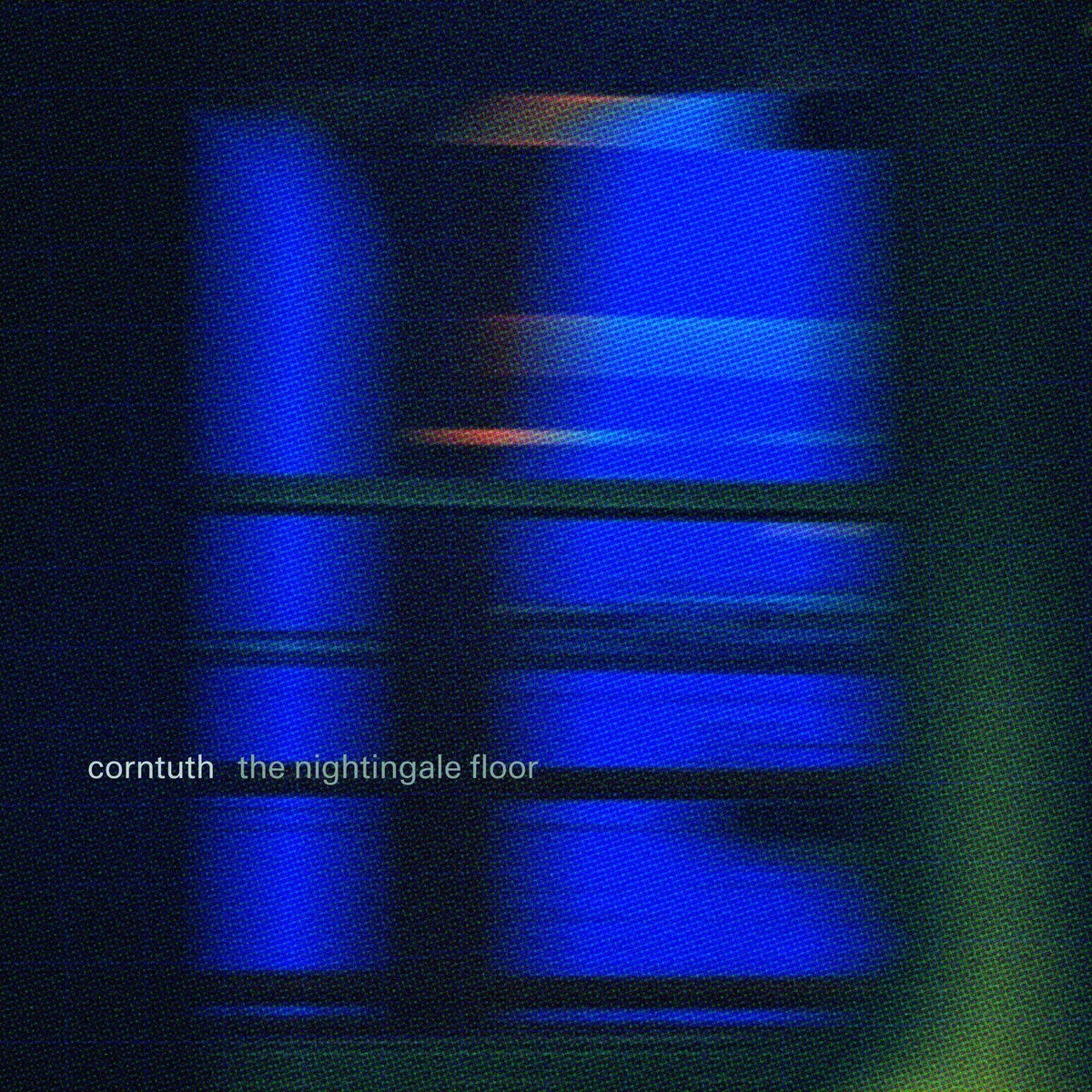
Today we’re listening to Corntuth, an American ambient musician based in Brooklyn. His new record, The Nightingale Floor, is the 13th release from Flow State Records. We released three of his previous records: Music To Work To (2020), The Desert Is Paper Thin (2021), and Letters To My Robot Son (2022). He grew up playing guitar and piano, recording indie and folk rock songs with his brother, playing in bands and later gravitating toward ambient music via Brian Eno and Hiroshi Yoshimura. At the beginning of covid, he picked up a Yamaha DX7 which has been his go-to ambient instrument. The Nightingale Floor incorporates drum loops and field tape, the latter taken from a trip to Japan. The record is co-released by Aural Canyon, who are making it available on a limited edition cassette. We’re also revisiting The Desert Is Paper thin, an acoustic guitar-driven record in the ambient country style, featuring the late Pete Finney on pedal steel guitar. A conversation with Corntuth follows the streaming links.
The Nightingale Floor - Corntuth (36m, slight vocals on track 2)
Bandcamp / Spotify / Apple Music / YouTube Music / Amazon Music / Tidal
The Desert Is Paper Thin - Corntuth (40m, no vocals)
Bandcamp / Spotify / Apple Music / YouTube / Amazon Music / Tidal
What’s your earliest memory of music?
Probably my dad singing “Summertime Blues” by The Who. I remember when we were very young that he would sing that song. “There ain’t no cure for the summertime blues.” I’m sure that’s not actually the first experience I had of music, but that’s a really early one.
When I was a kid, I was obsessed with Bob Dylan because I had very curly hair and I had a toy guitar. Before I could really speak, I was struggling to say Bob Dylan’s name.
Was the toy guitar your first instrument?
Yeah, it was. I wanted to play the saxophone when I was a kid. I grew up near a store called Daddy’s Junky Music, and I remember going there and there was a dude with really long hair. He told my parents that he played the saxophone when he was really young and it had broken his fingers. He thought that I shouldn’t play the saxophone. So that led me to playing guitar and then piano.
I put the guitar away for a long time and focused on piano. I can’t really remember why. But I came back to guitar because my brother started playing it. I remember the first song he taught me to play was “Wooden Ships” by Jefferson Airplane.
What was your journey with piano?
My mom was a pianist and she was involved early on in my learning to play. I remember every Sunday in the fall we would listen to the George Winston record Autumn. I think we maybe had a couple other Windham Hill records, but it was really that George Winston record that I fell in love with. My whole family loved it. I associated it with the warmth of being inside when it’s cold and dark outside. A lot of the things I wanted to learn how to do on piano stemmed from that record.
I had a high school jazz band experience, like a lot of people do, that I was pretty serious about, and that expanded my sense of harmony. I was in rock bands and played keys and guitar and worked on songwriting through that. But I think the George Winston experience and that kind of music stuck with me.
Shout out to George Winston and Windham Hill Records.
Shout out to In Search of The Turtle’s Navel too, just an incredible record.
When did you start making your own music?
I started very young. Because I was so obsessed with Bob Dylan, I always wanted to write songs. I’m sure I had some half baked attempts when I was a toddler.
My parents had a PC. It was like a chunky old Dell that had a microphone, and I found a way to make that the recording device. It would get blown out really quickly because it was not meant for music or complicated mixing. So each layer exponentially increased the gain. But I would make songs on that that were kind of indie folk songs.
When I was in 8th grade, the Gorillaz’ album Demon Days came out, and I lived in Boston. The day it came out, for whatever reason, they were at Newbury Comics in Boston. I went with my best friend. We got in line a couple hours early, and for whatever reason, we were the first people they let in. Danger Mouse was there, Damon Albarn, and Jamie Hewlett. Albarn was a hero of mine. I said to him, “I want to be a musician. What do you recommend?” And Damon Albarn was like, “You should buy a tape recorder, like a four-track tape recorder, and just record something every single day.”
So I went back home and told my mom what he said. My mom often recounted this story of this time we’d met Hank Aaron the baseball player and he talked about practicing with a stick and a bottle cap. This is not at all how we grew up. But my mom thought it was a good principle (selectively enforced) that you should really prove you were serious about something before getting a bunch of gear for it.
But I came back from the Damon Albarn conversation saying, “Look, Damon Albarn says I need to get a proper tape recorder.” Later on I got a proper tape recorder as a like graduation present, a Fostex digital recorder that had multi-track and onboard effects. And I went crazy with that thing and recorded a ton, making music with my brother. Then more computer tools started coming out and they helped a lot.
What kinds of computer tools?
We definitely were using Logic. We started a lot more home recording: indie rock, indie folk tracks. We listened to a lot of Rolling Stones growing up and my brother’s a great guitarist, so there was some stuff in the vein of “Moonlight Mile” by the Stones.
I was using open tuning a lot, along the same lines as the George Winston stuff I mentioned. I was more eager to write songs than I was to get very technically gifted at an instrument. Open tunings are sort of a hack to make something that sounds good and interesting fast. If you really want to know how to use them, you obviously have to spend a lot of time studying that specific tuning. I backed into that over years of hacking my way through them.
What was the origin of the Corntuth project?
I knew this guy named Tony, who has an amazing synthesizer company called Analog Craftsman, that was based near where I grew up in Massachusetts. In the early days of the pandemic, Tony was moving to the West Coast, and he knew that I’d always loved this Yamaha DX7 that he had, this amazing synthesizer from 1983. He hit me up when he was moving and was like, “I’ll give you a really sweet deal on this, if you want to take it off my hands.” So I immediately jumped at that. He also threw in a Yamaha R100 reverb unit, which is an amazing old digital reverb from the ‘80s.
I’d also been a devoted Flow State reader for some time and through that I’d gotten into ambient music. I remember listening to Thursday Afternoon by Brian Eno while I was working at a boring job and feeling really weird in a way that I kind of enjoyed. I was listening to a lot of what was being recommended in Flow State. Also the Vampire Weekend record Father of the Bride had a song called “2021” which sampled a Haruomi Hosono composition for Muji. I loved the song but I really loved the sample, so I started listening to that a bunch. Those were the things that made me start thinking about what I could do with that synthesizer.
How did you approach Nightingale Floor differently from previous albums?
A few things are different on this record. I took a lot longer with it, first of all. Most of the Corntuth records are improvisations, I just improvise a ton and fiddle around with sounds and then I edit it into something that feels more composed. On this there are definitely improvisations, but it’s more carefully crafted. I wanted to experiment with found sounds and ambient field recordings. And also rhythms, like specifically drum loops.
So for the first time I did a lot of rooting around trying to find drum samples from old drum machines. And in one instance there’s a loop from a contemporary drummer, whom I love – feeb. I had spent a lot of time traveling and specifically had one pretty big trip to Japan, which is a major pilgrimage for anyone who loves ambient music. It was the rainy season, and I felt like I kept winding up in places that sounded really interesting to me. Then in one older building, I met a man who told me they had a nightingale floor – this old floor that sounds like a nightingale singing when you walk on it. In the process of trying to record what that floor sounded like – just stomping around on it, trying to make it sing – I felt like I was basically doing what I do with a synthesizer, which is just like banging at various instruments and seeing what comes out of them and then making a record out of it.
So I had this desire to combine these field tapes with more compositions. And introducing outside elements that were scaffolding the music, like with rhythm as well.
How did you approach incorporating the drums?
I would listen to a ton of samples and try to find ones that connected with me for some reason. Once I found those, I would create really long loops of them. Then start playing on top of them, letting a structure emerge. I wanted there to be – not the feeling of a live drummer, but of variation in the drums. I wanted to figure out how I could put a bunch of moments in the recordings that grab your attention without breaking a sort of peaceful flow.
One of the ways I was doing that in the record was finding little moments in the drum loops where I could process the drum differently with the time-based effects that actually changed what the pattern being played was. You can hear that most clearly on “Align.” I would do a phase of that and try and find these little pockets where it could morph, then go back and play more and sculpt around that.
And the instruments you used?
As always, the DX7. I used a lot of harmonica too on this record. There are some moments where I’m doing extreme vocal processing on my own voice. And there’s a little acoustic guitar. But yeah, otherwise it’s the DX7, drum loops, and field tape.
Were there any other albums that you were listening to while making this?
Haruomi Hosono, a lot of that. I was listening to Ernest Hood’s Neighborhoods, especially how he works with field tape. I really fell in love with Susumu Yokota and Synergetic Voice Orchestra in the process of making this. Then there’s always the classic people like Harold Budd and Brian Eno. I was listening to Wet Land a lot by Hiroshi Yoshimura too.
What are you working on next?
Right now I’m working on two film scores. One has been in progress for a long time, which is part of why I took some time off making records. That’s been really fun. I think it’s also part of why I wanted to work with field tape because it’s really fun to put music to a story, or try to tell a story with music. So I’m finishing up those two film scores, and then I have a site-specific project out in Wichita, Kansas, which I am making plans for in November. I’m really excited about that. I’m hoping to have something from that to share early next year.