

Today we’re kicking off the new year by listening to Brian Eno, as is tradition. We’re playing the two albums on which Eno first explored the ideas that came to define “ambient music,” as he called it. In his excellent new book, 20th Century Ambient Music, Dusty Henry writes:
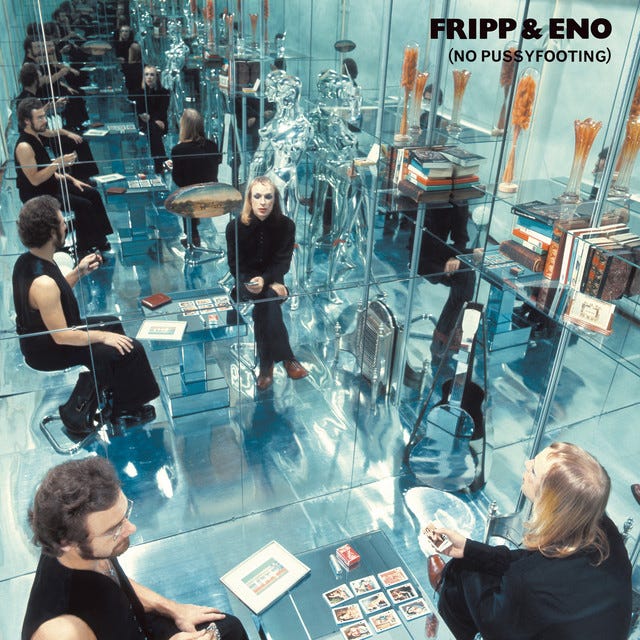
While leaving a popular band [Roxy Music] that was still on the rise could conceivably be a career ending move, it opened up space for Eno to truly “space out.” Shortly after the split from the band, Eno began working with Robert Fripp – guitarist and founding member of the prog rock group King Crimson. At the time, Eno had returned to his love of tape loops and tape delay and invited Fripp to come to his house and see what he was working on. Eno played Fripp loops and Fripp would play guitar overtop. While this was happening, Eno would record and loop Fripp’s guitars back over the tape loops…. This technique created the iconic, dreamlike sounds of Fripp & Eno’s first two albums they’d create together – 1973’s (No Pussyfooting) and 1975’s Evening Star…. The expansive, meandering sounds on these two records also nicely set up the impending revelation Eno was about to have.
That revelation was that music could be made in a way that altered one’s environment and headspace, and permit various levels of attention; music could be, as he wrote in A Year With Swollen Appendices, “as ignorable as it is interesting.”
(No Pussyfooting) - Brian Eno & Robert Fripp (40m, no vocals)
Spotify / Apple Music / YouTube Music / Amazon Music / Tidal
Evening Star - Brian Eno & Robert Fripp (48m, no vocals)
Spotify / Apple Music / YouTube Music / Amazon Music / Tidal
We wish you a great start to the new year.
The legend.
Jonathan Lethem did a wonderful piece on No Pussyfooting a while back
https://www.newyorker.com/magazine/2005/02/28/the-beards