

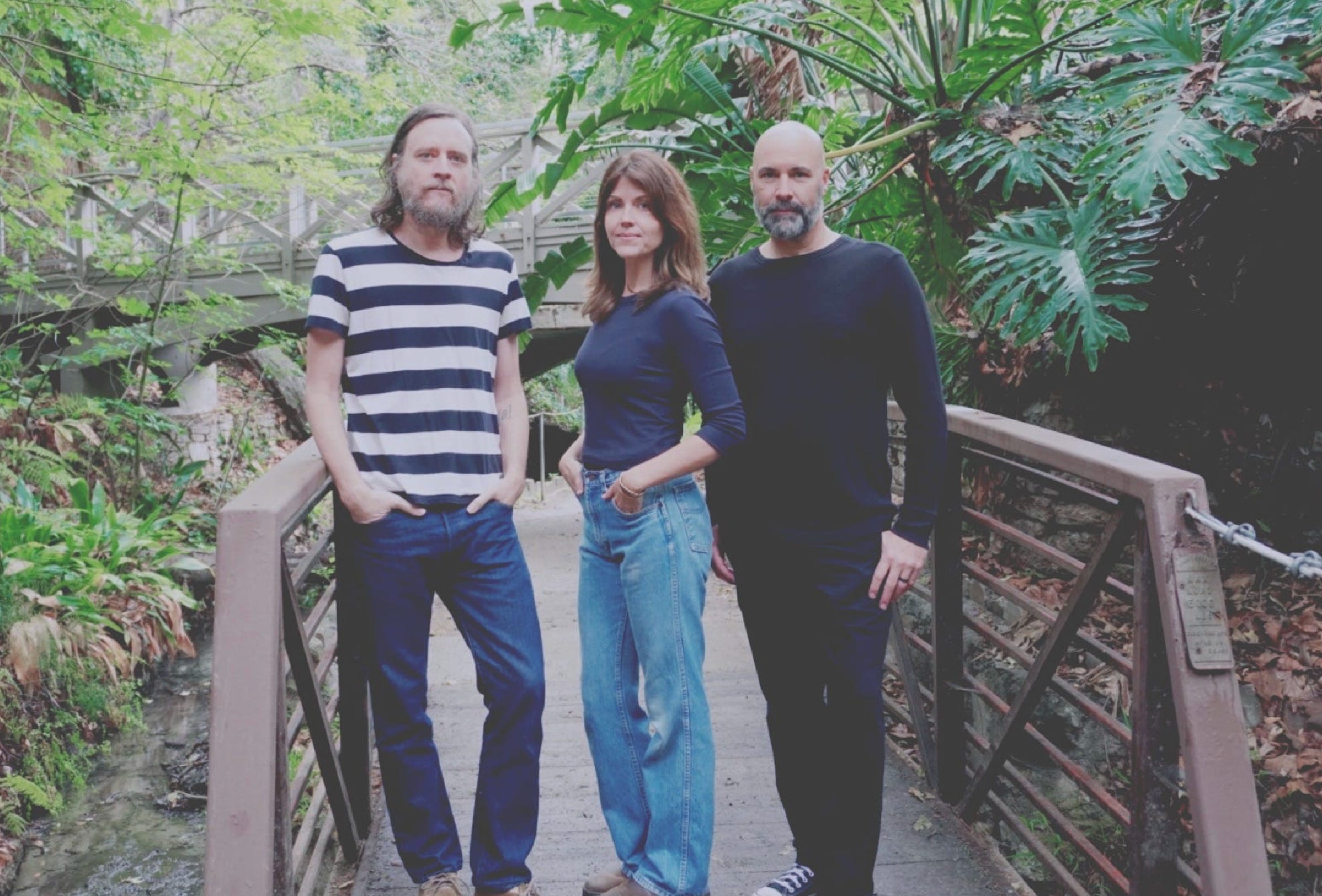
Today we’re listening to Almost An Island, an ambient music project from California-based musicians Cynthia Bernard (aka marine eyes), James Bernard, and Kenneth James Gibson. They grew up in the Bay Area, New York, and El Paso respectively. Cynthia and James work on the label Past Inside the Present, a purveyor of consistently interesting ambient music. All three have been making ambient music for years, and they convened in 2023 to explore a collaborative album. The fantastic result is the self-titled Almost An Island record, which came out in August. We’re also playing an awakened souls record, night songs from 2022, which is a joint effort from Cynthia and James. A conversation with the three musicians follows the streaming links.
Almost An Island - Almost An Island (45m, some vocal tones)
Spotify / Apple Music / YouTube Music / Amazon Music / Bandcamp / Tidal
night songs - awakened souls (40m, some vocal tones)
Spotify / Apple Music / YouTube Music / Amazon Music / Bandcamp / Tidal
Where did you all grow up?
Cynthia Bernard: I grew up in Northern California, inland of San Francisco. I was in Stockton until I was about 8 and then grew up in a town called Concord right on the cusp of Clayton. Then lived in San Francisco for quite a bit before heading down to L.A.
James Bernard: I was born in New York. I’m a native New Yorker. Lived out there for quite some time, and I moved down Florida for a bit and then out to Los Angeles in 2014 or so.
Kenneth James Gibson: I was born in a place called Burlington, which is right outside Toronto. Then I moved to El Paso, Texas, when I was four and was raised there.
How did you get into ambient stuff?
JB: I was always intrigued by ambient music from an early age. I was into Brian Eno from way back, but even before that, I was into synth music in general, especially chill stuff. What really kicked it off more for me was, I was composing electronic music in the early ‘90s, mainly dance music: acid and trance. The label that I was signed to was Rising High Records out of the U.K., which released a large amount of ambient music as well. They would send me white-labels and CDs when I was making trance music. I decided I would try my hand at making something ambient as a way to go to sleep and process things. Eventually it got released, so I started creating more of it. But it started with me making it just for myself to find a sense of calm in the world and feel peaceful for a bit.
CB: James’s first official ambient record just had its 30th anniversary last year.
JB: They released it in ‘94. It was called Atmospherics. It was on Rising High Records, and it came out at the same time that they were releasing Mixmaster Morris, Luke Vibert/Wagon Christ – which was sort of alternative ambient.
KJG: I love that stuff.
JB: And the early Pete Namlook stuff.
CB: MLO.
JB: MLO, which was Jon Tye. MLO’s Io album was everything to me. When they sent me that album, I was like OK, 20-minute songs, got it.
KJG: For me, I might’ve gotten into ambient originally by listening to My Bloody Valentine. Then getting into Warp Records stuff: Seefeel, and then some weirder stuff. I really loved Electric Company’s first record. I was also listening to stuff like Flying Saucer Attack. At the same time, being in Texas, I knew the Stars of the Lid guys – their first record had just come out. Of course I was listening to Brian Eno around that same time. It’s kind of a mishmash of experimental stuff and straight ambient stuff. There was a really good record store in Austin – actually two really good record stores. One was a CD-only store – this is the early ‘90s. I remember going in there quite a bit, both those places, and just listening to tons of music. The CD place had lots of ambient music. It was early ‘90s ambient music, and I remember that having a big impact on me, even if now I can’t remember half of it.
This is like chill out room music?
KJG: Yeah. Going to raves, and going to the chill room – that was before I was making techno. I’ve made tons of techno as well. James and I have that in common. I loved The Orb. The Orb’s ambient stuff was a huge inspiration, especially the weirder stuff like Orbus Terrarum and Pomme Fritz. To this day those are still some of my favorite ambient records. Once I was really turned on to Eno, that changed things up for me because I love those sounds.
CB: I was raised in such a musical family, like a music appreciation family. My dad played soft piano while waiting for us – three girls – to get ready to leave the house. I remember that from a young age. They have a huge wall – still do to this day – of CDs and vinyl right when you walk into their house. I’ve always been a researcher/explorer, so I would sometimes grab a CD that I didn’t know and lay on the ground and listen to it. The other thing that I would say from my roots is that my dad taught me to look at the producer of an album I liked, and then find more records that producer worked on. Brian Eno, once again – I definitely looked into his discography. I listened to Enya – my mom would always have that on. That really made a mark on me. And then a lot of gentle instrumentals, like my mom would always have on Anthony Phillips, his soft guitar solo stuff that was his side project to Genesis. My parents were huge into prog.
When I started to write my own things, even at a young age like nine, I would sit and hum outside underneath the porch and listen to the rain. Also, my sister’s a massage therapist – she was always destined to be one. She would give me massages with ocean wave sounds on when I was like nine. I remember the sound of nature and relaxing into that. So nature sounds had an influence on me too. As I got older, I got really into Feel Good Lost by Broken Social Scene – that’s a huge record for me. I had that on constantly after that came out – this is like late high school. Then as I was graduating high school and starting college, I was listening to more Sigur Rós and diving deep into ambient post-rock. As a side note, I always joke that I came to ambient because I hugged Brian Eno. When I worked in San Francisco, I served him dinner, and it was soon after that that I started writing ambient compositions. I do have a photo of that moment, and his eyes are definitely closed.
How did you all meet and come up with the idea to form this project?
JB: That’s a a multi-layered story. Cynthia and I are, obviously, together. We’ve been making music for a bit now. Kenneth and I met a while ago. I want to say late ‘90s, early 2000s, Ken?
KJG: Yeah, I think around there.
JB: We initially we met online. We didn’t actually meet in person until a show some years later. I’ve been working in the music industry on the music instrument side of things since the ‘90s. I was with Korg and then Propellerhead Software (the makers of Reason and ReCycle), and I’m currently with Spectrasonics (we make Omnisphere and Keyscape). But I met Ken when I was working at Propellerhead. I was the artist relations and global demonstration/sound design guy. Ken and I got connected, and he sent me CDs of this [A]pendics Shuffle stuff, and I was blown away. I was like, “These sounds are all over the place.” I love it. I sent him Reason. I would help various artists out with software for free and have them maybe send us a quote or something.
So Ken and I met then, and he sent me a bunch of CDs, which I actually dug out a few months ago and was like, “Wow, I still have them.” We didn’t really keep in contact or anything, and then maybe a year and a half back, Ken reached out on Instagram and was like, “How, you look familiar, your name looks familiar – do we know each other?” I said, “Yeah, we know each other. I sent you Reason.” He reached out because he had a remix album that he was putting together for Further Translations. He asked if I could do a remix of a song. I said we should do an arrangement with Cynthia. That led to the “Art of Forgetting Yourself” remix. On that remix, we immediately felt like there’s something here. The way that Cynthia and I remix – we don’t remix, we rework. We take a piece of the original song and write a new song around it. That’s what we did with that piece as well. That’s where it started.
CB: That came out in November 2023. And then we were all together at this show where I opened for Acetone in May ‘23.
JB: We hadn’t sorted out the project then yet.
CB: That night was one of the times when we were like, “We’re really gonna do this thing.” We really started working on the record last October. And then we wrapped it up by January.
KJG: It’s one of my favorite records I’ve ever been part of.
CB: It was such a beautiful experience.
How did you all collaborate on it?
CB: We all have constant ideas. I think that something beautiful about the three of us together is that a starting point could come from any one of us. We didn’t do any of this together in person. James and I, of course, did from home, but we would share files back and forth with Ken. One of us would send over an idea and each song would bloom from there.
JB: It was almost like a game of musical telephone. We were each adding bits. If Cynthia and I came up with an idea, we’d send it to Ken, and he would send us back something with stems that he did, like this whole new thing around what we’d sent him. Sometimes what he made was so good we removed everything we did and then wrote something new to what Ken did. In those cases, what we had originally sent him ended up being nothing more than a spark for this new idea. Other times, we completely went with the original idea that maybe Ken sent and we just wrote to that, and that was the song. Then there were songs where we were just using each other’s files of music as sources for samples to reconfigure.
KJG: I did a lot of that.
CB: I love the processing that Ken did with my voice. On the song “Wide Open,” that was originally a demo of mine. Where that song went, I like squealed when I heard it. What Ken was able to accomplish with my vocal stems that I sent was create this whole other beautiful world.
KJG: I almost liked doing that part more than anything. Cynthia’s vocals are amazing. Being able to take any of those stems and make full songs by sampling and processing them. It made my job easy.
CB: I fell in love with the pedal steel from David Cuetter, a longtime collaborator of Ken’s. Sometimes we started with ideas that he would send over, which would be raw sessions, no effects applied.
JB: Ken and David were just jamming and recorded lots of stuff.
CB: Gold mine. I fell in love with finding and building loops from those sessions. I love working with loops in general. I might record, on my own, like a 20-minute thing and then find a few short loops and go from there. But this became a new love of mine because there was a whole world built by this pedal steel, which I then carved and crafted from those raw files. I could do that all day.
KJG: “Lonesome Sound” is the one you’ll hear that on. That originally started with me and Dave Cuetter in my cabin in Idyllwild, and we were just jamming. We ended up using just two chords of that. We didn’t know what we were gonna use those sessions for. Dave came down, we wrote a bunch of music, and it ended up being perfect for this project. There’s so much to be mined from those pedal steel sessions. There’s enough there for another two albums.
JB: We still have all those files. There’s gonna be other stuff.
CB: Another big one was “What Got Us To Our Feet.” I think that was the first track where I was like, “Oh boy, this is a new love of mine.” Taking from the first minute and then minute ten of a recording session. Once that came together, that’s when we knew we had something. With each song, we were all just like, wow we just did that. It felt like each song was something greater than ourselves. We were like, “The muse is here. Let’s follow it.”
JB: There were some songs where, after we finished it, I kind of sat back and was like, “Where did that come from?”
KJG: I still do that. What I love about listening to this record is I don’t know what I did on each track. I know some things I didn’t do. But I listen to some tracks and I’m like, “I don’t know what I did on this track.” It all becomes one breathing piece, and it’s still fresh to me when I listen to it.
CB: We were really immersed in the present moment. We all got lost in the moment when we were making these songs. That’s something we all need a lot right now, to be fully immersed in a space of creation. That comes easy for the three of us together. That’s part of the magic of the album.
Aside from pedal steel, what were the main instruments that you used?
KJG: I used my Moog Prodigy a bunch. For guitar, the majority was my old ‘74 Mustang and a little bit of my Tele that I have with me in L.A.
CB: Piano.
KJG: Yep, and lots of processing.
JB: The piano is pretty special, whatever you’re doing on it. With the effects chain it becomes another instrument.
KJG: It’s a really old piano, the one that’s in my Idyllwild studio. It’s definitely out of tune. Not all the way out of tune. I never like it to be perfectly in tune. It’s almost a little too much out of tune right now, actually. It’s definitely the out-of-tune Pet Sounds-y kind of piano. The effects chain was lots of reverb. Nothing too extravagant. The piano itself has its own character.
JB: All the little quirks.
KJG: It’s very noisy. Even if you hit something soft, you hear all the crunches of the strings and hammers.
JB: It’s almost like a prepared piano.
CB: You can feel that you’re in the room with the instrument, like if Ken is moving on the stool. All of those things are left in. I love the human touch of that.
KJG: I just had a session the other day with someone who hasn’t been to that studio yet, and I was like, “When you’re recording here, you’re going to have extra noise.” It’s just the way it is at the cabin. You’re going to hear creaks and the wood making noises and birds.
JB: I busted out a few instruments. There’s a quirky sort of Julee Cruise-esque guitar which comes from the Bass IV. It’s a bass guitar, but it’s six strings. It looks like a guitar, but it’s bigger. It’s an octave lower. It’s not a baritone because it’s not B to B – it’s actually E to E. It’s a Fender Squire. I used that a bunch. You can hear that at the end of “Wide Open” – it’s the main riff for that. Another thing I used was a Chapman Stick, which is an instrument that you play by tapping on the frets instead of strumming or picking. When you play it, you look ridiculous because you have to hold it quite suggestively. It looks phallic. You have to kind of put it in your belt. You can hear that instrument on “Perfume Gloves,” and I added some tremolo and distortion to it to give it a kind of “Space Cowboy” sound. With the six-string bass like on “Quadrivium,” I do some electronic-style looping, and I do a lot of swelling, so you don’t really hear the attack portion, you just hear the sustained notes. And then some piano using Keyscape. I did use an unusual instrumental called taishōgoto, also known as a Nagoya harp, which is a traditional Japanese instrument that’s typically plucked. It’s odd-looking, where it has strings but in order to fret the note, there’s a keyboard that looks like a piano keyboard, and you press down one of the keys to depress something to fret the note, and then you can strum it. I have an electric one, and instead of strumming it I decided to use a bow. You can hear that on “Promise To Fade,” the last track.
CB: I did a lot with vocals and my guitar pedals. That’s how I accomplished a lot of the sound with my vocals. Strymon pedals – I love Strymon pedals. I was using the Recording King Resonator guitar. That was used for “Palo Verde.” I also used my Fender Strat. I did a lot of guitar textural stuff as well, and loved working with those pedal steel files. I know I did some synth stuff too, using the Osmose. I love the Strymon El Capistan pedals – that was all over that. Big Sky. Microcosm. A lot of things with the Chase Bliss Mood pedal, which I still don’t understand how to use properly.
KJG: I also need to figure out how to use the Mood pedal. I’ve used it, but I have no idea what I’m doing with it.
Sometimes it can be more fun to use when you don’t know how it works.
JB: Muscle memory doesn’t stick with the Mood pedals. Those back switches, man. I don’t mess with those. There’s a trick to using the Mood II. The trick is engage it before you record, because on the Mood II you can punch in and start to add stuff after the fact.
What are you all working on next?
CB: We’re working on a new Almost An Island song right now. We want to get started on working on our next record together. I have a lot of different things brewing as marine eyes. I’ve been working on my fourth solo record gradually, which has been a beautiful process. I have some other things that are already done and slated for next year, which are collaborations.
JB: We have a new awakened souls song coming. I’ve got a full album of stuff that I’m still mulling over – what stays, what doesn’t stay. It’s probably going to be out on Past Inside the Present sometime soon.
KJG: This last couple weeks, I’ve been working on my next solo record, whenever that’s gonna come out. I have a couple collaborations in the works as well. Thinking about the next Almost An Island album quite a bit. I’m producing other people too, for example working on the Head Shoppe album. Lots in the works.
Good morning. Awakened Souls pick is not on today's playlist on Spotify.
Thanks for this interview! We had a lovely time chatting with you!