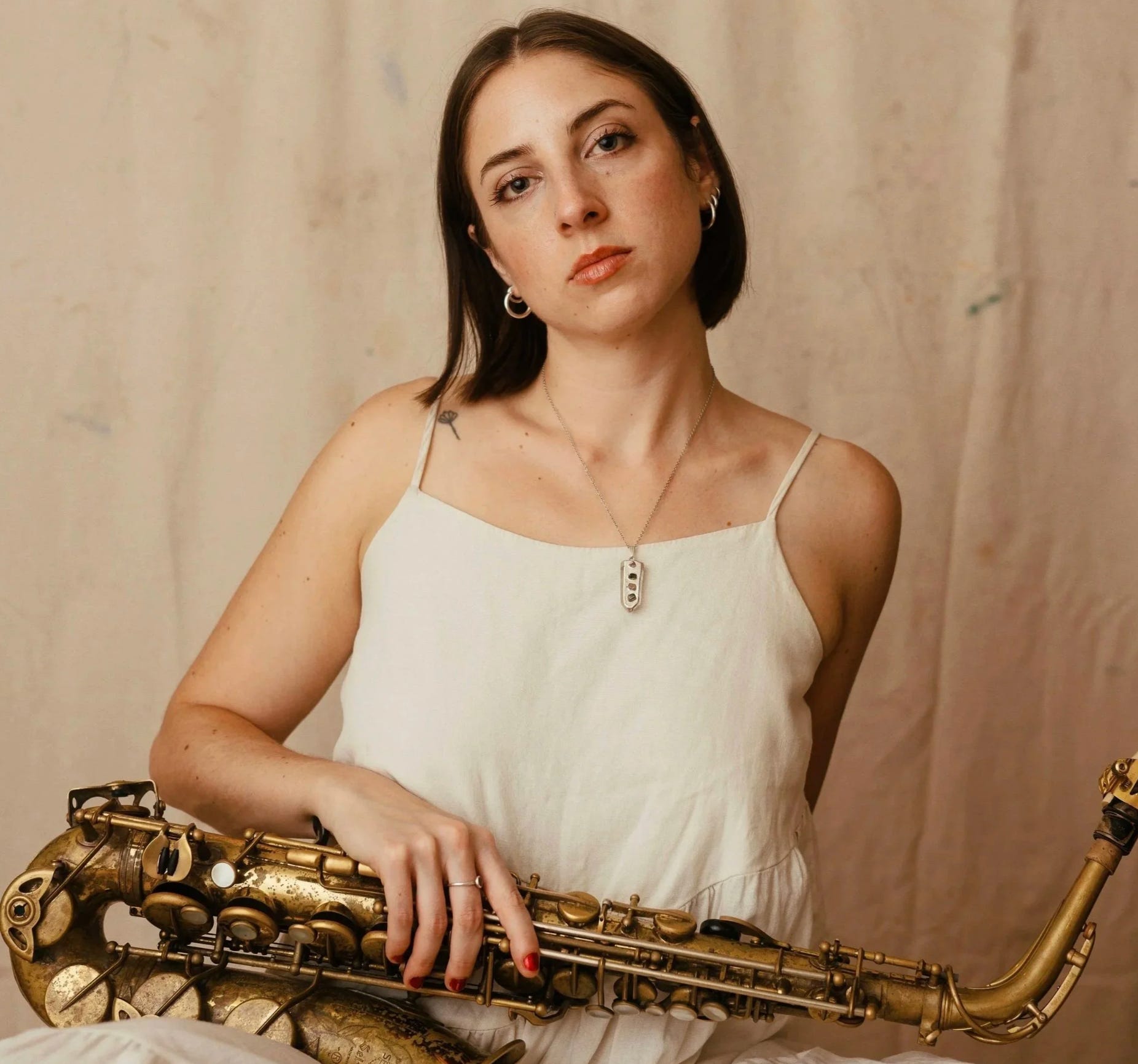
Today we’re listening to Alden Hellmuth, an American saxophonist and composer from Connecticut. She started playing sax in elementary school and continued with the instrument through graduate school at the Herbie Hancock Institute at UCLA. There she was mentored by Hancock himself as well as trumpeter Ambrose Akinmusire. She released her debut LP, Good Intentions, in 2024, a record that oscillates between tension and resolution, chaos and calm, channeling influences like Ornette Coleman and Albert Ayler. Her latest record, Tether, came out in June, continues this style and includes a dueling-bass setup (Logan Kane and Miller Wren). A conversation with Alden follows the streaming links.
Tether - Alden Hellmuth (40m, no vocals)
Bandcamp / Spotify / Apple Music / YouTube Music / Amazon Music / Tidal
Good Intentions - Alden Hellmuth (40m, no vocals)
Bandcamp / Spotify / Apple Music / YouTube Music / Amazon Music / Tidal
What’s your earliest memory of music?
My earliest memory is probably singing along with my mom’s CDs or singing in the choir at church.
Tell us how you got started with the saxophone, what your early favorite pieces to play were.
I started playing saxophone in elementary school band and at the time I loved playing the music from Disney movies.
Which were the artists / albums that helped you find your own sound and style?
Listening to artists like Muhal Richard Abrams, Anthony Braxton, Henry Threadgill, Jonathan Finlayson, Steve Lehman, Ingrid Laubrock, Ambrose Akinmusire, and so many more really inspired my voice/compositional style. Whenever I hear something surprising or interesting, I take notes. I’m constantly collecting ideas. Also, having Ambrose as a mentor during my time at the HH Institute was crucial to my development. He really inspired and pushed me to dive deeper into the craft, try new ideas, and truly forge my own path. Having reassurance (and occasional direction) is really important when you’re exploring a new terrain.
What did you learn from Herbie Hancock?
The biggest thing I learned from Herbie Hancock was that music has no ego. Letting go is so important. I’m still very much working on achieving that level of presence.
What was the composition process like for Tether? How much of the tracks do you have in your head before going into the studio versus finding it there?
There is a lot of written source material, but I really wanted to let this band open up and deconstruct it all. All of the musicians featured are so incredible, and I wanted their individual voices to shine. My favorite moments are when the improvisational material is indistinguishable from the written material.
Tell us about the decision to have the double bass setup. How’d you think of doing that and what dynamics emerged from that?
The project actually started because Miller Wrenn (panned left) asked me to be part of a bill at this DIY space Non Plus Ultra in downtown Los Angeles. Logan Kane (panned right) was also on the bill, and I thought – why not have a band with both of them. They’re really distinct bassists and on totally opposite ends of the spectrum both improvisationally and sonically. It made sense. That gig really set the tone for the whole project, and for the first few months it was just something fun to explore outside of the school environment, but I started writing more and more for the project and it just made sense to document it.
How do you discover new music these days? Any recent interesting finds?
I discover music through my friends most of the time – what they’re listening to and what they’re a part of. I really love friends like Taja Cheek’s project L’Rain and Adam O’Farrill’s Elephant and Tyrone Allen’s UPWARD. I also always circle back to my favorites – recently I’ve been revisiting live recordings of Wayne Shorter and Keith Jarrett. I like to spend time with records (either again or for the first time) and listen to them over and over again, like most recently Steve Grossman’s Some Shapes To Come. Also, just today a friend showed me this Hubert Laws album Wild Flower and I’m obsessed!
Name an underrated artist from the past 50 years.
Oooh there are SO many artists that deserve more recognition, but maybe Mal Waldron or Booker Little or Julius Hemphill or Steve Lacy – there’s really too many !
What are you working on next?
I have a sextet/septet project I’m currently refining (and figuring out funding haha), and I’m also trying to write for a new quintet with my New York band!